Which maths activities work for pupils with SEMH needs in EYFS to Year 2? Here’s why maths can trigger big feelings, how to make maths feel safe, 7 calm, hands-on activities, a 10-minute ten-frame game to try today, and how to involve parents.
For pupils with social, emotional and mental health (SEMH) needs, maths can be a flashpoint. A wrong answer, a timed task or a busy carpet session can quickly lead to tears, anger or refusal. Many of these pupils also have gaps in early number skills, which makes the worry worse.
The answer is to make maths feel safe first, then make it hands-on, playful and short. The Calm Before Maths and Ten Frames cards in the Mooki Dyscalculia deck help with both.
Why can maths be hard for pupils with SEMH needs?
SEMH needs can include anxiety, low mood, ADHD, attachment difficulties and trauma. Maths can be hard because:
- right and wrong is very clear – a wrong answer can feel like a big failure
- it builds step by step – gaps from earlier on make new learning feel impossible
- it can be fast – quick-fire questions and timed tasks raise stress
- it’s often public – answering on the carpet or at the board can feel exposing
- worry blocks thinking – when a child feels unsafe, it’s hard to hold numbers in mind
The Department for Education’s guidance on mental health and behaviour in schools explains how mental health needs can show up as behaviour in class.
How to make maths feel safe
Before the activity, think about the feelings. Try to:
- start with a calm routine – the same start every time, like a breathing exercise or a counting song
- make mistakes normal – say, “Mistakes help our brains grow,” and make a few yourself
- avoid timed tasks and public answers – use whiteboards, thumbs up or whispering to a partner instead
- give a way out – a “help” card or a break card, so pupils can ask without words
- offer choices – “Do you want to use cubes or counters?” gives a sense of control
- praise effort – “You kept trying even when it was hard” builds confidence
Maths activities for pupils with SEMH needs in EYFS to Year 2
The EEF’s guidance on improving maths in the early years and KS1 recommends using concrete objects and movement, and building maths into everyday activities. These calm, hands-on activities do just that:
- Ten frames – fill a 2 by 5 grid with counters to show numbers to 10. It helps pupils “see” numbers
- Quick look – flash a dice pattern or a few counters for 2 seconds. “How many did you see?” builds number sense without counting
- Board games – simple track games, like snakes and ladders, build counting and turn-taking
- Number line walks – jump along a floor number line, counting on and back
- Maths in real life – count snacks, share fruit, or set the table in the role-play corner
- Building towers – make towers of cubes and compare them: “Which is taller? How many more?”
- Story maths – read a counting book, then act it out with toys
Our number sense activities and maths games for kids with dyscalculia have more ideas.
Try it today: in class – a 10-minute ten-frame game
Use this with one pupil or a small group, at a calm time.
- Calm start (1 minute). Do three slow “smell the flower, blow out the candle” breaths together.
- Show the ten frame (2 minutes). Put counters in the frame one at a time, counting together. Show that 5 fills the top row.
- Quick look (3 minutes). Put some counters in the frame, show it for 2 seconds, then cover it. Ask, “How many?” Then uncover and check together. Start with 1 to 5.
- Pupil’s turn (3 minutes). The pupil makes a number for you to guess. Make a mistake on purpose and say, “Oops! Let me check.” Laugh together.
- Finish with praise (1 minute). Name what went well: “You knew 5 straight away without counting.”
Repeat often. When the pupil is confident, move on to numbers up to 10, then two ten frames.
Want ready-made calm maths activities?
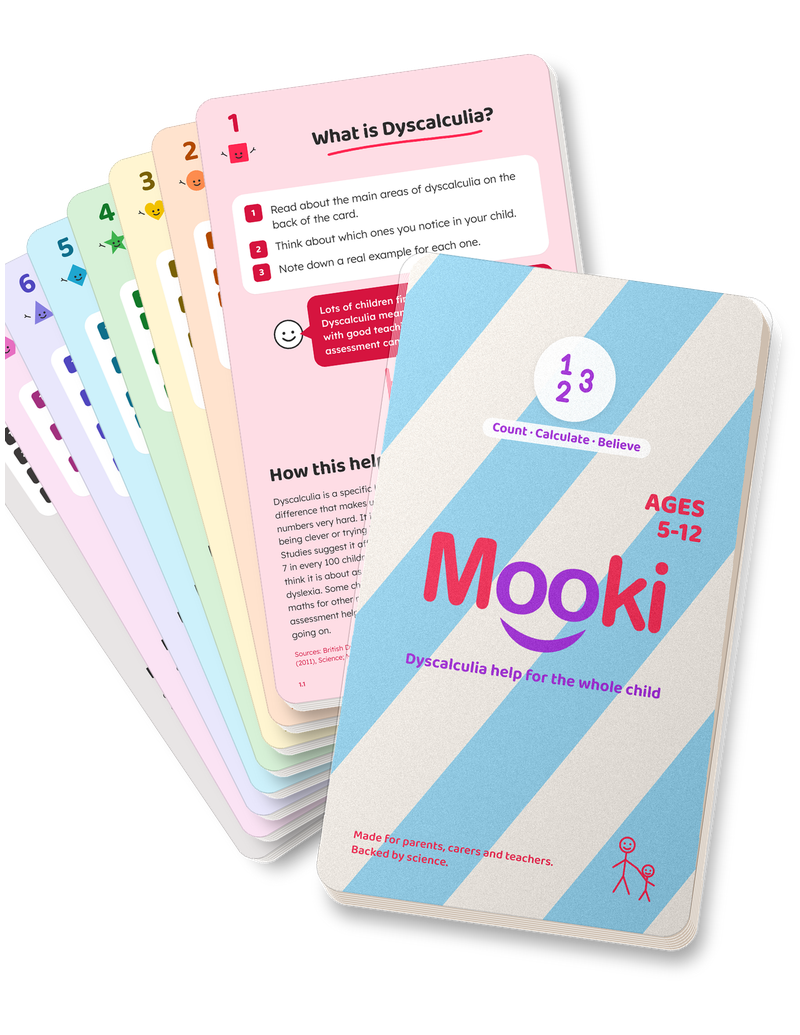
The Calm Before Maths, Ten Frames and Quick Look cards give you simple steps and printable sheets to make maths feel safe and hands-on. The Mistakes Help Me Learn card helps pupils cope when they get it wrong. Each is one of 56 ten-minute activities in the Mooki Dyscalculia deck. For pupils with big worries, add the Calm Down Kit card from the Mooki Anxiety deck.
Instant download · use on a phone, tablet or class whiteboard, or print for your pupils
How to plan a maths lesson for pupils with SEMH needs
If you’re planning a full lesson, for an observation or an SEMH setting interview, keep it:
- predictable – share a visual plan at the start, and stick to it
- short – 3 or 4 short parts, each with a clear end
- hands-on – every pupil has something to touch and move
- low-risk – no one has to answer alone in front of the group
- warm – praise effort, notice calm behaviour and keep your voice steady
A calm room helps too. Our guide to creating a calming SEND classroom has ideas.
Working with parents
Ask parents how their child feels about numbers at home. Some children love counting toys but freeze at “maths”. Share simple games to play at home, like counting stairs or playing a dice game. Keep it light and fun, so maths doesn’t feel like more pressure.
When to involve the SENCo or outside help
Talk to your SENCo (special education teacher in the US) if a pupil:
- is very distressed by maths, most days
- still can’t count small groups of objects by the end of Reception (kindergarten)
- forgets number facts from one day to the next
- has big gaps compared with classmates, even with extra help
Some pupils have maths anxiety, and some have dyscalculia. Our guides to maths anxiety or dyscalculia and early signs of dyscalculia explain how to tell.
Read next: Worry box for kids
The bottom line
For pupils with SEMH needs, maths starts with feeling safe. Then keep it hands-on, playful, short and low-pressure, and make mistakes normal. You know your pupils best. For ready-made activities, the Mooki Dyscalculia deck has 56 ten-minute cards, including Calm Before Maths and Ten Frames.