If your child finds maths hard, these number sense activities will help you build the deep “feel” for numbers that everything else rests on. Each one takes about ten minutes and uses things you already have at home.
Many children who struggle with maths (math, in the US) are not short of effort. They are short of number sense. The good news is that number sense can be built, step by step, through play, talk and hands-on practice.
What is number sense?
Number sense is a child’s gut understanding of how numbers work. A child with good number sense knows that 8 is a lot more than 2, that 7 is close to 10, and that 5 and 5 make 10 without counting.
It includes a few key skills:
- Subitising: seeing how many are in a small group at a glance, without counting.
- Comparing: knowing which of two numbers or groups is bigger.
- Part-whole thinking: seeing that 7 can be split into 5 and 2, or 4 and 3.
- Number order: picturing where a number sits on a line, and what comes before and after.
Number sense and dyscalculia
The British Dyslexia Association’s dyscalculia page describes dyscalculia as a difficulty with understanding and working with numbers, including naming, ordering and comparing quantities. In other words, weak number sense sits at the heart of it.
Lots of children find maths tricky for many reasons. The BDA notes that around a quarter of people have some difficulty with maths, while about 6% have dyscalculia, according to its page on how dyscalculia is identified. Whatever the reason, building number sense helps.
Number sense dyscalculia work is not about rushing to sums. It is about going back to the foundations and making them strong.
Try it today: three 10-minute number sense activities
1. Flash and say (subitising)
Put 1 to 5 buttons or pasta shapes under a tea towel. Lift it for two seconds, then cover again. Ask, “How many did you see?”
- Start with neat dice patterns, then try messy groups.
- Ask, “How did you see it?” A child might say “3 and 2”.
- Once 5 is easy, move up to 6 to 10 using two small groups.
2. Make ten (number bonds)
Draw a ten frame: two rows of five boxes. Put 6 counters in it. Ask, “How many more to make 10?” Your child can see the four empty spaces.
Swap roles so your child makes a number for you. Then try it with a hidden part: put 10 counters out, hide some under a cup and ask how many are hiding.
3. Washing line numbers (number lines)
Peg cards numbered 0 to 10 on a string, with a few gaps. Your child fills in the missing numbers. Then ask, “Which is closer to 10, 6 or 3?”
For older children, use 0 to 100 and only peg the tens. Ask them to place 47 roughly where it belongs.
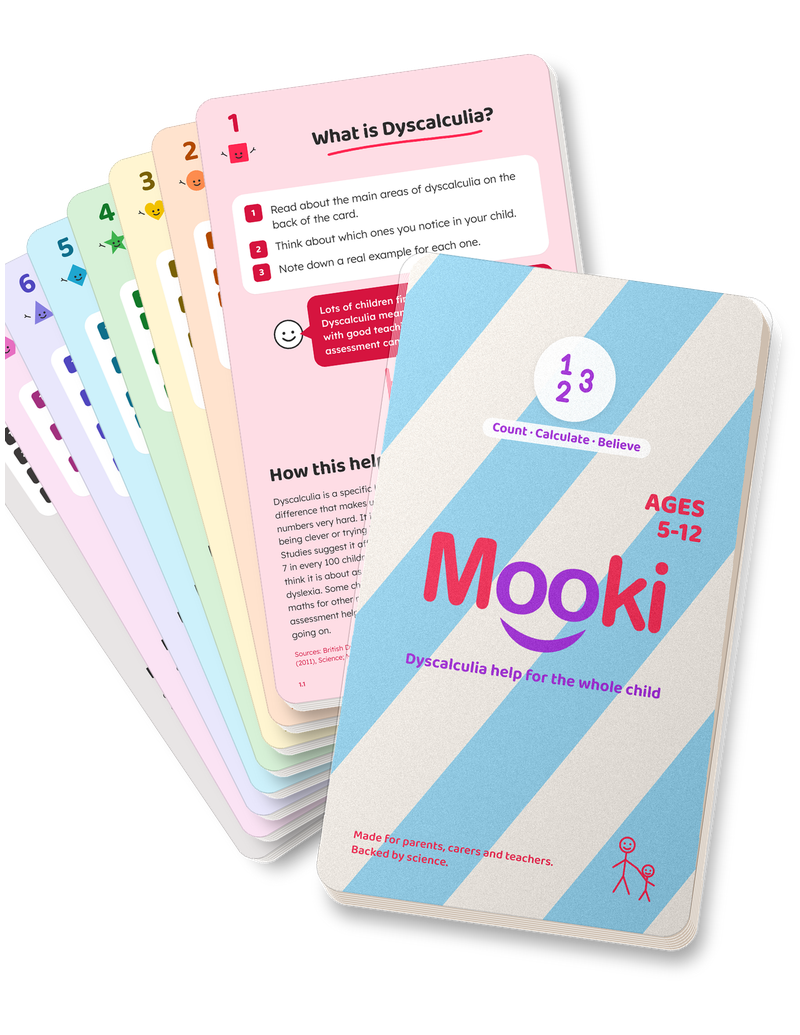
Want ready-made number sense games?
Quick Look, Ten Frames and Number Line Walk turn subitising, number bonds and number lines into simple games. Each is one of 56 ten-minute activities in the Dyscalculia deck.
Instant download · use on a phone or tablet, or print and fill in at home or school
Number sense games for every day
Games are one of the easiest ways of building number sense, because children play them again and again without it feeling like work.
The Education Endowment Foundation’s guidance on early maths says board games such as Snakes and Ladders are especially helpful for understanding numbers. A well-known study by Siegler and Ramani (2008) found that preschool children who played a simple numbered board game got better at ordering numbers than those who played a colour version. You can read the What Works Clearinghouse review of the board game study.
- Snakes and Ladders: ask your child to say each number as they move, not just count the squares.
- Dice snap: roll two dice and shout “snap” when the totals match.
- Higher or lower: turn over playing cards and guess if the next is higher or lower.
- Dominoes: great for subitising and matching amounts.
Subitising activities and tips that work
Some simple habits make a big difference to how well these activities work for a child who finds maths hard.
- Use real objects first. Let your child touch and move things. Then use pictures. Only then use written numbers.
- Keep it short. Ten minutes of focused play is better than half an hour of tears.
- Go little and often. A few minutes most days beats one long session a week.
- Talk about it. Ask “How do you know?” so your child explains their thinking.
- Stay at the right level. If it feels too hard, go back a step. Success builds confidence.
Research backs up the use of pictures and models. The US IES practice guide on helping students who struggle with maths recommends visual representations, such as number lines and arrays, as part of support.
How school can help
In England, the Department for Education’s maths guidance for primary schools sets out the core number ideas children need before they can move on. Ask your child’s teacher which of these your child is working on, so you can practise the same thing at home.
If your child is still struggling after plenty of support, talk to the class teacher or SENCo (in the UK), or the teacher and school psychologist (in the US). If you’re worried, your child’s school is the best place to start.
For teachers: Maths activities for pupils with SEMH needs, EYFS to Year 2
The bottom line
Number sense is the root of all later maths, and it can grow at any age. A few minutes of play with counters, dice and number lines each day can help your child feel that numbers make sense. Keep it light, celebrate small wins, and remember that every child gets there at their own pace.