If your child repeats sounds, stretches words or gets stuck when they talk, this guide is for you. You’ll learn what stammering in children looks like, why it happens, when to get advice and simple ways to help at home.
Stammering in children is common, and it is not your fault. With calm, patient listening and the right support, most children who stammer grow into confident talkers. In the US, the same thing is called stuttering, so you’ll see both words here.
What is stammering (or stuttering)?
Stammering and stuttering mean exactly the same thing. “Stammering” is the usual word in the UK and “stuttering” is used in the US. Both describe speech that doesn’t flow smoothly.
A child who stammers might:
- Repeat sounds or syllables, such as “b-b-b-ball” or “mu-mu-mummy”.
- Repeat whole short words, such as “I-I-I want that”.
- Stretch sounds out, such as “ssssssun”.
- Get stuck, with no sound coming out for a moment (often called a “block”).
- Show effort, such as blinking, tensing their face or stamping a foot.
- Swap words or stop talking to avoid getting stuck.
The NHS guide to stammering explains that the most common kind starts in early childhood, while speech and language are growing fast. This is called developmental stammering.
How to help a child who stammers at home
You don’t need special training to help. The way you listen makes a real difference. These tips are based on advice from the UK charity Stamma and the Stuttering Foundation.
- Slow your own speech. Talk in a calm, unhurried way and leave short pauses. This works better than telling your child what to do.
- Don’t say “slow down” or “take a breath”. It puts more pressure on them. Show them there’s plenty of time instead.
- Don’t finish their words. Even when you mean to help, it can feel frustrating.
- Ask one question at a time and give them time to answer.
- Listen to what they say, not how they say it. Keep natural eye contact and respond to their message.
- Take turns as a family, so no one has to rush or compete to be heard.
- Talk about it if it feels right. Simple, neutral words help, such as “That was a bumpy word. Lots of people get stuck sometimes, and that’s OK.”
Try it today: 10 minutes of calm talking time
- Pick a quiet time and turn off the TV and phones.
- Let your child choose a toy, game or book.
- Follow their lead. Comment on what they’re doing in short, slow sentences.
- Ask very few questions. Leave pauses so your child can talk if they want to.
- If they get stuck, wait calmly, keep looking at them and respond to what they said.
Doing this for 5 to 10 minutes a day can build confidence. Both Stamma and the Stuttering Foundation recommend regular one-to-one time like this.
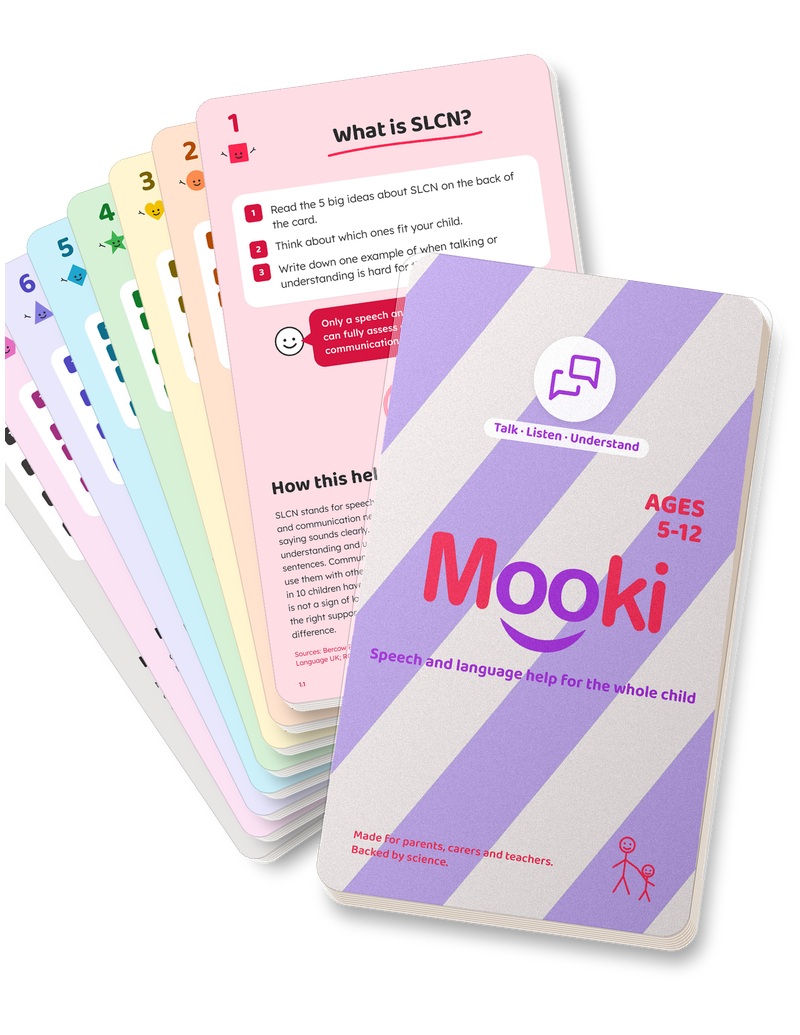
Want to help your child talk with more confidence?
Our Smooth Talking and Talking Heroes cards turn these tips into calm, child-friendly activities you can share. They're two of 56 ten-minute activities in the Mooki Cards Speech and Language deck.
Instant download · use on a phone or tablet, or print and fill in at home or school
How common is stammering, and what causes it?
Stammering is more common than many parents think. The NHS says around 1 in 12 young children go through a phase of stammering. In the US, the National Institute on Deafness and Other Communication Disorders (NIDCD) says it happens most often between the ages of 2 and 6.
The exact cause isn’t known. Research points to a mix of things:
- Genes: stammering often runs in families. The NHS says around 2 in 3 people who stammer have a family history of it.
- Brain differences: small differences in how the speech areas of the brain work.
- Fast language growth: a child’s ideas can race ahead of the words they can get out.
Boys are more likely to stammer than girls. Most importantly, stammering is not caused by anything parents have done. It is also not a sign of low intelligence or nerves, although feeling rushed or tired can make it worse on some days.
Toddler stuttering: a phase, or something to check?
Many toddlers go through a bumpy patch when they’re learning to put sentences together. Speech and Language UK describes this as a perfectly normal stage for many 2 to 3 year olds. The good news is that most children grow out of it. The NHS says around 2 in 3 children who stammer will eventually speak fluently, but no one can predict which children will.
Because it’s hard to tell, it’s worth getting advice early rather than waiting. The NHS says treatment is often successful with pre-school children.
| Often part of learning to talk | Worth getting advice |
|---|---|
| Easy, relaxed repeats of whole words or phrases | Repeats of parts of words, stretched sounds or silent blocks |
| Comes and goes over a few weeks | Has lasted more than a few months |
| Your child doesn’t seem to notice | Your child seems upset, tense or avoids talking |
| No family history of stammering | A parent or relative stammers or stammered |
The NIDCD notes that health professionals usually suggest an assessment if a child has stammered for 3 to 6 months, shows signs of struggle, or has a family history of stammering.
Getting help: who to see in the UK and US
If you’re worried, talk to your GP or paediatrician, or your child’s school or nursery. You know your child best.
In the UK:
- Talk to your health visitor or GP. In many areas, you can also contact children’s speech and language therapy (SLT) services directly.
- Call Stamma’s free helpline on 0808 802 0002 to talk things through.
- If your child is at school, share what helps with their teacher and the SENCo (special educational needs co-ordinator).
- The Michael Palin Centre for Stammering, a specialist NHS centre in London, has information for parents and offers therapy for children and young people.
In the US:
- Talk to your pediatrician, who can refer you to a speech-language pathologist (SLP). This is the US name for a speech and language therapist.
- For children under 3, ask about your state’s early intervention programme.
- For children aged 3 and over, contact your local school district. If stuttering affects learning, support may be written into an IEP (Individualized Education Program).
Therapy for young children often involves coaching parents, so you’ll learn ways to help at home too.
Stammering at school
School can bring new pressures, such as reading aloud, answering the register or speaking in class. A few simple changes help a lot:
- Agree with your child’s teacher what helps, and ask your child what they’d like.
- Give extra time to answer, without anyone rushing or finishing words.
- Offer other ways to join in, such as answering in pairs or with a friend.
- Deal with teasing quickly, and talk with the class about how everyone speaks differently.
- Celebrate what your child says, not how fluently they say it.
Hearing about people who stammer and still do the jobs they love can boost confidence too. Stamma shares real stories from people who stammer of all ages.
The bottom line
Stammering in children is common, and it isn’t caused by anything you did. Many children grow out of it, and early advice gives your child the best start. Keep listening calmly, give plenty of time and focus on what your child is telling you. Your patience shows them their voice matters.