Which reading comprehension activities work for autistic children in KS1? Here’s why comprehension can be tricky even for strong readers, 7 activities that help, a 10-minute story map lesson to try today, and how to share it with parents.
Some autistic pupils in Year 1 and Year 2 (kindergarten to 2nd grade) are brilliant at reading words. They can decode long words and read aloud fluently. But ask “Why was the bear sad?” and they may look blank. Others find both reading and understanding hard.
Comprehension can be taught. The Story Map and Question Words cards in the Mooki Speech and Language deck give you simple, visual ways to do it.
Why do some autistic children find reading comprehension hard?
Reading comprehension means understanding what you read. For autistic children, the tricky parts are often:
- inference – working out what isn’t said, like why a character did something
- feelings – understanding how characters feel and why
- “why” and “how” questions – these are harder than “who” and “what”
- figurative language – phrases like “raining cats and dogs” may be taken literally
- the big picture – remembering the order of events, or what the story was mostly about
- interest – a story they don’t care about can be hard to follow
Some pupils also have a language need alongside autism. Our guide to speech, language and communication needs explains more.
The EEF’s Improving Literacy in Key Stage 1 guidance recommends a balanced approach that teaches decoding (phonics) and comprehension together, alongside speaking and listening.
Reading comprehension activities for autistic children in KS1
These activities work well for autistic pupils, and for many others in your class too:
- Story maps – draw the beginning, middle and end as three boxes, with pictures
- Question word cards – who, what, where, when, why, with a symbol for each. Start with “who” and “what”
- Picture walks – look at the pictures before reading and talk about what might happen
- Feelings faces – stop and ask, “How does she feel?” and point to a face card. Then ask, “How do you know?”
- Act it out – use toys or puppets to retell the story, so pupils can see what happened
- Choose from options – instead of an open question, offer two answers: “Was he happy or sad?”
- Use their interests – choose books about their favourite topic, like trains, animals or space
Try it today: in class – a 10-minute story map lesson
Use a short picture book the pupil likes, or one linked to their interests.
- Read it together (3 minutes). Read the story aloud. Point to the pictures as you go.
- Draw three boxes (1 minute). Label them “beginning”, “middle” and “end”.
- Fill the beginning (2 minutes). Ask, “Who is in the story? Where are they?” The pupil draws, points or picks a picture.
- Fill the middle and end (2 minutes). Ask, “What happened?” and “How did it end?” Use the pictures in the book to help.
- Ask one “why” question (2 minutes). Point to a picture: “Why is he crying?” Offer two choices if needed, then praise their answer.
Over time, add more boxes, then ask the pupil to retell the story using their map.
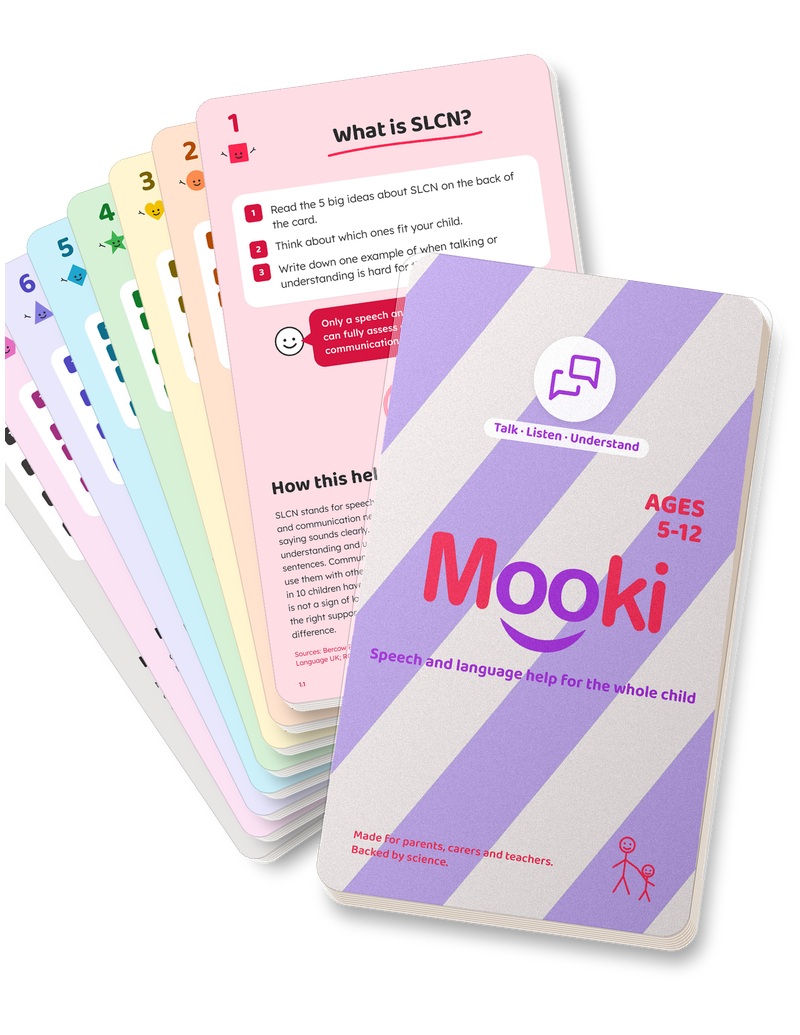
Want ready-made comprehension activities?
The Story Map, Question Words and Share a Book cards give you simple, visual steps and printable sheets to build understanding in short, calm sessions. Each is one of 56 ten-minute activities in the Mooki Speech and Language deck. For pupils who learn best through their passions, add the Interest-Led Learning card from the Mooki Autism deck.
Instant download · use on a phone, tablet or class whiteboard, or print for your pupils
Making reading comprehension less stressful
Many autistic pupils feel anxious when they don’t know the “right” answer. To help:
- give thinking time – wait at least 10 seconds before prompting
- show, don’t just ask – put the question in writing or with a symbol
- accept different answers – pointing, drawing or choosing are all fine
- keep sessions short – 10 minutes of focused work beats 30 minutes of stress
- teach phrases – explain sayings like “over the moon” with pictures
For more autism-friendly activities, see our 25 activities for children with autism.
Working with parents
Share the same tools at home. Send the question word cards or a story map home with a favourite book. Ask parents which books their child loves. Many autistic children enjoy reading the same book many times, and that’s a great way to build understanding. Try asking a new question each time.
When to involve the SENCo or outside help
Talk to your SENCo (special education teacher in the US) if a pupil:
- can read words but understands very little, even with picture support
- struggles to answer simple “who” and “what” questions
- seems to have trouble understanding spoken language too
A speech and language therapist can check their language and suggest next steps. If decoding is also hard, see how to help a child who struggles with reading. For pupils who don’t use speech, see supporting a non-verbal autistic pupil. Our guide on the difference between speech and language explains why understanding words matters.
The bottom line
Many autistic pupils can read words well but need help understanding them. Make it visual, start with “who” and “what”, use their interests and keep sessions short. You know your pupils best. For ready-made comprehension activities, the Mooki Speech and Language deck has 56 ten-minute cards, including Story Map and Question Words.