If your child’s worries feel big and you want simple coping skills for kids with anxiety, this guide helps you build a personal calm-down toolkit together, with ideas for breathing, movement, self-talk and the senses.
Every child is different. A trick that settles one child can annoy another. That is why a toolkit works so well: your child tries a few anxiety tools for kids, keeps the ones that help and drops the rest.
What are coping skills for kids with anxiety?
Coping skills are small, practical things a child can do when worry starts to rise. They don’t make worry vanish. They help your child ride the feeling until it passes.
The NHS describes anxiety in children as a natural reaction to stress, a bit like a wave that builds and then fades. You can read more in the NHS guide to anxiety in children. Coping skills are your child’s surfboard.
A good toolkit has four parts:
- Breathing to slow the body down.
- Movement to burn off the jittery energy.
- Self-talk to answer the worried voice.
- Sensory and grounding to bring attention back to the here and now.
Aim for one or two tools in each part. Too many choices can feel overwhelming in a wobbly moment.
Building the toolkit: breathing and movement
Breathing: anxiety strategies for kids that work anywhere
Breathing is the most portable tool. Nobody needs to see it, and it works in a classroom, a car or a dentist’s waiting room.
The NHS suggests a simple version for children: three slow breaths, breathing in for a count of three and out for a count of three. Adults can use the longer NHS breathing exercise for stress and model it alongside their child.
Make breathing fun so your child actually uses it:
- Hot chocolate breath: smell the warm drink (breathe in), then cool it down (breathe out slowly).
- Finger tracing: trace up one finger as you breathe in and down as you breathe out, across all five fingers.
- Balloon belly: lie down with a soft toy on the tummy and watch it rise and fall.
- Candle and flower: smell the flower, blow out the candle.
Practise when your child is calm. A skill learned on a good day is much easier to reach for on a hard one.
Movement: anxiety tips for kids with busy bodies
Worry often lives in the body. Your child might feel a tight tummy, a racing heart or fidgety legs. Moving gives that energy somewhere to go.
The NHS recommends that children and young people aged 5 to 18 get an average of at least 60 minutes of moderate or vigorous activity a day across the week. You can read the NHS physical activity guidelines for children. In the US, the CDC physical activity guidelines say children aged 6 to 17 need at least 60 minutes of moderate to vigorous activity every day. Regular movement is good for wellbeing, and short bursts can help in a stressful moment too.
Quick movement tools:
- Ten star jumps or wall push-ups.
- A “shake it out” song: shake hands, arms, legs, then the whole body.
- Squeeze and relax: clench fists tight for five seconds, then let go.
- A brisk walk round the playground or garden.
Try it today: build a coping toolkit in 10 minutes
You need paper, pens and a box, bag or envelope.
- Talk (2 minutes). Ask, “What does worry feel like in your body?” Let your child point to where they feel it.
- Test (4 minutes). Try one breathing tool and one movement tool together. Ask your child to rate each one: thumbs up, sideways or down.
- Choose (2 minutes). Your child picks a favourite from each part of the toolkit and draws it on a small card.
- Store (2 minutes). Put the cards in the box with a calming object, such as a smooth stone or a stress ball.
Keep the box somewhere easy to reach. Over the next week, add a self-talk card and a grounding card.
Want to practise one coping skill every day?
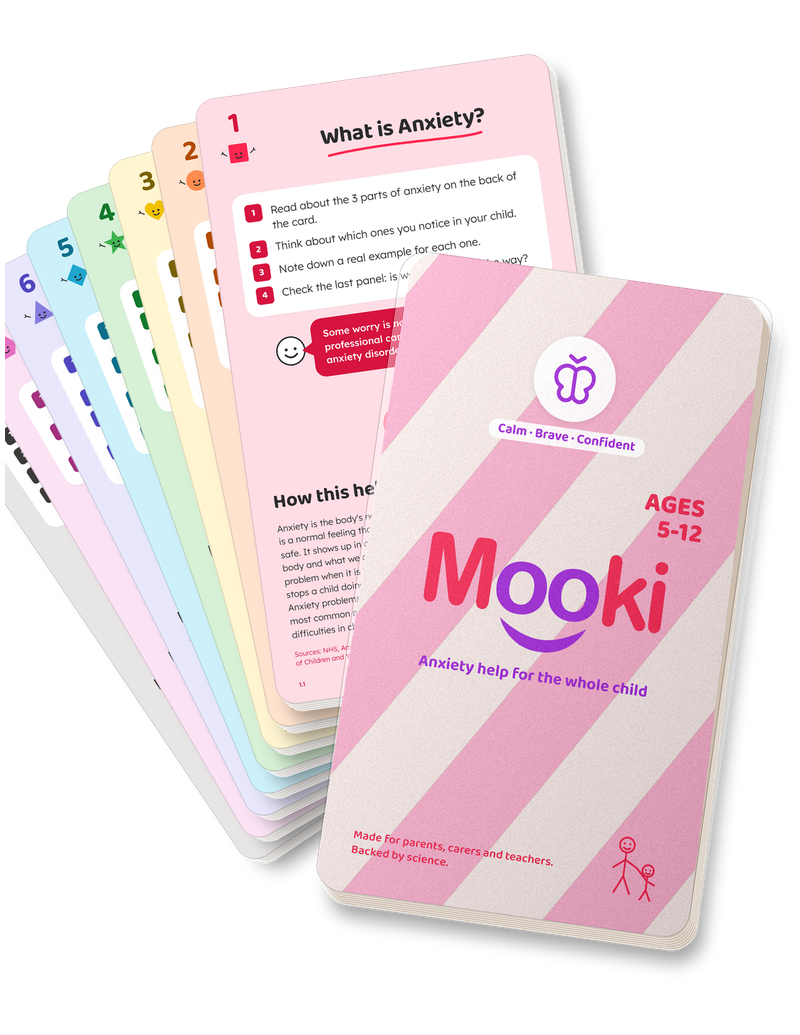
Calm Breathing, Grounding and Kind Self-Talk turn each part of the toolkit into a short daily habit. Each is one of 56 ten-minute activities in the Mooki Anxiety deck, with adult steps and a child worksheet.
Instant download · use on a phone or tablet, or print and fill in at home or school
More anxiety tools for kids: self-talk and the senses
Self-talk: what to say to the worry voice
Anxious children often hear a voice that says, “Something bad will happen” or “I can’t do it.” Self-talk helps them answer back in a kinder, braver voice.
Help your child choose a few short phrases:
- “This feeling is uncomfortable, but it will pass.”
- “I’ve done hard things before.”
- “I can take one small step.”
- “My body is sounding an alarm, but I am safe.”
Some children like to give the worry a name or draw it as a little character. That makes it easier to talk back to. Try “Thanks, Worry, but I’ve got this.”
Keep phrases short and real. “Everything will be perfect” won’t feel true. “I can cope” usually does.
Sensory and grounding tools for calm
Grounding pulls attention away from “what if” thoughts and back to the present moment. YoungMinds’ advice on anxiety suggests noticing things your child can see, hear, touch and smell.
Sensory tools to try:
- 5, 4, 3, 2, 1: name five things you can see, four you can touch, three you can hear, two you can smell and one you can taste.
- Cold water: splash hands or face, or hold a cool flannel.
- Something to squeeze: a stress ball, playdough or a soft toy.
- Favourite smell: a clean jumper that smells of home, or an orange to peel.
- Music: a calm playlist with headphones.
For children with SEN, sensory tools can be especially helpful. Ask your child’s teacher which ones can be used in class.
Turning skills into a daily habit
A toolkit only helps if your child remembers to use it. Little and often is the key.
- Practise daily, at a calm time such as after school or before bed.
- Model it yourself. Say out loud, “I’m feeling a bit stressed. I’m going to do my hot chocolate breathing.”
- Use a check-in. Ask your child to rate their worry from 1 to 5. If it’s 3 or more, they pick a tool.
- Praise the effort, not just the result: “You used your finger breathing. That was brave.”
- Share with school so teachers can prompt the same tools. In England, you can speak to the SENCo about SEN support at school. In the US, a school counselor can help, and a 504 plan can include agreed calming breaks.
The NHS Every Mind Matters anxiety tips make a similar point for adults: build self-care habits such as breathing into your daily routine, because doing them regularly can make a big difference.
When coping skills aren’t enough
Coping skills help with everyday worries. They are not a replacement for professional support. If your child’s anxiety is constant, getting worse, or stopping them from going to school, seeing friends or sleeping, it’s time to ask for help.
The NHS page on anxiety disorders in children explains when to seek help and what support is available. In the UK, start with your GP and your child’s school. In the US, talk to your pediatrician and the school counselor or school psychologist. The NIMH guide to children and mental health suggests getting help when a worry or behaviour lasts for weeks or longer, causes distress, or gets in the way at school, at home or with friends.
The bottom line
A coping toolkit gives your child a sense of control: “When worry shows up, I know what to do.” Start with one breathing tool and one movement tool, practise them on calm days, and add more as your child grows in confidence. Small, steady steps really do add up.