Looking for a gentle anxiety meditation for kids that you can read aloud at bedtime or in class? Here is a complete 10-minute script, plus simple tips to help your child settle into it.
You don’t need any training, special music or an app. Just a quiet space, a calm voice and ten minutes.
Can meditation help kids with anxiety?
Meditation for kids is really just guided calm. Your child learns to slow their breathing, notice their body and let busy thoughts drift by.
The NHS explains that mindfulness means paying attention to what’s happening inside and around you, moment by moment. It says studies suggest mindfulness can help with stress and anxiety. It also says it isn’t right for everyone, and some people find it doesn’t help.
That’s a useful reminder for parents. If your child hates it, that’s fine. Try a shorter version, a different time of day, or another calming tool.
YoungMinds’ advice on anxiety also suggests mindful activities, such as gentle yoga or meditation, as one way to help children manage anxiety.
Getting ready for a 10-minute anxiety meditation
A little preparation makes a big difference.
- Choose a calm time. Bedtime, after school or the start of a lesson all work. Avoid moments when your child is already very upset: practise first when they’re calm.
- Get comfy. Lying on a bed or rug, or sitting on a chair with feet flat on the floor.
- Dim the lights and turn off screens.
- Read slowly. Pause where you see “(pause)”. Pauses are where the calm happens.
- Let them keep their eyes open if closing them feels uncomfortable. Looking at one spot on the floor works too.
For children with SEN, keep the language simple, use a visual timer and allow fidgeting. Stillness is not the goal. Calm is.
The script: a 10-minute guided meditation for kids with anxiety
Read this aloud in a soft, slow voice. Timings are rough.
Part 1: Arriving (about 1 minute)
“Let’s get really comfy. Wriggle your body until it feels just right. (pause) Now let your body go still, like a sleepy cat curled up in the sun. (pause) You don’t have to do anything right. Just listen to my voice.”
Part 2: Balloon breathing (about 2 minutes)
“Put one hand on your tummy. Imagine there’s a balloon inside. Breathe in slowly through your nose, and feel the balloon fill up. One, two, three. (pause) Now breathe out slowly through your mouth, and feel the balloon go down. One, two, three. (pause)
Let’s do that again. In, two, three. (pause) Out, two, three. (pause) And one more time. In, two, three. Out, two, three. (pause)
Now just let your breathing find its own gentle rhythm.”
Part 3: Body scan (about 3 minutes)
“Let’s say hello to your body. Start with your toes. Wiggle them, then let them rest. (pause) Feel your legs getting heavy and soft, sinking into the bed. (pause)
Now your tummy. If there’s a tight or wobbly feeling there, that’s OK. Breathe into it, like you’re blowing warm air onto it. (pause)
Feel your shoulders. Lift them up to your ears… and drop them down. (pause) Let your arms go floppy, like spaghetti. (pause)
Now your face. Make a big scrunchy face… and let it go smooth. (pause) Your whole body is resting now.”
Part 4: The safe place (about 3 minutes)
“Imagine a place where you feel safe and happy. It might be a beach, a cosy den, a forest or somewhere you made up. (pause)
What can you see there? (pause) What can you hear? Maybe waves, or birds, or the wind. (pause) What can you feel? Warm sand? A soft blanket? (pause)
If a worry floats into your mind, that’s OK. Picture it as a cloud. Watch it drift across the sky… and float away. (pause) You don’t need to chase it. Just let it go. (pause)
Stay in your safe place for a few more breaths. You can come back here any time you like.”
Part 5: Coming back (about 1 minute)
“Now let’s slowly come back. Take one big breath in… and out. (pause) Wiggle your fingers and toes. (pause) If you’re going to sleep, stay snuggled and let your body rest. If it’s daytime, open your eyes slowly and have a big stretch. Well done.”
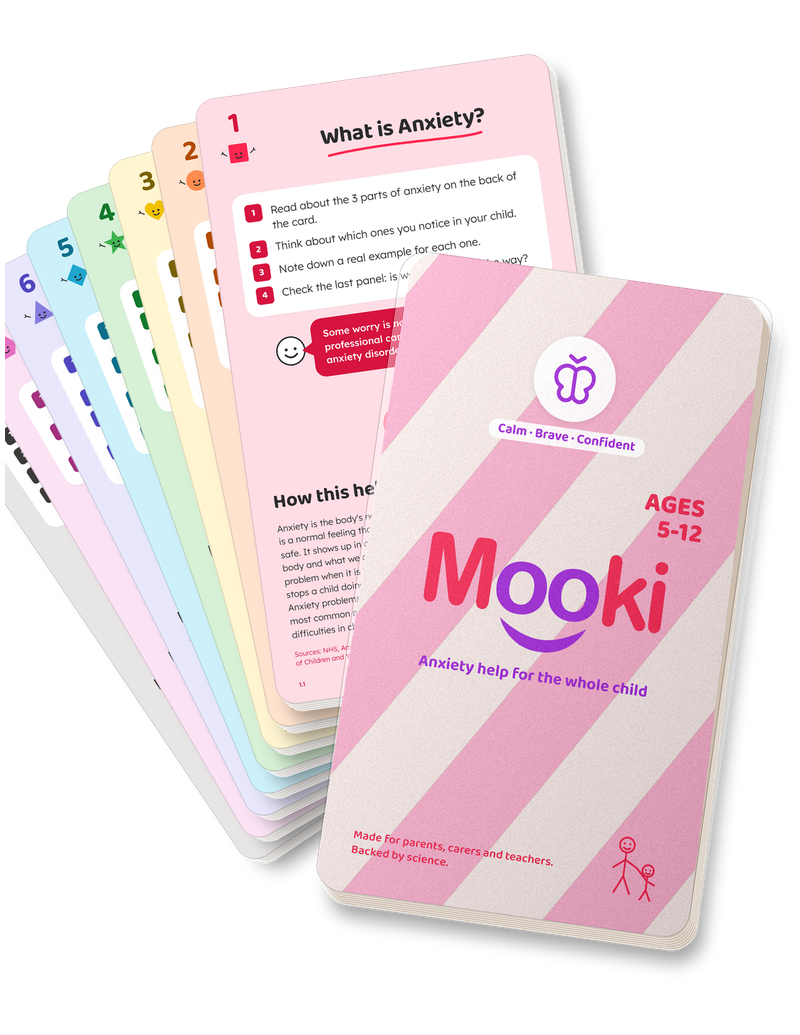
Want more 10-minute calm for your child?
Mindful Moments, Calm Breathing and Body Signals build on this script with short, playful practice. Each is one of 56 ten-minute activities in the Mooki Anxiety deck, with adult steps and a child worksheet.
Instant download · use on a phone or tablet, or print and fill in at home or school
Tips to make it work
- Use the same script for a week. Familiar words help children relax faster.
- Let your child shape it. They can choose the safe place, or add a pet or favourite toy.
- Record your voice reading the script, so your child can play it at bedtime.
- Join in. Calm grown-ups help children feel calm. The NHS breathing exercise for stress is a good one for you to practise too.
- Don’t force it. If your child giggles or chats, that’s normal. Gently bring them back, or stop and try tomorrow.
Using meditation in the classroom
A shorter version works well after lunch, before a test or after a busy playtime.
- Use Part 2 (breathing) and Part 4 (safe place) for a 5-minute version.
- Let children rest heads on desks or sit with feet flat on the floor.
- Give quiet alternatives, such as colouring, for children who find it hard to close their eyes.
- Keep it optional and low pressure, so it stays a calm experience rather than another task.
The NHS lists mindfulness as one of its five steps to mental wellbeing, so it fits well with a wider wellbeing plan in school.
When meditation isn’t enough
Meditation is a calming tool, not a treatment. If your child’s worries are there most days, are getting worse, or stop them from sleeping, going to school or seeing friends, it’s time to get help.
The NHS page on anxiety disorders in children explains when and how to seek support. In the UK, talk to your GP and your child’s school or SENCo. In the US, talk to your pediatrician and the school counselor. The NIMH guide to children and mental health suggests getting help when a worry lasts for weeks or longer, causes distress, or gets in the way at school, at home or with friends, and the CDC page on anxiety in children explains how talking therapies such as CBT can help.
The bottom line
A 10-minute anxiety meditation gives your child a calm space they can return to again and again. Read the script slowly, keep it relaxed and let your child make it their own. Over time, the breathing and the safe place become tools they can use on their own, wherever worry shows up.