Confused about the difference between speech and language? This guide explains both in plain English, with everyday examples, so you can understand what your child’s teacher or therapist means.
People often use “speech” and “language” as if they mean the same thing. They don’t. Knowing the difference helps you describe your child’s needs clearly and understand the support they’re offered.
What is speech and language? The short answer
Here’s the simplest way to think about it:
- Speech is how we say sounds and words out loud.
- Language is the words and sentences we understand and use to share ideas.
A child can have clear speech but struggle with language. Another child can have rich language but unclear speech. Some children find both hard.
What is speech?
Speech is the physical part of talking. It’s about using your breath, voice box, lips, tongue and jaw to make sounds. The American Speech-Language-Hearing Association (ASHA) describes three main parts:
- Articulation: making the sounds of speech, like “s”, “k” or “th”.
- Voice: using breath and the vocal folds to make sound, including how loud or high it is.
- Fluency: the smooth flow and rhythm of talking.
The US National Institute on Deafness and Other Communication Disorders describes speech as carefully coordinated muscle movements that shape sound into words we recognise.
Speech difficulties in children: examples
- Maya, aged 4, says “tup” for “cup” and “dod” for “dog”. People outside her family find her hard to understand. This is a speech sound difficulty.
- Sam, aged 5, often repeats the first sound of words: “c-c-c-can I have a drink?” This is stammering, a fluency difficulty. The NHS notes that many young children go through a phase of stammering.
- Ella, aged 8, has a voice that is often hoarse and croaky by the end of the day. This may be a voice difficulty, which should be checked by a GP or paediatrician.
What is language?
Language is the “what” of communication: the words we know and how we put them together. It isn’t just spoken. Language can be written, signed or shown with gestures too.
Language has two big sides:
- Understanding (receptive language): making sense of what others say, like following instructions or understanding a story.
- Using (expressive language): putting thoughts into words and sentences, like explaining an idea or telling news.
Within these, children are learning word meanings, how words change (“jump”, “jumped”, “jumping”), how to build sentences, and how to use language socially, such as taking turns in a chat.
Language difficulties in children: examples
- Leo, aged 6, speaks clearly, but when his teacher says, “Put your book in your tray, then line up,” he only does the first part. This is a difficulty with understanding language.
- Aisha, aged 9, knows what she wants to say but uses short, simple sentences and often says “that thing” when she can’t find a word. This is a difficulty with using language.
Children with long-term language difficulties that have no known cause may be diagnosed with developmental language disorder (DLD).
Is your child's difficulty speech, language or both?
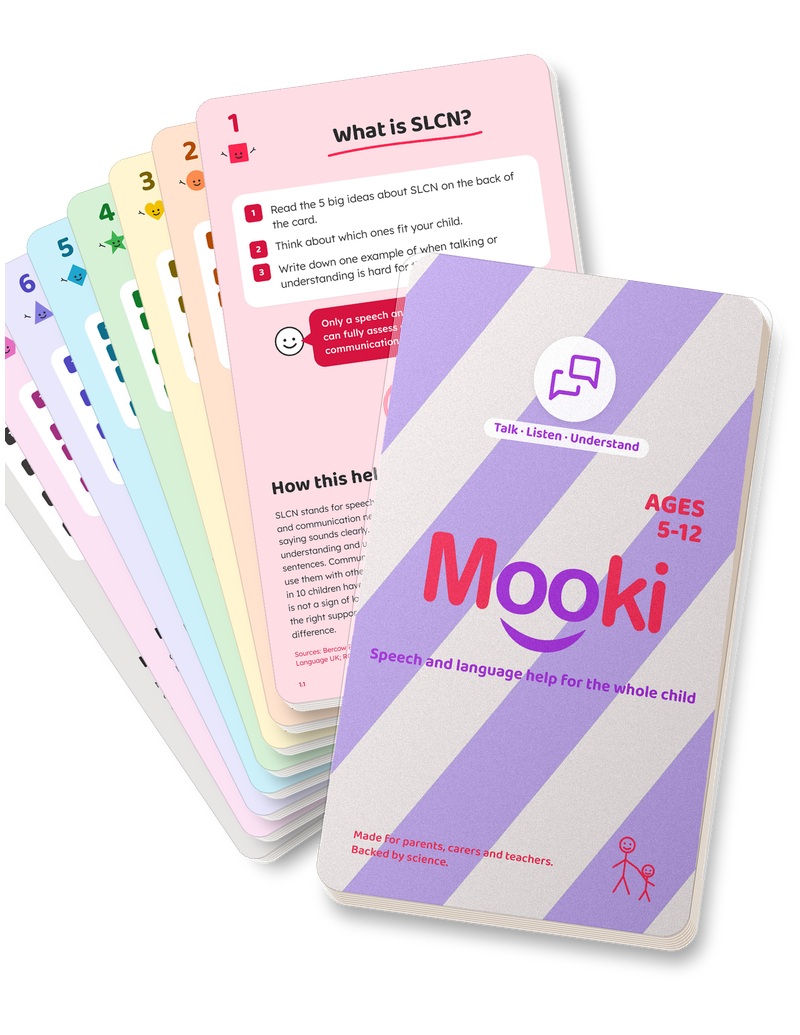
The Speech or Language? card helps you spot which area your child finds hard, and Explain It helps you talk about it with them. It's one of 56 ten-minute activities in the Speech and Language deck.
Instant download · use on a phone or tablet, or print and fill in at home or school
Try it today: a 10-minute “speech or language?” check
Spend ten minutes noticing, not testing. Use a picture book and a few toys.
- Listen to sounds (3 minutes). Ask your child to name things in the pictures. Are the sounds clear? Which ones are tricky?
- Check understanding (3 minutes). Give a few instructions that get longer: “Find the cat.” “Find the cat and the ball.” “Before you find the cat, point to the tree.”
- Check talking (4 minutes). Ask your child to tell you what’s happening on a page. Notice their sentences. Are they short or long? Do they find the words they need?
Jot down what you notice. If sounds were the tricky bit, it’s likely speech. If following or explaining was harder, it’s more likely language. Share your notes with your child’s teacher or therapist.
The relationship between speech and language
Speech and language are different, but they work closely together. Language is the message, and speech is one way of delivering it.
They also affect each other. A child who is hard to understand may avoid talking, which gives them less practice with language. A child with language difficulties may also have unclear speech. ASHA notes that speech and language difficulties can happen together.
Reading and writing are language skills too. ASHA counts them as part of language, so a child with language difficulties may also find it harder to understand what they read or to write down their ideas at school.
And both link to communication: using speech and language to connect with people, through eye gaze, gestures, turn-taking and tone of voice.
Why the difference matters
Knowing whether your child’s needs are about speech, language or both helps:
- you explain your worries to your GP, health visitor, paediatrician or school
- the therapist choose the right kind of support
- teachers adapt the classroom, for example by giving instructions in smaller chunks for a child with language needs
By age 3, the CDC’s milestones say most children talk well enough for others to understand them most of the time. If your child isn’t there yet, or you’re unsure, it’s worth asking for advice. If you’re worried, talk to your GP or paediatrician, or your child’s school.
The bottom line
Speech is how we say sounds and words. Language is the words and sentences we understand and use. Your child might need help with one, the other or both, and each kind of difficulty can be supported. Understanding the difference is a great first step to getting your child the right help.