
This guide walks parents through the main types of speech and language disorders in children, from speech sound difficulties to developmental language disorder (DLD), and what we know about their causes.
When a professional mentions a “speech and language disorder”, it can be hard to know what they mean. The good news is that most fit into a few clear groups. Knowing which group your child’s needs fall into helps you understand the support they’ll get.
What are speech and language disorders?
A speech and language disorder is a difficulty with communication that is more than a short delay and affects a child’s everyday life.
The first big split is between speech and language:
- Speech is how we make sounds and words: clear sounds, smooth flow and a healthy voice.
- Language is how we understand and use words and sentences to share ideas.
The American Speech-Language-Hearing Association explains that children can have a speech disorder, a language disorder, or both together.
Types of speech disorders
Articulation disorder
This is a difficulty with the physical movements needed to make certain sounds. A child might say “thun” for “sun” because their tongue is in the wrong place. It often affects just a few sounds.
Phonological disorder
Here the difficulty is with the sound patterns of a language, rather than moving the mouth. A child might leave off the ends of words (“ca” for “cat”) or swap a whole group of sounds, such as saying “t” for every “k”. ASHA’s guidance for therapists notes that articulation and phonological difficulties often overlap, and a child may have both. Together, they are known as speech sound disorders.
Fluency disorder (stammering or stuttering)
A child who stammers (stutters in the US) may repeat sounds, stretch them out or get stuck. The NHS says around 1 in 12 young children go through a phase of stammering, and many grow out of it.
Voice disorder
This affects the sound of the voice itself. A child’s voice may often sound hoarse, croaky, strained or too quiet. Voice problems in children are less common, and they should always be checked by your GP or paediatrician.
Childhood apraxia of speech
This is a rarer speech disorder where the brain finds it hard to plan and sequence the movements for speech. Children may know exactly what they want to say but struggle to get the sounds in the right order.
Types of language disorders
Developmental language disorder (DLD)
DLD is a long-term difficulty with understanding and using language that has no known cause. The Royal College of Speech and Language Therapists says it affects around 7.6% of children. A large study in England put that at roughly two children in every class of 30.
A child with DLD might have:
- receptive language difficulties: trouble understanding what others say
- expressive language difficulties: trouble finding words or building sentences
- or a mix of both
The name DLD was recommended by an international panel of experts. It replaced older terms such as “specific language impairment”.
Language disorder linked to another condition
When language difficulties come with another condition, such as hearing loss, Down syndrome or brain injury, experts call it a “language disorder associated with” that condition. Autistic children may also have language differences, alongside differences in social communication.
Causes of speech and language disorders
For many children, there isn’t one simple cause. The US National Institute on Deafness and Other Communication Disorders (NIDCD) and other experts point to several factors that can play a part:
- Hearing loss: if a child can’t hear speech clearly, it’s harder to learn it. The NHS notes that long-lasting glue ear can affect speech development too.
- Genes: speech and language difficulties often run in families. The NHS notes that about 2 in 3 people who stammer have a family history of it.
- Neurological differences: some disorders, such as apraxia of speech, are linked to how the brain plans speech.
- Other conditions: autism, cleft palate, cerebral palsy and learning disabilities can all affect communication.
Here’s what does not cause speech and language disorders: bad parenting, being “lazy” or speaking more than one language at home. In fact, the NHS guide to helping your child talk says learning more than one language can help, and encourages parents to use whichever language feels comfortable.
Is it a speech difficulty, a language one, or both?
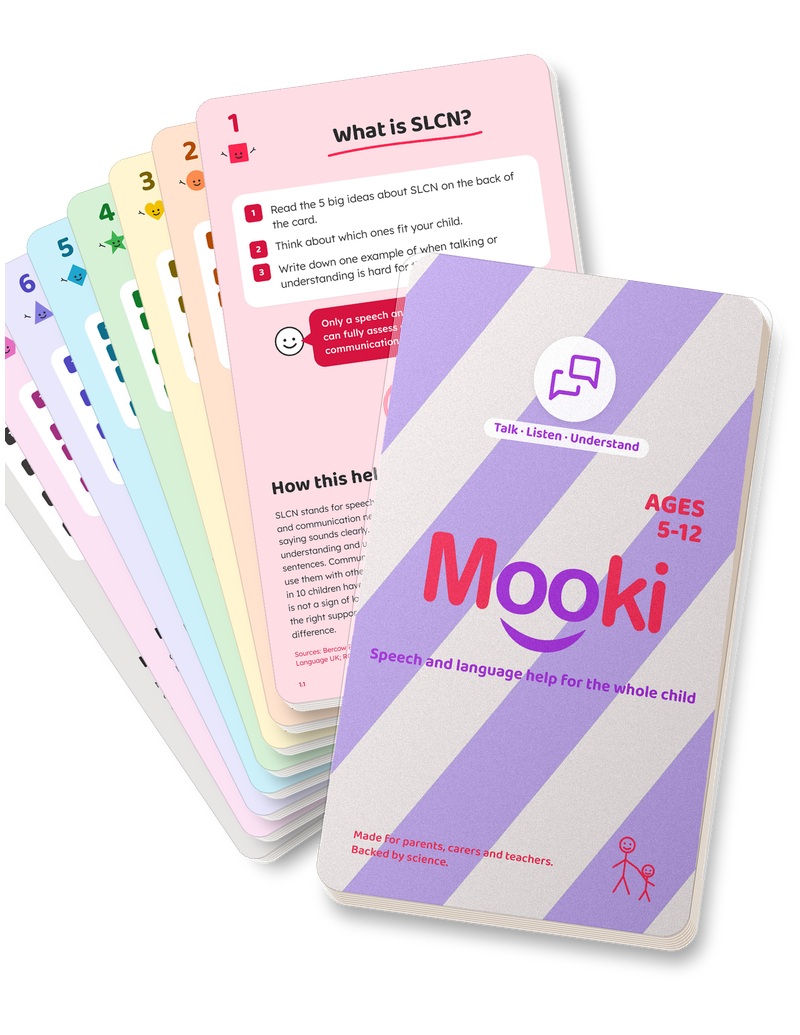
The Speech or Language? card helps you work out where your child's difficulties lie, and What is DLD? explains developmental language disorder simply. It's one of 56 ten-minute activities in the deck.
Instant download · use on a phone or tablet, or print and fill in at home or school
Try it today: a 10-minute “speech or language?” detective game
Not sure where your child’s difficulties lie? Spend ten minutes playing and noticing.
- Sound check (3 minutes). Look at a picture book. Ask your child to name things. Do they say sounds clearly? Jot down any sounds they swap.
- Understanding check (3 minutes). Give simple instructions: “Put the teddy under the chair.” Then make them longer: “Give me the cup, then touch your nose.”
- Talking check (4 minutes). Ask your child to tell you what happened in the story. Do they use full sentences? Can they keep events in order?
Take your notes to your GP, health visitor, paediatrician or SLT. They’re very useful starting points.
Speech or language impairment in US schools
In the US, the special education law IDEA has a category called “speech or language impairment”. The federal definition includes stuttering, unclear speech, language impairments and voice impairments that affect a child’s education. Children who qualify can get speech therapy through an IEP.
In the UK, these needs come under speech, language and communication needs (SLCN). Your child can get SEN support at school, and some children get an EHCP.
Key points
Speech and language disorders come in different types: speech sound, fluency, voice and language disorders, including DLD. Many children have more than one. Causes are often a mix of genes, hearing and how the brain develops, and they are never anyone’s fault. If you’re worried, talk to your GP or paediatrician, or your child’s school, and ask for a speech and language assessment.