
If your child has dyslexia and still struggles with maths, or you’re not sure which difficulty is behind their struggles, this guide is for you. It explains how dyscalculia and dyslexia differ, why they often go together, and how to help with both.
Dyscalculia and dyslexia are both specific learning differences. They have similar-sounding names, and they are sometimes confused, but they affect different things. Many children have both, so understanding where one ends and the other begins can make support much better.
Free 10-minute course
Money and time help for dyscalculia
Everyday maths made easier, in 3 short activities. 10 minutes a day, with free printable worksheets.
What is the difference between dyscalculia and dyslexia?
Dyslexia mainly affects reading and spelling. Children with dyslexia often find it hard to link sounds to letters, read words quickly and spell them. The NHS describes dyslexia as a common learning difficulty that mainly affects things like reading and writing, and says it can affect using numbers too.
Dyscalculia mainly affects understanding numbers. The core difficulty is with number sense: knowing how big numbers are, comparing them and seeing how they relate. That makes calculation, number facts and place value hard.
Understood points out that calling dyscalculia “maths dyslexia” isn’t accurate. It’s a different condition, not dyslexia in maths.
| Dyslexia | Dyscalculia | |
|---|---|---|
| Main area affected | Reading, spelling, writing | Number sense and calculation |
| Early signs | Trouble with letter sounds and rhymes | Trouble counting and comparing amounts |
| In maths | Reading word problems, remembering facts and sequences | Understanding what numbers mean and how big they are |
| Everyday life | Reading signs, forms and instructions | Money, time, estimating and directions |
| Common to both | Working memory, confidence, avoidance | Working memory, confidence, avoidance |
Why do dyscalculia and dyslexia often go together?
It’s common for children to have both. Scientists are still learning why, but there are a few likely reasons:
- Shared thinking skills. Both can involve weaker working memory, which is holding information in your head while you use it. Both reading and maths need lots of this.
- Language matters in maths. Counting words, number facts and maths vocabulary are all language. Children with language difficulties can find these harder.
- Genes and brain development. Learning differences often run in families and tend to cluster together.
The research backs up this overlap:
- The British Dyslexia Association says around 60% of people with dyslexia have difficulties with maths. Not all of them have dyscalculia, but many find maths hard.
- In a large study of primary children, Queen’s University Belfast found that most children with likely dyscalculia also had another developmental difficulty, such as dyslexia or speech and language difficulties.
The same study found something striking: children with dyslexia were far more likely to have a diagnosis and support than children with dyscalculia. Dyscalculia is easily missed, especially when dyslexia is already known.
How dyslexia affects maths
A child with dyslexia but not dyscalculia usually understands numbers well. They may “get” the maths but trip up on the way in. You might see them:
- Struggle to read questions and word problems.
- Find it hard to remember times tables and sequences, such as days of the week.
- Mix up similar-looking symbols or numbers, like 6 and 9.
- Lose their place in long calculations.
- Do much better when a question is read aloud.
The key clue: their number sense is secure. They can usually tell which number is bigger, estimate sensibly and explain their thinking out loud.
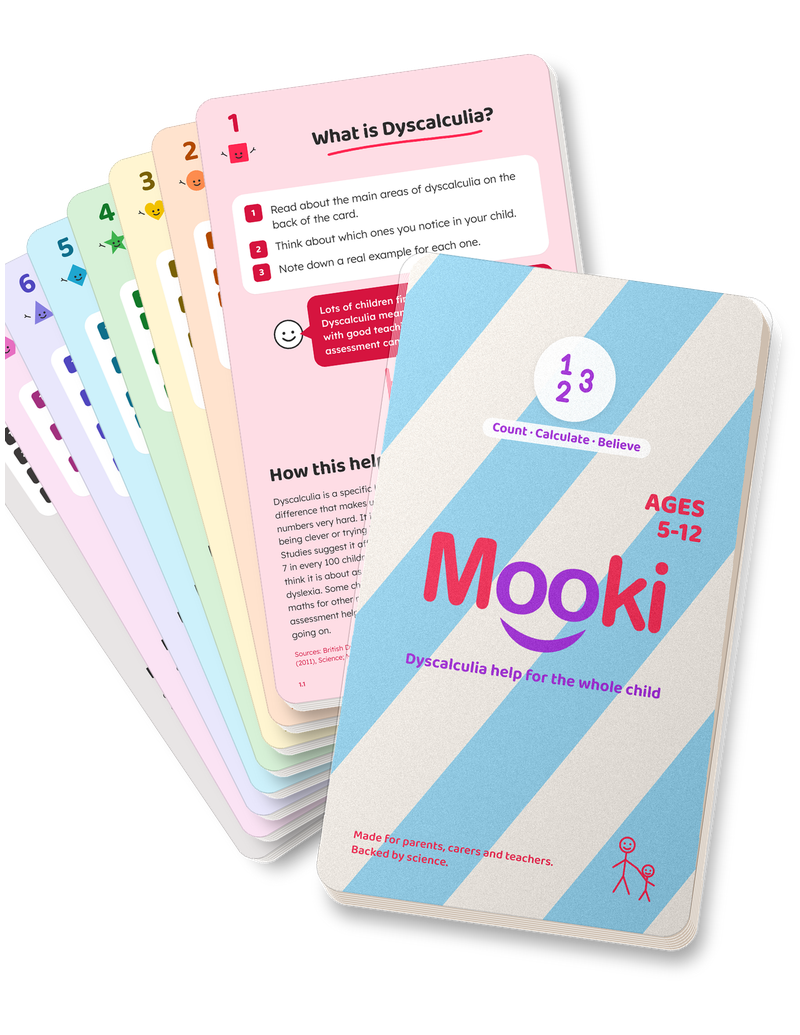
Help for reading and numbers, side by side
Dyscalculia and Friends explains how it links with dyslexia, while Word Problems and Draw It make tricky questions easier to tackle. Each is one of 56 ten-minute activities in the Mooki Cards dyscalculia deck.
Instant download · use on a phone or tablet, or print and fill in at home or school
How dyscalculia shows up differently
A child with dyscalculia struggles with the numbers themselves, even when there’s no reading involved. You might see them:
- Count in ones for simple sums long after peers have stopped.
- Find it hard to compare two numbers or estimate amounts.
- Not notice when an answer is wildly wrong.
- Struggle even when questions are read aloud.
If your child has both, you may see a mix of these signs, and their maths may be affected more than either difference alone would explain.
Word problems: where both differences meet
Word problems are a big challenge for many children with dyslexia, dyscalculia or both. To solve one, a child has to:
- Read the words accurately.
- Understand what’s being asked.
- Pick out the important numbers.
- Choose the right operation.
- Do the calculation.
- Check the answer makes sense.
Dyslexia can block steps 1 and 2. Dyscalculia can block steps 4 to 6. A child with both can get stuck almost anywhere.
Try it today: a 10-minute word problem routine
Pick one short word problem from homework or make one up, such as “Sam has 7 apples. He gives 3 to Mia. How many does he have now?”
- Read it aloud together, so reading isn’t a barrier.
- Ask your child to tell the story in their own words.
- Draw it. Simple circles or a bar split into parts are perfect.
- Solve it using the drawing or real objects.
- Check it: “Does 4 apples make sense? Did Sam end up with fewer?”
Do just two or three problems. Highlighting key words and numbers in word problems is one of the common classroom supports you can ask school about, and having questions read aloud can help too.
How to help a child with dyscalculia and dyslexia
The good news is that many helpful approaches work for both:
- Multisensory, hands-on learning: use objects, pictures and talk together.
- Small steps and lots of practice: go slowly and revisit often.
- Reduce reading load in maths: read questions aloud and use clear, uncluttered worksheets.
- Visual supports: number lines, hundred squares and word banks for maths vocabulary.
- Extra time: many children need more time to read and to calculate.
- Protect confidence: praise effort and strategies, and remind your child they are not “bad at learning”.
Getting the right support at school
If your child already has a dyslexia diagnosis but maths is still very hard, ask whether dyscalculia has been considered. The SASC definition of dyscalculia lists dyslexia as a condition that often occurs alongside it.
In the UK, talk to the SENCo about your child’s maths as well as their literacy. SEN support plans can include targets for both.
In the US, ask whether your child’s evaluation looked at maths skills as well as reading. An IEP can include goals for both areas.
If you’re worried about how your child is coping overall, you can also talk to your GP or paediatrician.
Ten-minute activities, like those in Mooki Cards, can sit alongside any reading support you already use at home.
The bottom line
Dyslexia and dyscalculia are different, but they often travel together. Knowing which is which helps you and your child’s school target the right support. Read questions aloud, use objects and drawings, and keep practice short and kind. Your child can make real progress with both.