
If you’ve heard the term SLCN at school or nursery and want to know what it means for your child, this guide explains speech, language and communication needs in plain English, and where to start.
Speech, language and communication needs are very common. They can look quite different from one child to the next, which is why the term can feel confusing at first. Let’s break it down.
What is SLCN?
SLCN stands for speech, language and communication needs. It is a broad UK term for any difficulty with talking, understanding or using language to connect with others.
In England, the SEND Code of Practice groups special educational needs into four broad areas. SLCN sits within “communication and interaction”. So if your child’s school says your child has SLCN, they mean your child needs some extra help in this area.
SLCN is an umbrella term, not a diagnosis. Some children with SLCN have a named condition, and others don’t.
What do people call it in the US?
US schools and doctors don’t usually say SLCN. You are more likely to hear “communication disorder”, “speech and language disorder” or “speech or language impairment”. That last one is a category in IDEA, the US special education law, and the federal definition covers things like stuttering, unclear speech, language difficulties and voice problems that affect a child’s learning.
What is speech, language and communication?
It helps to think of SLCN as three overlapping parts. The American Speech-Language-Hearing Association explains the difference between speech and language in a similar way.
| Part | What it means | What you might notice |
|---|---|---|
| Speech | Making sounds clearly and smoothly | Hard to understand, swaps sounds, stammers |
| Language | Understanding and using words and sentences | Struggles to follow instructions, find words or explain ideas |
| Communication | Using language with other people | Finds turn-taking, conversation or reading faces tricky |
A child might have needs in just one area, or in all three.
How common are speech and language needs?
More common than many parents realise. The charity Speech and Language UK estimates that around 1.9 million children in the UK are struggling with talking and understanding words.
Research gives a sense of scale too. A large study of children starting school in England found that about 7.6% had a language disorder with no known cause, now called developmental language disorder (DLD). That’s roughly two children in every class of 30. Another 2.3% had language difficulties linked to another condition, such as a learning disability.
So if your child has SLCN, you are far from alone.
Speech and language difficulties: what can cause them?
Often, there isn’t one clear cause. Speech and language problems can be linked to:
- hearing loss or frequent ear infections such as glue ear
- a family history of speech or language difficulties
- developmental language disorder (DLD)
- autism, ADHD or a learning disability
- physical differences, such as a cleft palate
It’s important to say this clearly: SLCN is not caused by bad parenting. It is also not a sign of low intelligence or laziness. Many children with SLCN are bright, curious and full of ideas. They just find it harder to get those ideas across.
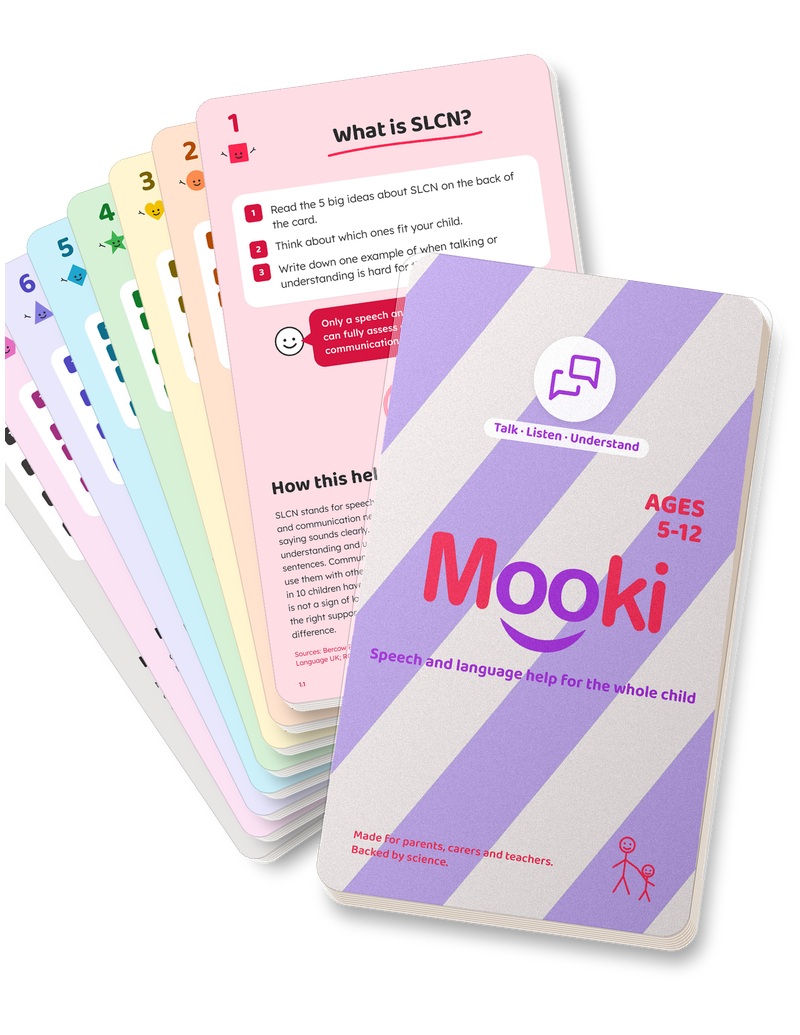
Want to explain SLCN to your child and their school?
What is SLCN? helps you understand your child's needs, Explain It helps you talk about them with your child, and Talk to School gets everyone working together. It's one of 56 ten-minute activities.
Instant download · use on a phone or tablet, or print and fill in at home or school
Try it today: a 10-minute “comment, don’t quiz” chat
Children with SLCN can freeze when faced with lots of questions. Try this instead.
- Join your child’s play for 10 minutes. Let them choose what to do.
- Comment on what they’re doing. “The car is going fast!” “You found a blue block.”
- Pause. Give your child at least five seconds to join in.
- Copy and add. If they say “car”, you say “red car” or “car crashing”.
- Ask just one or two questions at most, and make them easy to answer.
This takes the pressure off talking, and it’s one of the simplest ways to build speech and language in children.
How speech and language needs can show up day to day
SLCN doesn’t only affect talking. Because language is part of almost everything, it can show up in surprising places:
- Learning: finding it hard to follow the teacher, learn new topic words or understand maths (math) word problems.
- Reading and writing: struggling to understand stories or put ideas down on paper.
- Feelings: getting cross or upset because they can’t explain what’s wrong.
- Friendships: missing jokes, or finding it hard to join in games.
Spotting these links helps adults respond with patience, not frustration.
Where to start if you’re worried
Step 1: watch and note
Jot down what you notice for a week or two. Write down examples, like “didn’t follow two-step instruction” or “strangers couldn’t understand him”. The Speech and Language UK information pages have ages and stages guides to compare with.
Step 2: talk to someone
- UK: Speak to your health visitor, GP or your child’s teacher and SENCo. In many areas, you can refer your child to NHS speech and language therapy yourself.
- US: Speak to your pediatrician. Under 3, contact your state’s Early Intervention program. From age 3, ask your public school district for an evaluation.
Step 3: get support at school
In the UK, your child can get SEN support at school without a diagnosis. If they need a lot of help, you can ask about an education, health and care plan (EHCP). In the US, your child may get support through an IEP or a 504 plan.
Step 4: find your people
Charities like Afasic support families of children with speech and language needs, and have a helpline for parents.
The bottom line
Speech, language and communication needs are common, and they are nobody’s fault. SLCN covers a wide range of difficulties, from unclear speech to trouble with understanding or conversation. With the right support at home and school, children with SLCN can and do make great progress. Start by noticing, asking and getting the right people on your side.