If times tables cause tears in your house, this guide is for you. You’ll find pattern-based, hands-on ways to learn times tables with dyscalculia that build real understanding, without endless chanting and drilling.
Many children with dyscalculia work hard on their tables and still find the facts slip away by the next day. That is not laziness. It is a sign that they need a different route in.
Why are times tables so hard with dyscalculia?
Dyscalculia is a difficulty with understanding and working with numbers, as the British Dyslexia Association explains. Times tables lean heavily on things many children with dyscalculia find hard:
- Remembering lots of separate facts that look alike.
- Understanding what “3 lots of 4” really means.
- Counting on in steps (skip counting) without losing their place.
- Working under time pressure, which can trigger worry.
Rote learning alone often fails because there is nothing to hang the fact on. When a child understands patterns and links, a forgotten fact can be worked out from one they know.
What schools expect, in the UK and US
In England, the national curriculum for maths expects children to know their 2, 5 and 10 times tables in Year 2, the 3, 4 and 8 tables in Year 3, and all tables up to 12 x 12 by the end of Year 4.
Year 4 children also take the multiplication tables check in June. According to the government’s information for parents, it has 25 questions with 6 seconds each, there is no pass mark, and access arrangements are available for pupils with SEND. Talk to your child’s school if you are worried about it.
In the US, multiplication facts are usually taught in grades 2 to 4 (roughly Years 3 to 5 in the UK). Expectations vary by state, so ask your child’s teacher.
Try it today: build a times table from a pattern
This 10-minute activity works for any table. Here it is with the 4s.
- Make it real. Use Lego bricks or pasta to make 1, 2, 3 groups of 4. Say, “3 lots of 4 is 12.”
- Build an array. Lay the groups in rows. Turn the array round to show 3 x 4 is the same as 4 x 3.
- Find the pattern. Write the answers on a 100 square and colour them in. Ask, “What do you notice?”
- Link to what they know. Show that the 4s are double the 2s: 2 x 6 = 12, so 4 x 6 = 24.
- Finish with a win. End on two or three facts your child now feels sure of.
Want times tables practice that sticks?
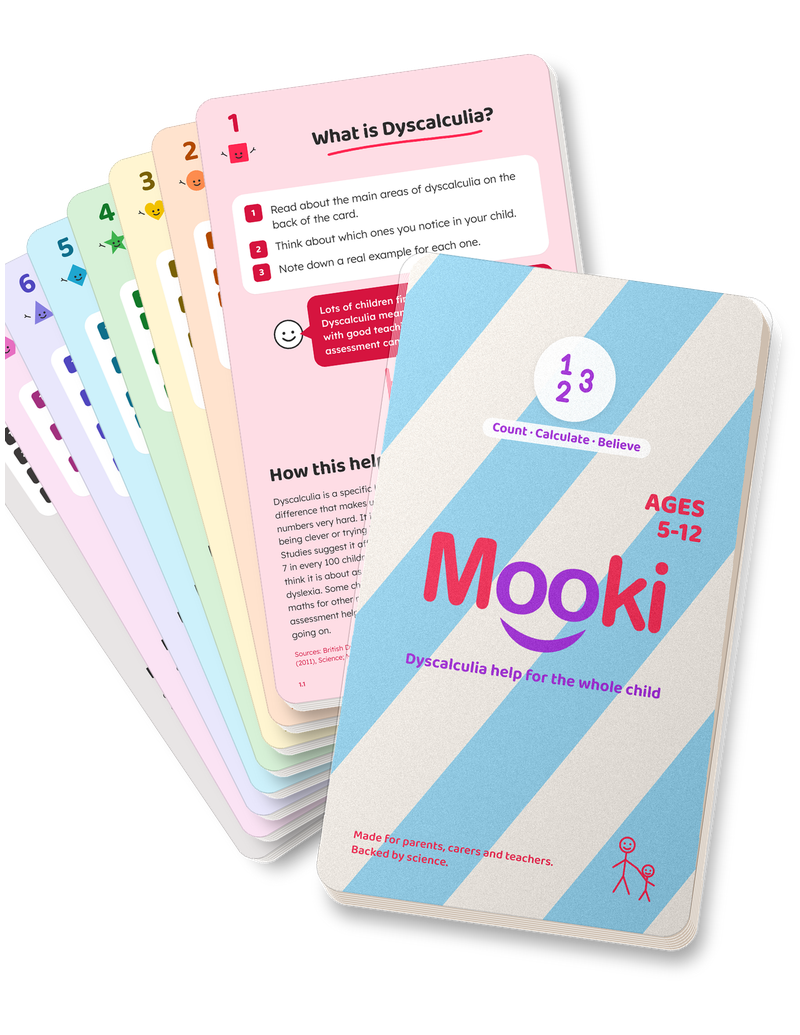
Times Table Patterns and Fact Tricks help your child see links between facts, and Little and Often keeps practice short. Each is one of 56 ten-minute activities in the Dyscalculia deck.
Instant download · use on a phone or tablet, or print and fill in at home or school
Multiplication tricks for kids that build understanding
The best tricks are not magic shortcuts. They are links between facts. The NCETM’s times tables resources encourage teaching fluency and understanding together, exploring patterns and using links between tables such as 2, 4 and 8.
- Doubling: the 4s are double the 2s, and the 8s are double the 4s.
- Turnarounds: 7 x 3 is the same as 3 x 7, so every fact learned is really two.
- Tens and halves: 5 x 8 is half of 10 x 8. Find 80, then halve it to 40.
- One more group: if 5 x 6 is 30, then 6 x 6 is 30 plus one more 6.
- Nines on fingers: hold up ten fingers and fold down the one you are multiplying by. The fingers either side give the tens and ones.
A kind order to learn them in
Start with the 10s, then the 5s and 2s, because they have the clearest patterns. Next come the 4s and 8s (built by doubling), then the 3s, 6s and 9s. Leave the 7s until last. By then, your child will already know most 7s facts from the other tables.
Make a small “facts I know” card. Each week, add one or two new facts. Seeing the card fill up is very motivating.
How to learn times tables with less stress
Short, regular practice is far kinder than long sessions. The US IES practice guide for students who struggle with maths suggests spending about 10 minutes of each support session on building quick recall of basic facts.
- Drop the stopwatch at first. Speed comes after understanding, not before.
- Play games. Roll two dice and multiply, or play times table snap.
- Move. Jump along a chalk number line in steps of 3 on the patio.
- Allow a table square for harder work. If your child’s lesson is on long multiplication, a times table grid lets them focus on the method.
Watch for worry, too. Research from the University of Cambridge on understanding mathematics anxiety found that maths anxiety starts young and was more common in children with dyscalculia. Timed tests can make it worse, so keep the mood calm and light.
When to ask for multiplication tables help at school
If your child still cannot recall facts after lots of patient practice, tell the class teacher. They may be able to offer small-group work, more hands-on resources or a table square in class.
In the UK, you can also ask to talk to the SENCo about SEN support. In the US, you can ask the school about extra math help or whether an evaluation is needed. If you’re worried, the school is the right place to start.
Key points
Children with dyscalculia can learn times tables, but they usually learn them best through patterns, objects and links, not drilling alone. Keep sessions short, playful and regular, and celebrate every new fact. Slow, steady progress is still progress, and your calm support makes a real difference.