How do you teach phonics in an autism unit or resource base? Here’s how to adapt your phonics scheme for autistic pupils, how to teach blending to a child with autism and EAL, a 10-minute phonics session to try today, and how to involve parents.
Phonics can be one of the best parts of the day in an autism unit. It’s structured, repetitive and predictable, which many autistic pupils love. But a fast whole-class phonics lesson, with lots of talk and quick changes, can also be overwhelming.
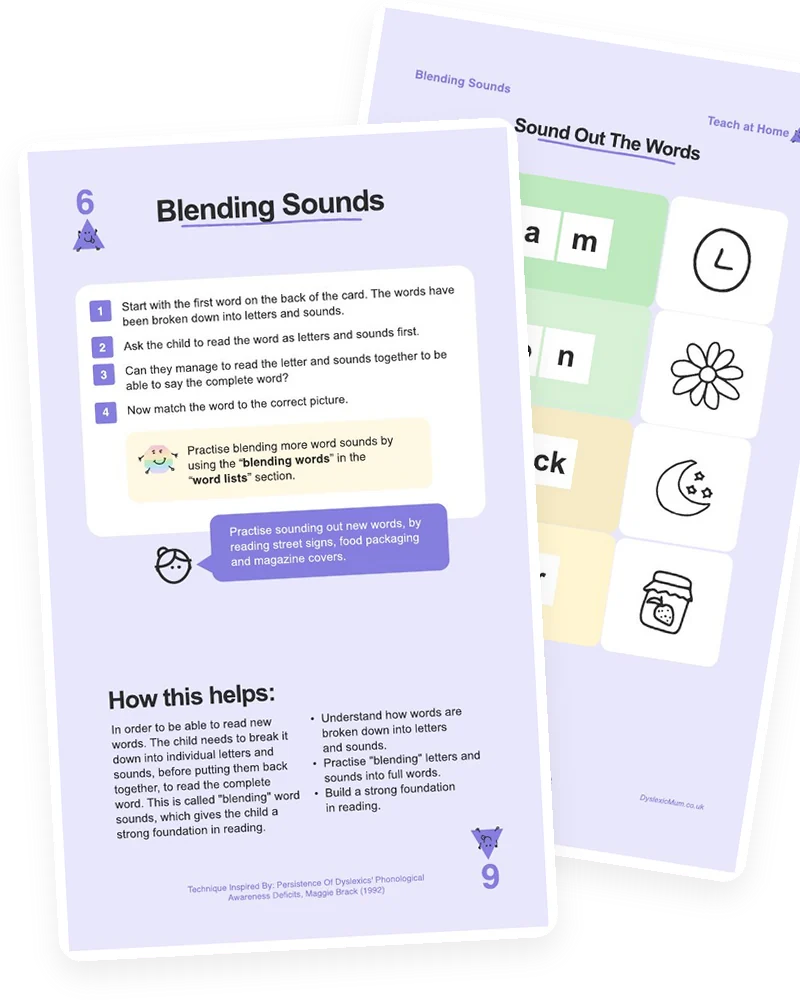
Small changes make a big difference. The Blending Sounds and Word Sounds cards in the Mooki Cards dyslexia deck turn phonics into short, fun games that work well with autistic pupils.
Does phonics work for autistic pupils?
Yes. Systematic phonics is the main way children in England learn to read, and that includes most autistic pupils. The Department for Education’s reading framework sets out how schools should teach it, with extra support for pupils who need it most.
Autistic pupils may need phonics taught a little differently, because they may:
- find it hard to copy sounds on demand, or to speak in front of others
- be more sensitive to noise in a busy phonics session
- need more time to process each instruction
- learn letters quickly by sight but find blending harder
- need a strong reason to join in, like a favourite topic
How to adapt phonics in an autism unit
Keep the same scheme your school uses, so pupils can move on smoothly. Then adapt how you teach it:
- Keep the routine the same – the same order, the same place and the same words every session
- Show the plan – a visual timetable for the session, like “sounds, blend, read, finish”
- Say less – short instructions and the same phrases each time, like “My turn, your turn”
- Make it visual and hands-on – letter tiles, magnetic letters, sand trays and sound buttons
- Make it multi-sensory – trace letters, tap out sounds, jump on letters. Our guide to multi-sensory learning has ideas
- Use their interests – blend words about their favourite things, like “c-a-r” for a car fan
- Accept other ways to answer – pointing to the right letter, choosing a picture, or using an AAC device all count
- Keep it short – two 10-minute sessions often work better than one 30-minute lesson
For pupils who don’t speak, you can still teach phonics. They can hear the sounds, point to letters, match words to pictures and use their communication system. Our guide to supporting a non-verbal autistic pupil has more ideas.
Try it today: in class – a 10-minute phonics session
Use this with one pupil or a small group.
- Show the plan (1 minute). Point to the visual timetable: “Sounds, blend, read, finish.”
- Review 3 sounds (2 minutes). Hold up three letter cards the pupils know, like s, a and t. Say each sound together, or point to each one as you say it.
- Blend with objects (3 minutes). Put three letter tiles in a row: s, a, t. Touch each tile as you say the sound, then sweep your finger under them and say “sat”. Then it’s their turn.
- Read and match (3 minutes). Show the word “sat” and two pictures. The pupil matches the word to the right picture.
- Finish (1 minute). Point to “finish” on the timetable. Give clear, specific praise: “You blended s-a-t. Brilliant.”
Repeat the same routine every day. Change just the sounds and words, so the pupil knows what’s coming.
Want ready-made phonics games?
The Blending Sounds and Word Sounds cards turn phonics into short, structured games, with steps for you and a printable activity for your pupil. Both are among 56 ten-minute activities in the Mooki Cards dyslexia deck. Pair them with the Visual Timetable card from the Mooki Autism deck and Sound Play from the Mooki Speech and Language deck.
Instant download · use on a phone, tablet or class whiteboard, or print for your pupils
How do you teach a child with autism and EAL to blend and read?
Pupils who are autistic and learning English as an additional language (EAL) are learning new sounds, new words and a new way of reading all at once. To help:
- don’t drop the home language – research suggests being bilingual doesn’t hold back autistic children’s language. Two 2011 studies, reported by The Transmitter, found no harm to language skills
- teach meaning first – use real objects and pictures so the pupil knows what “cat” or “sun” means before blending it
- use words they know – start with words that are common, short and easy to picture
- listen for tricky sounds – some English sounds may not exist in their home language, so give extra practice
- work with families – ask parents to share books, songs and rhymes in their home language too
- check carefully – don’t assume a slow start is only about language, or only about autism. The Bell Foundation’s guidance on EAL and SEND says no single test can tell them apart
Phonics lesson ideas for an autism unit
Keep phonics fun and active with these ideas:
- sound hunt – find objects in a box that start with a sound
- post the word – post picture cards into the box that matches their first sound
- jumping blends – jump along three letter cards on the floor, saying each sound, then jump off and say the word
- favourite-thing words – make a phonics book with words about the pupil’s special interest
Our free phonics worksheets and word matching game have more resources.
Working with parents
Share the sounds you’re working on each week, with a picture for each. Ask parents to practise for just a few minutes at home, in the same way you do in class. Send home the same letter cards, so the pupil sees the same thing in both places.
When to involve the SENCo or outside help
Talk to your SENCo or unit lead (special education teacher in the US) if a pupil:
- knows letter sounds but still can’t blend after a lot of practice
- finds it very hard to hear the different sounds in words
- isn’t making progress, even with adapted teaching
A speech and language therapist can check how the pupil hears and says sounds. Our guide to the foundations of reading explains each step.
Read next: Speech and language delay: signs and when to worry
The bottom line
Phonics works for most autistic pupils when it’s predictable, visual, hands-on and short. Keep your school’s scheme, adapt how you teach it, and use their interests. You know your pupils best. For ready-made phonics games, the Mooki Cards dyslexia deck has 56 ten-minute activities, including Blending Sounds and Word Sounds.