Looking for dyscalculia games that don’t feel like homework? Here are 15 low-prep maths games for kids aged 5 to 12, using dice, playing cards and board games you probably already have. Each one takes about ten minutes and builds number sense.
Games are one of the best ways to help a child who finds maths hard. They give lots of practice without the pressure of a worksheet, and they make numbers something to enjoy together rather than dread.
Why maths games help children with dyscalculia
Children with dyscalculia need more practice than most, and they need it to feel safe. Games are perfect for this.
- Lots of repetition without boredom.
- Low pressure: a lost game is no big deal.
- Talk: games give natural chances to say “How did you know?”
- Real understanding: moving a counter along a track helps children feel how big numbers are.
The Education Endowment Foundation’s early maths guidance recommends board games, such as Snakes and Ladders, as particularly helpful for understanding numbers. In one study, young children who played a simple numbered board game for four short sessions got better at ordering numbers and estimating where they sit on a number line.
Understood notes that games work best for practising skills a child has already been taught, rather than teaching brand new ideas. Playing together also helps you see your child’s strengths and where they get stuck.
Before you start: tips for success
- Keep it short. Ten minutes is plenty.
- Let your child win sometimes, but not always.
- Use fingers and objects freely. They’re tools, not cheating.
- No timers. Speed can raise anxiety.
- Talk out loud about your own moves: “I’m on 7 and rolled 3, so 8, 9, 10.”
- Stop while it’s fun.
Dice games (number games for kids aged 5 to 8)
1. Dot spotter
Roll a dice and cover it with your hand. Lift for a second: “How many dots?” Seeing amounts without counting (subitising) is a key number skill.
2. Race to 20
Draw a track of 20 squares. Take turns rolling one dice and moving along, counting each square aloud. First to 20 wins. This builds counting on and the feel of a number line.
3. Roll and build
Roll a dice and build a tower with that many Lego bricks. After five rolls, whose tower is tallest? Compare: “Mine has 14, yours has 11. Who has more?”
4. Double trouble
Roll one dice and say the double: 4 becomes 8. Use counters to check. Doubles are a great stepping stone to other number facts.
5. Make ten
Roll one dice and find its partner to make 10. If a 6 shows, ask: “6 and what make 10?” Fill a ten frame (2 rows of 5 boxes) with counters to check.
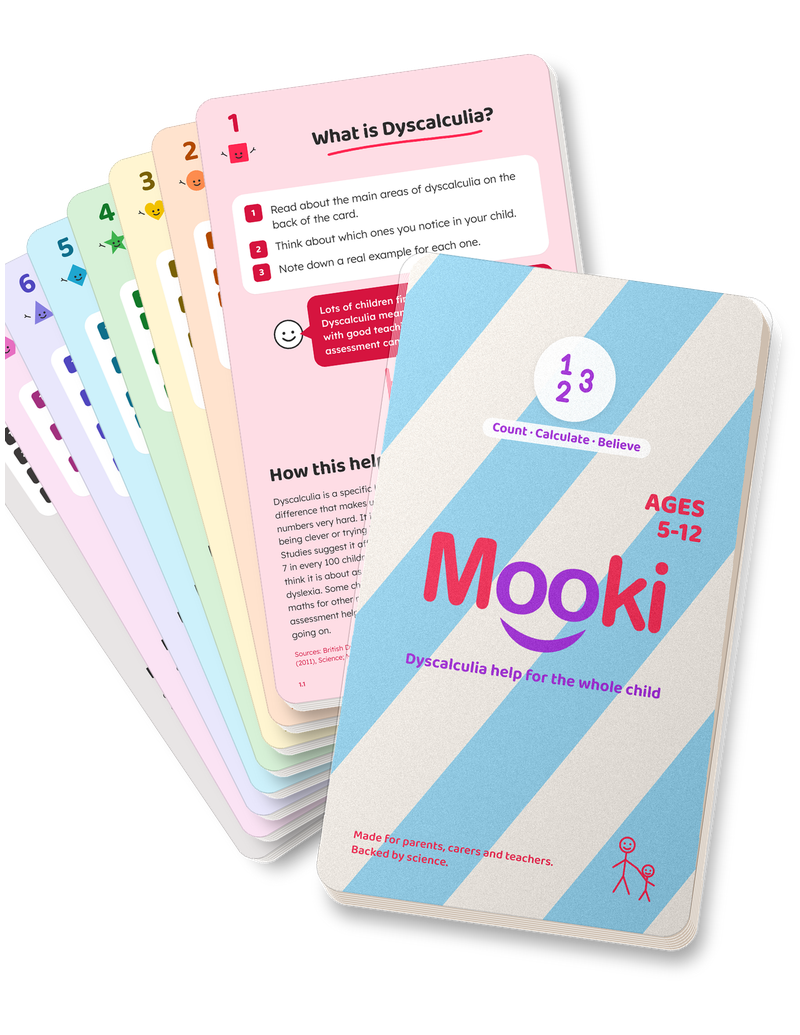
Ten-minute maths games, ready to play
Board Games, Play Together and Quick Look turn number practice into family fun with simple steps and printable boards. Each is one of 56 ten-minute activities in the Mooki Cards dyscalculia deck.
Instant download · use on a phone or tablet, or print and fill in at home or school
Card games (maths games for ages 6 to 10)
Remove the picture cards from a standard pack, or use number cards you make yourself.
6. Higher or lower
Turn over a card. Will the next one be higher or lower? Great for comparing numbers.
7. Snap to ten
Like Snap, but you shout “Ten!” when two cards side by side add up to 10. Play slowly so it stays calm, not a race.
8. War (or Top Trumps with numbers)
Each player turns over a card. The biggest number wins both cards. For a harder version, turn over two cards each and add them.
9. Number line up
Deal 5 cards each. Put them in order from smallest to biggest. Then try biggest to smallest.
10. Go Fish for pairs
Play Go Fish, but a pair is two cards that make 10, such as 3 and 7. A lovely way to practise number bonds.
Board games and everyday games (ages 7 to 12)
11. Snakes and Ladders
A classic for good reason. Count each square aloud as you move, and ask “How many to the next ladder?”
12. Strike It Out
This free game from NRICH, the University of Cambridge maths project, uses a 0 to 20 number line. Players take turns crossing out numbers and making sums or differences. See how to play Strike It Out.
13. Shop keeper
Set up a pretend shop with price labels (start with 1p to 10p). Take turns buying and giving change with real coins. Move to bigger amounts as your child grows in confidence.
14. Dominoes
Match the ends, then count the total spots on each domino. Older children can add up the spots on both open ends.
15. Guess my number
Think of a number between 1 and 50. Your child asks questions like “Is it bigger than 25?” or “Is it even?” Swap roles. This builds number sense, reasoning and maths talk.
Try it today: your first ten-minute game
Not sure where to start? Try this tonight.
- Grab a pack of cards and remove the picture cards.
- Play Higher or lower for five minutes.
- Then play Number line up with five cards.
- Ask your child which game they liked best, and play that one again tomorrow.
That’s it: a calm, fun ten minutes of maths.
How to make games work for your child
- Match the level. Start with numbers up to 5 or 10 and go up only when it feels easy.
- Use real objects alongside games, like counters, coins or pasta.
- Mix it up. Rotate a few favourites so practice stays fresh.
- Be a good loser. Show your child how to say “Oh well, good game!”
- Praise thinking, not just winning: “I like how you counted on from 6.”
For more ideas, Understood has a list of board games that build maths skills for younger children.
If maths is causing a lot of worry or you think your child may have dyscalculia, talk to their teacher, SENCo or, in the US, ask about a school evaluation.
If you’d like a ready-made set, the Board Games and Play Together cards in the Mooki Cards dyscalculia deck give you more ten-minute ideas like these.
The bottom line
The best dyscalculia games are simple, short and fun. Dice, cards and board games give children lots of practice in a low-pressure way, and help them feel how numbers work. Play little and often, talk about your thinking, and enjoy the time together. Every game is a small step towards confidence.