
If you’re looking for dyscalculia treatment or help for your child, this guide explains what the evidence says really works. You’ll learn about structured, hands-on teaching, small steps and regular practice, and how to build a simple ten-minute routine at home.
When you search for dyscalculia help, you’ll find lots of products promising fast results. The honest truth is that there’s no quick fix. But there is good news: well-planned teaching, patience and steady practice can make a big difference to a child’s skills and confidence.
Is there a treatment for dyscalculia?
Dyscalculia is a lifelong learning difference, not an illness. So “treatment” really means teaching and support. As Understood explains, help comes through specialised teaching, classroom accommodations and practice at home.
Be wary of anything that claims to “fix” dyscalculia quickly, such as special glasses, coloured overlays, brain-training gadgets or expensive programmes with big promises. These aren’t backed by good evidence. Your time and money are better spent on approaches that are.
What does good dyscalculia intervention look like?
The Education Endowment Foundation (EEF) reviews research for schools in England. Its guidance on maths in Key Stages 2 and 3 includes using manipulatives and representations, and using structured interventions to give extra support. Its early years and Key Stage 1 guidance also recommends high quality targeted support for children who need it.
Putting that research together, good dyscalculia intervention usually has these features:
1. Hands-on and visual (multisensory) maths
Children learn best when they can see and touch maths. Teachers often call this the concrete, pictorial, abstract approach:
- Concrete: real objects, such as counters, cubes, coins or Lego.
- Pictorial: drawings, dots, ten frames, number lines and bar models.
- Abstract: written numbers and symbols, like 3 + 4 = 7.
Children move back and forth between these stages. Objects are a scaffold that is put away once a child understands. The EEF notes that they can help pupils of all ages, and that the decision to move on should depend on understanding, not age.
2. Small steps, built in order
Maths builds like a tower. If the bottom bricks are wobbly, everything above wobbles too. Good support:
- Finds out exactly what your child can and can’t do yet.
- Starts at that point, even if it’s well below their year group.
- Breaks each new idea into small, clear steps.
- Makes sure each step is secure before moving on.
3. Overlearning and regular review
Children with dyscalculia often need many more chances to practise before something sticks, and more reminders to keep it. This is called overlearning. It means:
- Practising a skill until it feels easy, then a bit more.
- Coming back to old skills often, so they aren’t lost.
- Short, frequent sessions rather than long, rare ones.
4. Explicit teaching and talk
Good support shows children clearly how to do things, then gives them a go with help, then lets them try alone. Talking matters too: asking your child to explain their thinking helps you spot mix-ups and helps them make sense of the maths.
Make ten minutes a day count
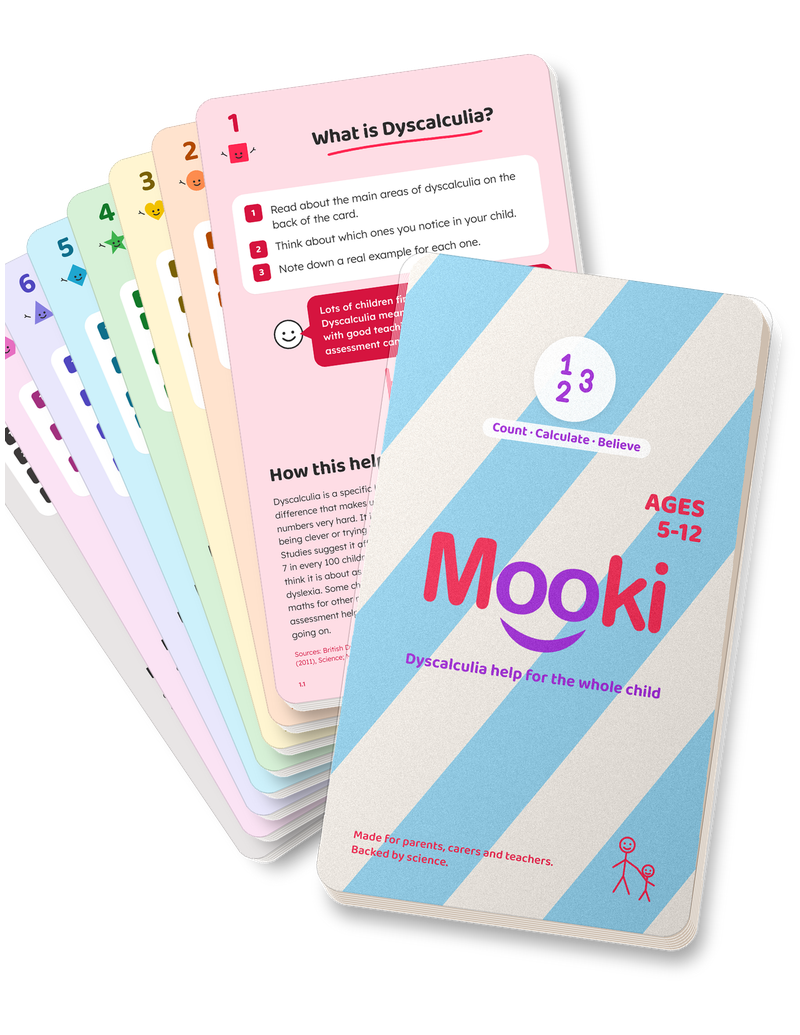
Help That Works shows what to ask school for, while Hands and Objects and Little and Often turn the evidence into simple home practice. Each is one of 56 ten-minute activities in the Mooki Cards dyscalculia deck.
Instant download · use on a phone or tablet, or print and fill in at home or school
What dyscalculia help should look like at school
Every school’s support will look a little different, but you can expect some of these:
- Small-group or one-to-one sessions with a teacher or trained teaching assistant, a few times a week.
- A clear plan with targets that are reviewed regularly.
- Classroom adjustments, such as extra time, number lines on the desk, fewer questions per page and using objects in lessons. Understood lists many useful classroom accommodations for dyscalculia.
- Links to class learning, so your child can use what they practise in group sessions back in lessons.
In the UK
Support usually comes through SEN support, which follows a cycle of assess, plan, do and review. Contact, the charity for families with disabled children, explains how this graduated approach works and says schools should meet parents at least three times a year. Ask the SENCo what maths intervention your child is getting, how often, and how progress is measured.
In the US
Support may come through an IEP, which includes specialised teaching and measurable goals, or a 504 plan, which gives accommodations. Understood has a clear guide to the difference between IEPs and 504 plans. Ask how often your child gets maths help and who provides it.
Good questions to ask school
- What does my child already do well in maths?
- Where exactly does their understanding break down?
- What intervention are they getting, how often, and for how long?
- Is it using objects and pictures, not just worksheets?
- How will we know it’s working?
- How can I help at home without confusing them?
Try it today: a ten-minute daily practice routine
Home practice works best when it’s short, regular and calm. Here’s a simple routine you can use most days.
- Warm up (2 minutes): a quick, easy game your child can win, like spotting dot patterns or counting to 20 and back.
- Main activity (5 minutes): one small skill, using real objects. For example, make 7 with counters in two groups, in as many ways as you can.
- Talk it through (2 minutes): “How did you know? Can you show me another way?”
- Finish with a win (1 minute): end on something your child can do well, and name what they did: “You kept going even when it was tricky.”
Keep a note of what you practised and how it went. Over a few weeks, you’ll see patterns and progress, and you’ll have useful things to share with school.
Tips to keep it working
- Same time, same place: after snack or before bath, so it becomes a habit.
- Stop before tears: if your child is tired or upset, call it a day.
- No timed drills: speed tests can raise anxiety. Focus on understanding first.
- Use fingers freely: finger counting is a useful tool, not cheating.
- Revisit old skills: a quick review stops them slipping away.
- Mind your words: try not to say “I was rubbish at maths too”. Say “Let’s work it out together” instead.
If your child seems very anxious or unhappy about school, talk to your GP, paediatrician or your child’s school.
A pack of ready-made ten-minute activities, like Mooki Cards, can take the planning off your plate and keep this routine going.
The bottom line
There’s no quick fix for dyscalculia, but there is help that works: hands-on, step-by-step teaching with lots of kind, regular practice. Work with your child’s school, keep home sessions short and positive, and celebrate small wins. Over time, those ten minutes a day really add up.