
This speech and language development chart shows what most children understand and say from age 1 to 5, so you can see how your child is getting on and know when to ask for advice.
Every child learns to talk at their own pace. Some chatter early, others take their time. A milestone chart gives you a rough guide, not a strict timetable. Use it to notice patterns, celebrate progress and spot anything worth checking.
How to use this speech and language milestones chart
The milestones below come from the US Centers for Disease Control and Prevention (CDC) and the National Institute on Deafness and Other Communication Disorders (NIDCD), and they broadly fit with UK guidance.
One important thing to know: the CDC places each milestone at the age by which at least 75% of children are expected to reach it. So most children reach these skills by the age shown, and many reach them earlier. If your child hasn’t reached one yet, it’s a reason to keep watching and maybe ask, not a reason to panic.
Look at your child’s age band and the one before it. If your child is doing most things in the band before, they’re likely on a typical path.
Speech and language development chart: age 1 to 5
| Age | Understanding | Talking |
|---|---|---|
| 1 year | Understands “no”. Responds to simple requests, like “Come here”. | Waves bye-bye. Says “mama” or “dada” or a special name. May say one or two other words. |
| 18 months | Follows one-step directions without you pointing, like “Give it to me.” | Tries to say three or more words besides “mama” or “dada”. |
| 2 years | Points to pictures in a book when asked. Points to at least two body parts. | Says at least two words together, like “more milk”. Uses gestures like nodding or blowing kisses. |
| 3 years | Understands when you ask what’s happening in a picture or book, and can answer, like “running” or “eating”. | Asks “who”, “what”, “where” or “why” questions. Has short back-and-forth chats. Says their first name. Is understood by others most of the time. |
| 4 years | Answers simple questions like “What is a coat for?” | Uses sentences of four or more words. Talks about something that happened in their day. |
| 5 years | Answers simple questions about a story you’ve read. | Tells a short story with at least two events. Keeps a conversation going. Uses simple rhymes. |
Sources: CDC milestone checklists and NIDCD. You can print this chart, or download CDC’s free printable checklists for each age.
A note on speech sounds
Clear speech takes time. The NIDCD notes that by 4 to 5 years, most sounds are said correctly, but some sounds can still be tricky. These include l, s, r, v, z, ch, sh and th. So a 4-year-old who says “wabbit” for “rabbit” is usually right on track.
Stages of speech and language development: what’s going on
It helps to know what’s happening behind the milestones:
- Year 1: listening and babbling. Babies tune into voices, copy sounds and start to link words with things.
- Year 2: the word explosion. Toddlers learn new words quickly and start joining two words together.
- Year 3: sentences and questions. Children start asking “why?” and having short conversations.
- Years 4 to 5: stories and grammar. Children tell stories, use longer sentences and play with sounds and rhymes, which helps with early reading.
Understanding usually comes before talking. A child will often understand a word for a while before they say it.
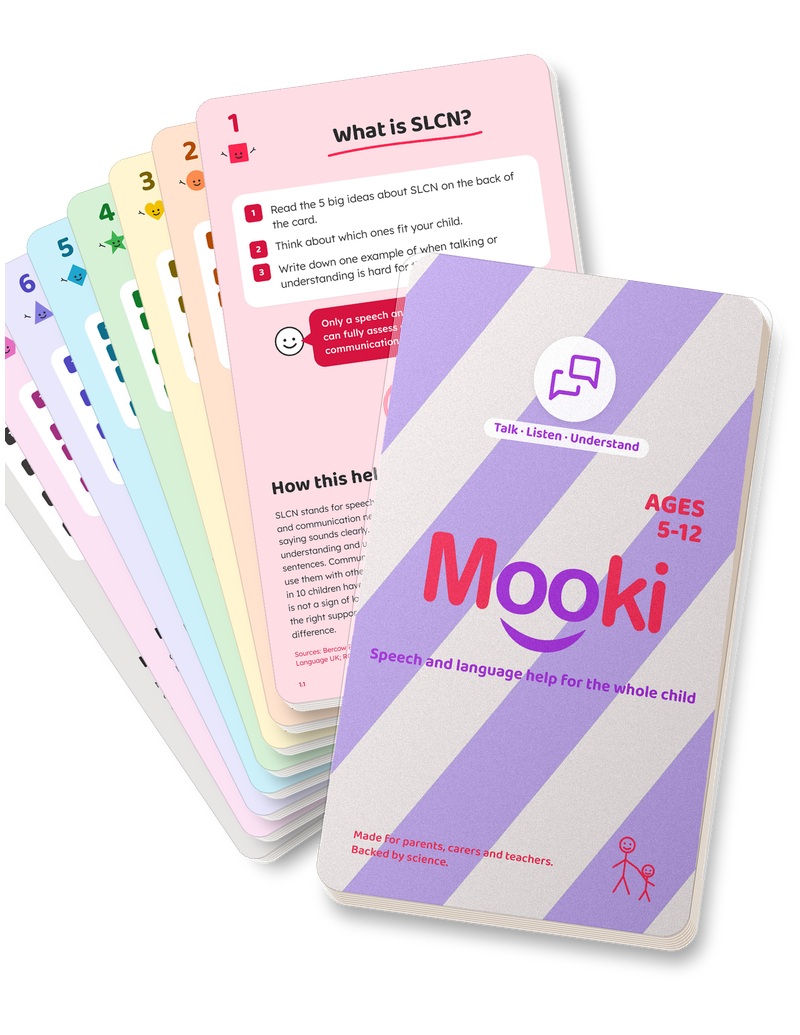
Want an easy way to check your child's progress?
Spot the Signs gives you a simple checklist to track your child's talking, and Sound Play builds listening and speech skills through games. It's one of 56 ten-minute activities in the Speech and Language deck.
Instant download · use on a phone or tablet, or print and fill in at home or school
Try it today: 10 minutes of sound play
Sound play builds the listening and speech skills behind these milestones. Try this with children aged 2 to 5.
- Animal noises (3 minutes). Hold up toy animals or pictures. Make the sound together: “moo”, “baa”, “ssss” for a snake.
- Rhyme time (3 minutes). Say pairs of words: “cat, hat”. Ask, “Do they sound the same at the end?” Older children can find their own.
- Clap it out (4 minutes). Clap the beats in names and words: “Ra-chel” is two claps, “but-ter-fly” is three.
Keep it light and silly. If your child gets a sound wrong, just say it back the right way, cheerfully.
When to seek advice
Trust your instincts. You know your child best. Ask for advice if your child:
- isn’t babbling or responding to sounds by 1 year
- isn’t using any words by 18 months
- isn’t joining two words together by age 2
- is very hard for family to understand by age 3
- has stopped using words or skills they used to have
- gets very frustrated or upset when trying to communicate
Who to talk to in the UK
Speak to your health visitor or GP. In many areas, you can also refer your child to NHS speech and language therapy yourself. The NHS guide to helping your child talk has tips for each age, and Speech and Language UK has detailed ages and stages guides.
Who to talk to in the US
Speak to your pediatrician at your child’s next well visit, or sooner if you’re worried. You can also use ASHA’s developmental milestones to start the conversation. For children under 3, you can contact your state’s Early Intervention program directly. From age 3, your public school district can evaluate your child.
The bottom line
A speech and language development chart is a helpful guide, but every child is different. Use it to notice and celebrate progress, and to check in with a professional if something doesn’t feel right. Asking early is never a waste of anyone’s time. Small, playful moments of talking together every day make a big difference.