
If you are wondering about 2 year old autism signs in your own toddler, this guide explains what to look for in language, play, senses and routines, what is just typical toddler behaviour, and the next steps in the UK and US.
Two is a busy, loud and wonderful age. It is also the age when many parents first wonder about autism. Toddlers are not small adults, and lots of “difficult” behaviour is completely normal. So how do you tell the difference? Let’s look at it together.
Free 10-minute course
Autism sensory needs
Find out what helps their senses, in 3 short activities. 10 minutes a day, with free printable worksheets.
Why age two matters
By two, most children are starting to combine words, copy adults and show you things they find exciting. These social skills make differences easier to notice.
The CDC says that by age two, a diagnosis from an experienced professional can be considered reliable. The American Academy of Pediatrics recommends autism screening for all children at 18 and 24 months. In the UK, the health visitor’s 2 to 2 and a half year review looks at speech, play and social skills.
2 year old autism symptoms: what to look for
The NHS list of signs of autism in children groups signs into communication, behaviour and play, and sensory differences. Here’s what that can look like at two.
Language and communication
- Few words, or words used to label things (“car”, “ball”) but rarely to ask for things
- Repeating words or phrases they have heard, sometimes from TV
- Not responding to their name, even though hearing is fine
- Leading your hand to what they want instead of pointing
- Not pointing to show you something interesting
Play and social interaction
- Little interest in other children
- Playing with toys in the same way each time, such as spinning wheels or lining things up
- Little pretend play, like feeding a doll or “cooking”
- Not noticing when you are hurt or upset. The CDC lists this as a sign by 24 months.
Sensory differences
- Covering ears at everyday sounds, like the hand dryer or the hoover
- Strong dislike of certain clothes, labels or textures
- Eating only a small number of foods
- Seeking movement or pressure, such as spinning, crashing or squeezing
Routines and repeated movements
- Big distress at small changes, like a new route to the shops
- Repeated movements, like hand flapping or rocking, often called stimming
- Strong attachment to one object or topic
What is typical toddler behaviour?
This is the part that reassures many parents. Some things look like autism signs but are very common at two.
| Common at two | Worth a closer look |
|---|---|
| Tantrums when tired or told “no” | Long, intense distress over very small changes |
| Liking the same bedtime story every night | Distress if any part of a routine changes |
| Playing alone some of the time | Rarely sharing interest or showing you things |
| Fussy eating phases | Eating only a few foods with strong reactions to textures |
| Learning new words at their own pace | Very few words, or losing words they used to say |
The key question is not “Does my child do this?” but “Does my child also share, point, copy and connect with me?” Autism is about a pattern, not one behaviour.
A note on the 2.5 year old and 26 month old
Between 26 and 30 months, language usually grows quickly. If your child is not yet joining two words together, rarely points to share, or has lost words they had, this is a good time to ask for a check. Any loss of skills, at any age, should be seen by a doctor.
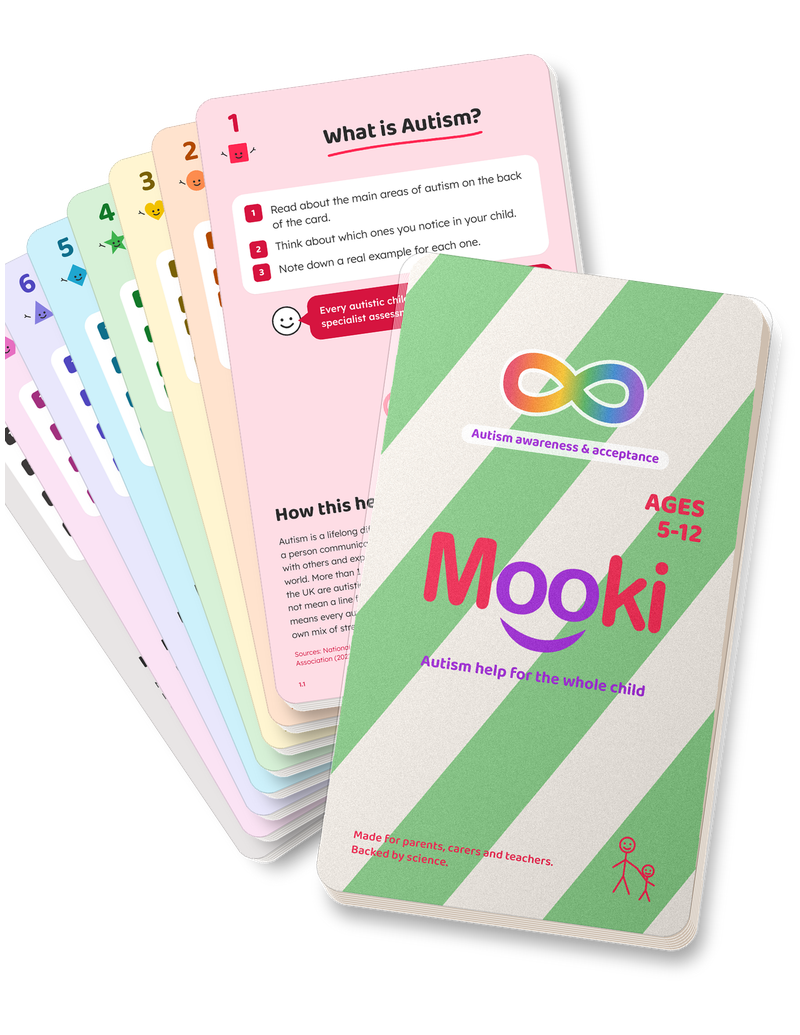
Ready for gentle ways to connect and understand?
As your child grows, Mooki's Spot the Signs, Sensory Detective and Getting Assessed cards help you notice patterns and plan support. Each is one of 56 ten-minute activities in the Autism deck.
Instant download · use on a phone or tablet, or print and fill in at home or school
Try it today: a 10-minute “join in” game
This simple connection game is in the same spirit as Mooki’s activity cards. It follows your child’s lead, which helps every two-year-old feel seen.
- Watch what your child is doing right now, such as rolling a car.
- Get your own car and copy exactly what they do, side by side.
- Add a fun sound: “Brrrm!” Then pause.
- Wait and watch. Do they look at you, smile or copy your sound?
- If they move away, follow gently. Don’t force eye contact.
- Stop after ten minutes or sooner if they’ve had enough.
Notice what made your child look up or laugh. Those moments are the building blocks of connection, and good notes for any appointment.
Next steps: UK and US referral routes
You don’t need to be sure before you ask. Professionals would much rather see a child who turns out to be fine than miss a child who needs support.
In the UK
- Talk to your health visitor or GP. Share your notes and examples.
- Ask about a referral to your local child development or autism team. The NHS autism assessments page explains the process.
- If your child goes to nursery, speak to the setting’s SENCo. Nurseries can start support without a diagnosis.
- Ask for a hearing check if your child doesn’t respond to sounds.
The NHS says it can take a few months or longer to get an assessment, so it helps to ask early.
In the US
- Talk to your pediatrician and ask for an autism screen, even if it’s not a routine visit.
- Ask for a referral to a developmental pediatrician or psychologist if concerns remain.
- Contact your state’s early intervention program for children under three. The CDC explains that you don’t need a doctor’s referral, and services are free or low cost for children who qualify.
- The AAP’s guide to next steps explains what happens while you wait.
Supporting your 2 year old with autism
Whether or not your child has a diagnosis, these ideas help:
- Use short, simple words and gestures together.
- Show a picture of what is coming next.
- Give warnings before changes.
- Notice and respect sensory needs, such as a quieter room.
- Build on what your child loves. Interests are a great way in.
If you’re worried, talk to your GP or paediatrician, or your child’s nursery.
The bottom line
Many two-year-olds have tantrums, fussy eating and strong opinions. Autism is about a pattern across communication, play and senses. If you see that pattern, or any loss of skills, ask for a check. Early support is gentle, playful and built around your child.