How do you create a calming SEND classroom? Here’s how to set up a calm, low-clutter room with calming displays, a quiet corner that pupils actually use, a 10-minute sensory walk to try today, and how to keep it working all year.
A calm classroom isn’t just nice to have. For many pupils with autism, ADHD, anxiety or sensory differences, a busy, noisy room makes learning much harder. Bright walls, buzzing lights and constant noise can use up the energy they need for learning.
The good news is that a calming classroom doesn’t need a big budget. The Sensory-Friendly Spaces and Quiet Space cards in the Mooki Autism deck walk you through it step by step.
Why does a calm classroom matter for SEND pupils?
Many autistic pupils process sensory information differently. The National Autistic Society explains that some people are over-sensitive to things like light, noise or touch, while others are under-sensitive and seek out more input. It lists schools as a common challenge, with busy corridors, loud playgrounds and bright lighting.
Pupils with ADHD or anxiety can also find a busy room hard. Too much going on makes it harder to focus and easier to feel overwhelmed. A 2014 study from Carnegie Mellon University found that young children in a heavily decorated classroom were more distracted and learned less than in a plainer room.
How to create a calming SEND classroom
Start with the room as a whole. Small changes help all pupils, not just those with SEND:
- Cut the clutter – clear surfaces, closed storage and labelled boxes
- Calm the walls – keep displays to a few key areas, and leave some wall space plain
- Soften the light – use daylight where you can, and turn off flickering or buzzing lights
- Lower the noise – felt pads on chair legs, soft furnishings and a “quiet voices” signal
- Keep things in the same place – pupils feel safer when they know where everything is
- Show the day – a visual timetable at the front, at pupil eye level
Calming displays for a SEND classroom
Displays should help learning, not compete with it. Try to:
- use calm, muted colours like soft green, blue or cream for backgrounds
- keep the front of the room, where pupils look most, the plainest
- put working walls to the side, with only what’s needed for the current topic
- use clear fonts and plenty of space around words
- include a feelings display, like a calm “How am I feeling?” chart pupils can point to
Set up a calm corner pupils actually use
A calm corner (or quiet space) is a small area where a pupil can go to calm down before things build up. To make it work:
- make it cosy, not exciting – a beanbag, cushion or tent, soft light and a few calming objects
- add a calm-down kit – ear defenders, a fidget, a timer and breathing cards
- teach it when calm – show pupils how and when to use it on a good day, not in a crisis
- use a simple signal – a card or hand sign to ask to go, so pupils don’t need to explain
- set a time – use a sand timer, then a clear way back, like “back to my seat, then next task”
- never use it as punishment – it’s a safe place, not a naughty corner
Our guide to creating a calm corner has more ideas, and the 3-3-3 rule is a quick grounding trick to add to your calm-down kit.
Try it today: in class – a 10-minute sensory walk
Do this after school, or with a pupil who can tell you how the room feels.
- Stand where they sit (2 minutes). Sit in the seat of a pupil who finds the room hard. What can you see, hear and smell from there?
- Look (2 minutes). Count how many displays, colours and moving things you can see from that seat. Note anything bright or flickering.
- Listen (2 minutes). Close your eyes. List every sound: the projector, the corridor, the radiator, the clock.
- Pick 3 changes (2 minutes). Choose three small changes, like moving the seat, turning off one light, or taking down one display.
- Check back (2 minutes). After a week, ask the pupil, “Is the room easier now?” Use a simple 1 to 5 scale or faces.
Want a ready-made plan for a calmer classroom?
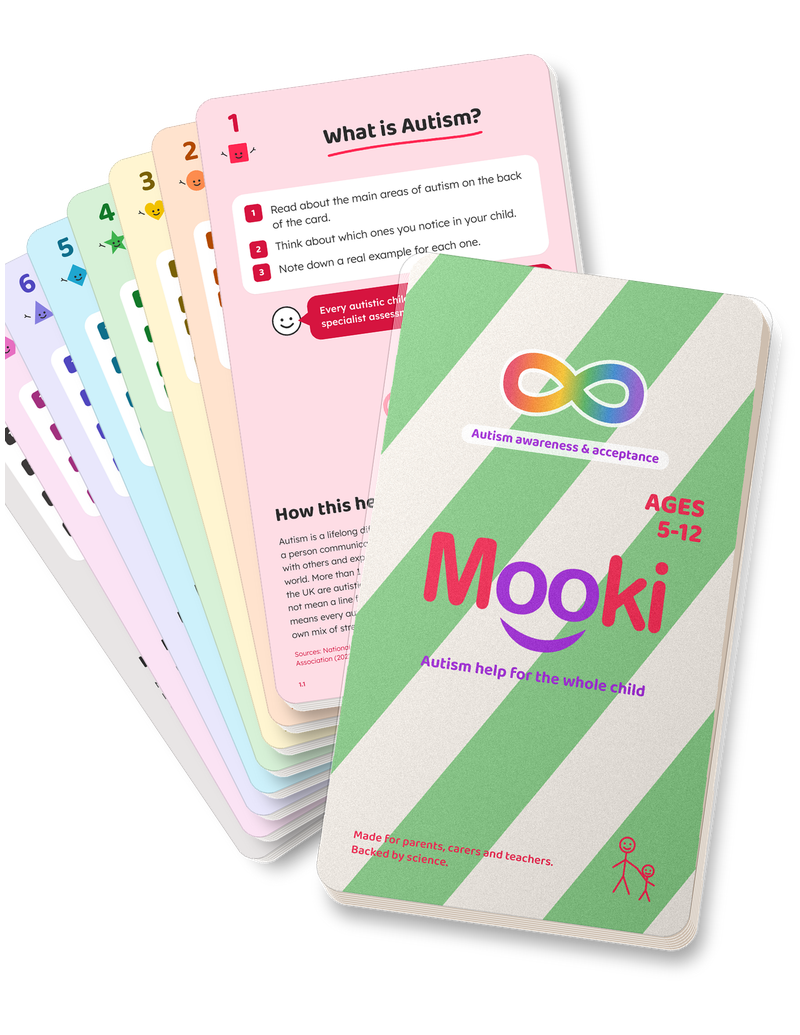
The Sensory-Friendly Spaces, Quiet Space and Sensory Detective cards help you spot what’s overwhelming pupils and set up a calm space that works. Each is one of 56 ten-minute activities in the Mooki Autism deck. For anxious pupils, add the Calm Down Kit card from the Mooki Anxiety deck.
Instant download · use on a phone, tablet or class whiteboard, or print for your pupils
Keeping a calm classroom calm
A calm room is also about routines. Try:
- a calm, predictable start to each day, like soft music and a quiet task
- warnings before changes and transitions
- regular movement breaks, so pupils don’t need to seek them out
- one calm signal for “stop and look”, used the same way every time
Our guide to helping a pupil with autism and ADHD stay focused has more ideas for planned breaks.
Working with parents
Ask parents what calms their child at home. It might be a song, a smell, a soft toy, a fidget or a favourite topic. Many of these can go into the calm-down kit. Share what works in class too, so home and school can use the same calming words and tools.
When to involve the SENCo or outside help
Talk to your SENCo (special education teacher in the US) if a pupil:
- is often overwhelmed, even after changes to the room
- covers their ears, hides or runs out of class
- seeks out a lot of movement or touch, in a way that isn’t safe
An occupational therapist can assess sensory needs and suggest ideas for the classroom.
Read next: Coping skills for kids with anxiety
The bottom line
A calming SEND classroom has less clutter, softer light, lower noise, clear routines and a calm corner pupils trust. It helps every pupil, not just those with SEND. You know your class best. For ready-made steps, the Mooki Autism deck has 56 ten-minute cards, including Sensory-Friendly Spaces and Quiet Space.