If maths homework ends in tears, slammed doors or a child hiding under the table, you’re not alone. This maths homework help guide gives you calm routines, ways to break tasks down and clear signs it’s time to talk to the teacher.
Homework battles are exhausting for everyone. The aim is not a perfect worksheet. It is a child who feels safe enough to try, and a parent who doesn’t dread the evening.
Why does my child cry over maths homework?
When a child cries over maths homework, there is usually a reason behind it. Common ones include:
- The work is too hard. The method made sense in class but has gone by home time.
- Tiredness. After a full school day, there is little left in the tank.
- Worry. Maths anxiety is real. The University of Cambridge report on maths anxiety found it is present from a young age, and that anxious children were more likely to talk about physical feelings in maths lessons.
- A learning difference. Some children have dyscalculia or another reason for finding maths (math) hard. The British Dyslexia Association lists several causes of maths difficulty, including dyslexia, ADHD and maths anxiety.
None of these is about being lazy. Spotting the reason helps you choose the right kind of help.
Try it today: a calm homework routine
A predictable routine takes a lot of the fight out of homework. Try this for the next week.
- Snack and break first. Give 20 to 30 minutes to eat, move and chat before any work.
- Same time, same place. A clear table with a pencil, rubber, ruler and some counters or a number line.
- Two-minute warm-up. Start with something easy your child can do, like counting in tens or a quick dice game.
- Set a timer. Agree a short burst, such as 10 minutes, then a movement break.
- Finish with praise. Name one thing they did well, such as “You kept going on that tricky one.”
If your child is already upset, stop and help them calm down first. A few slow breaths together, or a glass of water, will do more good than pushing on.
Want a calm start to maths homework?
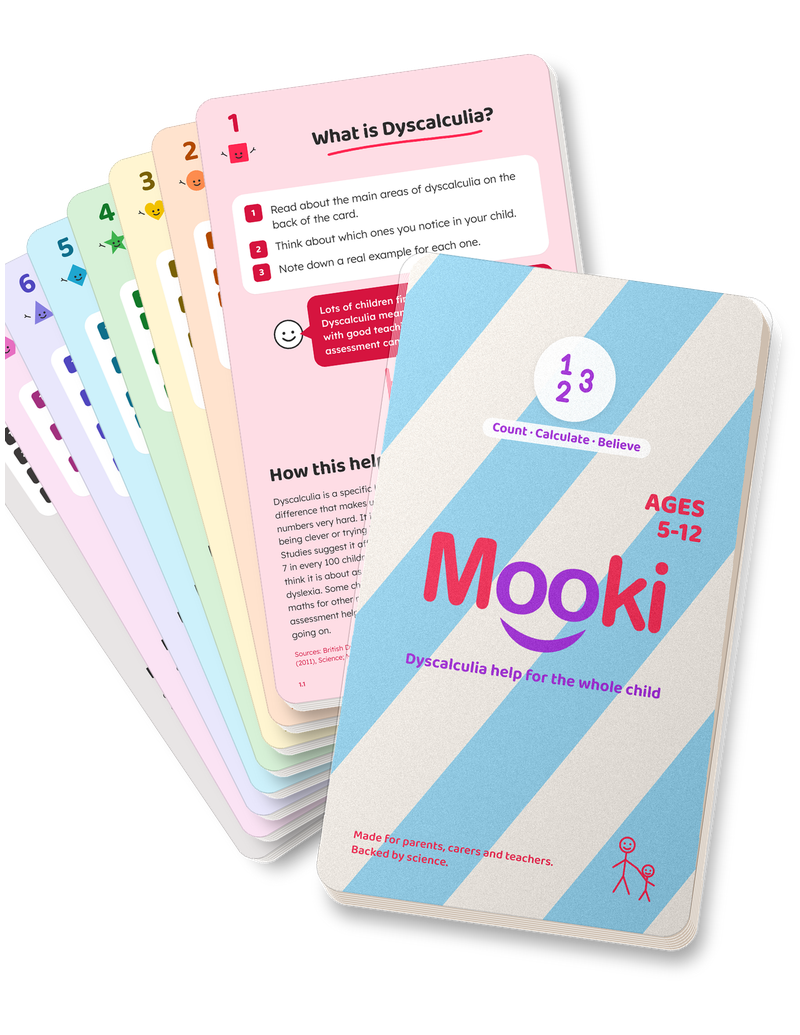
Calm Before Maths is a short warm-up to settle before starting, and Homework Helpers sets up a routine that works. Each is one of 56 ten-minute activities in the Dyscalculia deck.
Instant download · use on a phone or tablet, or print and fill in at home or school
How to help your child with maths homework
Your role is to be a calm coach, not the teacher. These steps help you support without taking over.
Break the task down
A full worksheet can feel like a mountain. Fold it or cover it with paper so only one question shows at a time. Tick each one as it’s done.
For a long question, write the steps as a numbered list. This idea appears in Understood’s list of classroom supports for dyscalculia, along with covering other problems and using checklists.
Ask, don’t tell
- “What is the question asking you to find?”
- “Can you show me with the counters?”
- “What did your teacher do in class?”
- “Does your answer look about right?”
Make it concrete
Let your child use objects, drawings or a number line. These are not cheating. They help the idea make sense.
Homework battles: what to do in the moment
Even with a good routine, some evenings will go wrong. When your child melts down, the goal is to calm things, not to finish the sheet.
- Name the feeling. “This feels really hard right now. That’s OK.”
- Take a break. Five minutes away from the table, with a stretch or a run round the garden.
- Shrink the task. “Let’s just do the first two together, then stop.”
- Know when to stop. If nothing helps, put it away. A note to the teacher is better than an hour of distress.
Afterwards, when everyone is calm, have a short chat. Ask your child what made it hard and what might help next time. Children often have good ideas, such as doing maths before reading, or using a number line.
Mind your own maths feelings
Many parents feel uneasy about maths themselves, and that is completely understandable. It is worth knowing, though, that children pick up on it.
A University of Chicago study of 438 young children found that when parents who felt anxious about maths often helped with homework, their children learned less maths over the year. The answer is not to stop helping. It is to keep your tone calm and positive.
- Avoid saying “I was rubbish at maths too.”
- Try “Let’s work it out together” or “Mistakes help our brains learn.”
- If you are stuck, it is fine to say, “Let’s ask your teacher tomorrow.”
When to tell the teacher
Homework should be practice, not a battle. Write a short note or email to the teacher if:
- Homework regularly takes far longer than the school expects.
- Your child can’t start without you sitting beside them the whole time.
- Tears, headaches or tummy aches happen most nights.
- Your child seems far behind classmates in maths.
Teachers can shorten tasks, change the level or give extra help in school. Tell them what you tried and how long it took.
In the UK, you can ask to meet the SENCo. The gov.uk guide to special educational needs explains SEN support. In the US, you can ask about extra math help, or whether an IEP or 504 plan might be needed. If you’re worried, talk to your child’s school.
The bottom line
Maths homework doesn’t have to mean a nightly battle. A calm routine, small steps and a gentle “ask, don’t tell” approach can turn things round. And if it is still too hard, that is useful information for the teacher, not a failure on your part or your child’s.