
Autism in girls is often missed, because many autistic girls hide their differences to fit in. This guide explains the quieter signs to look for at home and school, what masking is, and how to get your concerns taken seriously.
Autistic girls are not “less autistic” than boys. Their autism can simply look different, and the picture many people have of autism was built mostly around boys. Many autistic people prefer identity-first language, so we say “autistic girls” here.
Why are autistic girls diagnosed later?
In the US, boys are identified as autistic more than three times as often as girls, according to the American Academy of Pediatrics. Part of that gap is likely to be girls who are missed.
There are a few reasons:
- Masking: many girls learn to copy others and hide their struggles.
- Socially accepted interests: an intense interest in horses, a band or a book series may not ring alarm bells.
- Quiet distress: some girls withdraw rather than show their stress loudly in class.
- Expectations: teachers and doctors may still picture autism as a “boy thing”. The National Autistic Society says many autistic women and girls are missed or misdiagnosed because of outdated stereotypes.
What is autism masking?
Masking (also called camouflaging) means hiding autistic traits to blend in. The NHS says autistic girls may copy other children’s behaviour, stay quiet in difficult situations and seem to cope socially. The NHS page on signs in adults adds that autistic women may hide their feelings. Boys can mask too.
Masking might look like:
- Studying classmates and copying their phrases, laugh or clothes.
- Rehearsing conversations in advance.
- Forcing eye contact even though it feels uncomfortable.
- Hiding stims, such as finger flicking or hair twirling, at school.
- Being the “quiet, good girl” who never causes a problem.
Masking takes a lot of energy. Over time it can lead to exhaustion, anxiety and low mood. The NHS notes that autistic girls may be more likely to have mental health problems such as anxiety, depression or an eating disorder.
Signs of autism in girls that are often missed
These signs on their own don’t mean a girl is autistic. Look for a pattern that has been there since early childhood. You could use this as a simple autism in girls checklist and jot down examples.
Friendships and social life
- One intense best friend, and great distress if that friendship ends.
- Joining in by copying or “scripting” play, or always choosing to be the teacher or the baby.
- Prefers adults or younger children.
- Exhausted and needing time alone after social events.
- Finds group chats, unspoken rules and “girl drama” confusing.
Interests and routines
- Very deep interests that seem typical (animals, celebrities, fantasy books) but are unusually intense.
- Strong need to know the plan, and upset when it changes.
- Rules and fairness matter a lot.
Sensory and emotional signs
- Strong dislike of certain clothes, labels, food textures or noisy places.
- Stomach aches or headaches before school.
- Seems fine at school but falls apart at home.
- Struggles to name or describe feelings.
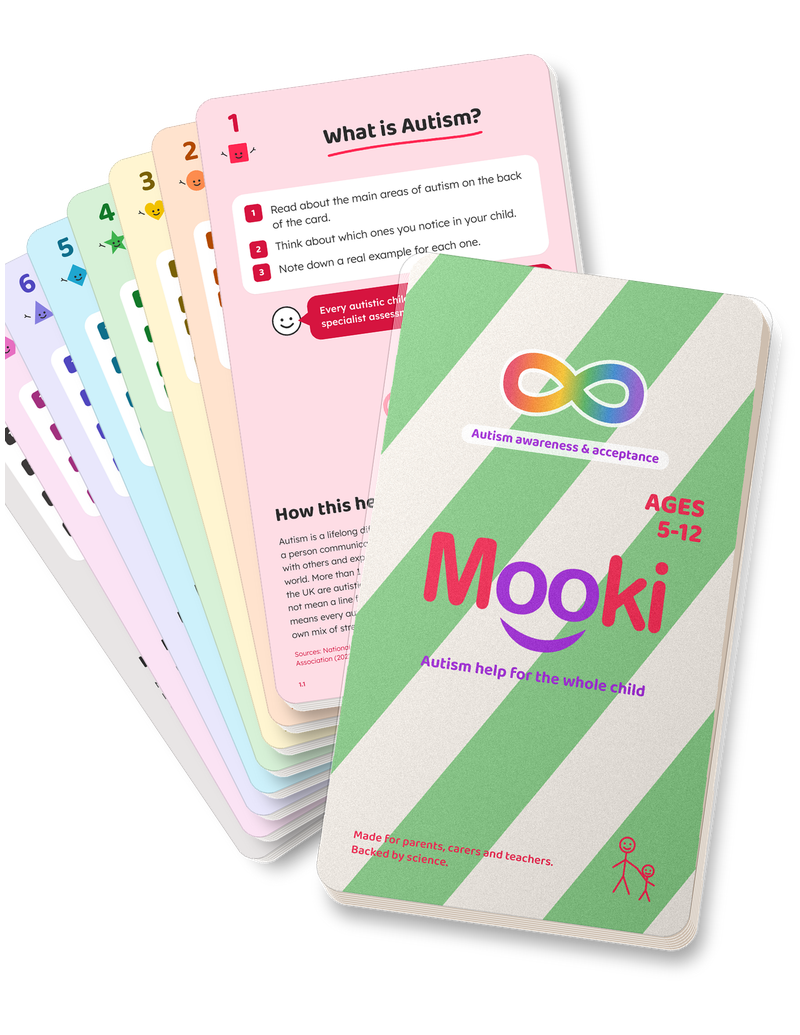
Is your daughter holding it all in at school?
Girls and Masking, My Energy Battery and Feelings Check-in help your child notice how she feels and recharge after school. Each is one of 56 ten-minute activities in the Mooki Autism deck.
Instant download · use on a phone or tablet, or print and fill in at home or school
After-school restraint collapse
Many parents of autistic girls say the same thing: “The school says she’s fine, but she explodes the moment she gets home.” This is sometimes called after-school restraint collapse. Your child has held it together all day, and home is where she feels safe enough to let go.
It is a sign of stress, not bad behaviour, and it is useful evidence. Keep a short diary of what happens and when, as this can help school and professionals see the whole picture.
Try it today: a 10-minute after-school decompress
This simple routine gives your child a soft landing after school.
- Snack and silence (3 minutes): offer food and a drink with no questions about the day.
- Choose a calm activity (4 minutes): drawing, a favourite book, a swing, or time with a pet.
- Feelings check (2 minutes): show three faces (happy, OK, worn out) and let her point.
- One kind line (1 minute): “Thanks for telling me. You worked hard today.”
Over a week or two, you’ll learn which days and subjects drain her most.
How to get taken seriously
Getting a referral can be harder for girls, because they may seem to cope well in short appointments. These steps help.
- Write it down: list specific examples from home and school, with dates. Include early childhood if you can.
- Mention masking directly: ask whether the professional has experience assessing girls.
- Ask school for their view: a teacher or SENCo may notice quiet signs too, such as being isolated at break.
- Don’t wait for a diagnosis to get support: school support should be based on need. In England, SEN support can start through the class teacher and SENCo.
In the UK, your GP or school can refer your child to the local autism team. The NHS explains that if you disagree with the outcome of an autism assessment you can ask for a second opinion. NICE guidance on recognising autism in children is used by professionals across England.
In the US, start with your pediatrician, who can refer you to a developmental specialist. You can also ask your school district for an evaluation for support at school.
YoungMinds has helpful advice if your daughter is anxious or low while you wait.
If you’re worried, talk to your GP or paediatrician, or your child’s school.
The bottom line
Autism in girls is real, common and often hidden behind a lot of hard work. Trust what you see at home, write it down, and ask for help early. With understanding and the right support, autistic girls can stop exhausting themselves trying to fit in, and start feeling proud of who they are.


