
If your child is starting school and you’ve noticed possible 4 year old autism symptoms, or your 5 year old is finding school harder than expected, this guide explains the signs that often appear at school entry and how to work with the class teacher.
Starting school is a huge change for any child. New rooms, new adults, new rules, lots of noise and a long day. For some children, this is the moment when autism signs that were quiet at home become much clearer. Here’s what to look for and what to do.
Free 10-minute course
Help an autistic child cope with change
Now and Next, visual timetables and countdowns, in 3 short activities. 10 minutes a day, with free printable worksheets.
Why autism signs often appear when school starts
In the UK, most children start Reception, the first year of primary school, in the September after they turn four. In the US, children usually start kindergarten at five. Either way, school asks a lot more of a child socially than home or nursery.
Children now need to sit on the carpet, follow group instructions, cope with busy lunch halls and make friends with new people. Autistic children who managed well in a smaller setting may start to struggle. The CDC lists signs such as not pretending to be someone else in play by four, and not singing, dancing or acting for you by five.
4 year old autism signs: what to look for
Friendships
- Wanting friends but not knowing how to join in
- Playing alongside others rather than with them
- Controlling games, or getting upset when others change the rules
- Preferring adults or much older or younger children
- Finding it hard to read faces or tone of voice
Transitions
- Strong distress when moving between activities, like from play to lunch
- Upset at changes such as a supply teacher or a cancelled PE lesson
- Struggling with the start and end of the day
- Needing lots of warning before anything new
Sensory overload
The school day is full of sound, light, smells and bodies. The National Autistic Society explains that sensory overload happens when a child takes in more than they can process. You might see:
- Covering ears in assembly or the lunch hall
- Refusing to wear the school uniform, or certain parts of it
- Avoiding messy play, glue or paint
- Running off, hiding or shutting down in busy times
- Being exhausted and “flat” after school
5 year old autism symptoms: the masking puzzle
When parents of a 5 year old with autism look back, one of the most common things they say is: “School says they’re fine, but at home it’s a different story.”
This is often linked to masking. The National Autistic Society explains that autistic children may hide their differences at school to fit in, by copying others or holding in distress. Then, once they are home and feel safe, it all comes out. This can look like meltdowns, tears, silence or refusing to talk about the day.
Masking is tiring. It is not “bad behaviour at home”, and it is not your fault. The NAS notes that this gap between school and home can lead to parents being wrongly blamed.
Autistic girls are especially likely to mask. The NAS guide to autistic girls explains that their differences are often missed, partly because they are more likely to mask and their interests may look similar to other children’s. Boys can mask too.
4 year old mild autism: quieter signs
Some children have quieter signs that are easy to miss, such as:
- Speaking very well but taking everything literally
- Following rules strictly and being upset when others don’t
- Being described as “shy”, “sensible” or “a bit of a worrier”
- Having one very deep interest
- Being very tired or anxious about school, without being able to say why
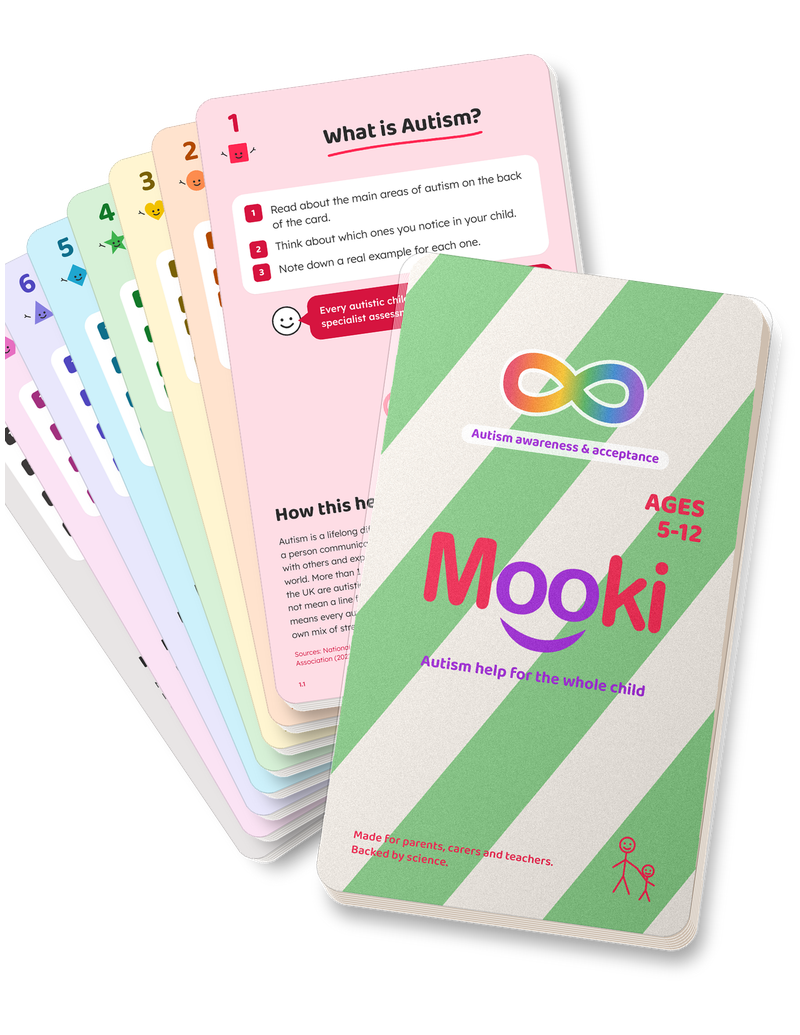
Want calmer mornings and smoother changes?
Mooki's Countdown to Change, Ready Bag and Girls and Masking cards help with school starts, transitions and hidden struggles. Each is one of 56 ten-minute activities in the Autism deck.
Instant download · use on a phone or tablet, or print and fill in at home or school
Try it today: a 10-minute calm start
Mornings are often the hardest part of the school day. This simple routine can help.
- The night before, lay out uniform and pack the bag together. Use a picture checklist so your child can tick each item.
- In the morning, show a simple visual plan: wake up, breakfast, dress, shoes, car, school.
- Give countdowns before each change: “Five minutes until shoes.”
- Build in a calm moment: two minutes of a favourite song, a cuddle, or squeezing a soft toy.
- At the gate, use the same short goodbye each day: “Have a good day. See you at three.”
After school, plan quiet time before questions. A snack, a quiet space and no pressure to talk can make the evening much calmer.
How to work with the class teacher
You and your child’s teacher are on the same team. Here’s how to make it work.
- Ask for a short meeting early, not just at parents’ evening.
- Share what you see at home, including after-school meltdowns. Teachers may not see them.
- Share what helps: warnings before changes, a quiet space, a visual timetable, ear defenders.
- Agree a simple way to keep in touch, such as a home-school diary or a short weekly email.
- Ask what they see, especially at lunch, break and transitions.
In the UK
Ask to speak to the school’s SENCo. The school can give SEN support without a diagnosis, such as a visual timetable, a quiet area or help at lunchtime. The NHS guide to supporting an autistic child has more ideas. Talk to your GP about a referral for assessment if you are concerned. Some children later need an education, health and care plan (EHCP), which is requested from your local council.
In the US
Talk to your child’s teacher and your pediatrician. You can ask the school in writing for an evaluation for special education. Your child may qualify for an IEP, which includes specialized teaching, or a 504 plan, which gives accommodations like a quiet space. Understood.org explains the difference clearly.
If you’re worried, talk to your GP or paediatrician, or your child’s school.
The bottom line
Starting school is a big step, and it often brings autism signs into focus. If your child is struggling with friendships, changes or noise, or is falling apart after school, trust what you see. Work with the teacher, ask for support early, and give your child calm time to recharge. With the right understanding, school can become a place where your child feels safe and does well.