This guide is for parents who want to understand how a speech and language therapist in schools supports pupils, and how to make the most of it. You’ll learn who does what, how support works in the UK and US, what to ask for and how to carry on the work at home.
Many children get help with talking, listening and understanding at school, not just in a clinic. Knowing how it works helps you ask the right questions and work as a team.
What does a speech and language therapist do in school?
A speech and language therapist (SLT) is trained to assess and support children’s communication. In the US, they’re called speech-language pathologists (SLPs). In school, their role usually includes:
- Assessing your child’s speech, language and communication.
- Setting targets (goals) that matter for learning and friendships.
- Working with children one-to-one or in small groups.
- Training staff, such as teachers and teaching assistants, to use helpful strategies every day.
- Advising on classroom changes, such as visuals, shorter instructions and extra thinking time.
- Reviewing progress and updating targets.
The Royal College of Speech and Language Therapists describes SLTs in schools training staff, helping to make the setting “communication friendly”, and working with whole classes, small groups or single pupils.
In many UK schools, the SLT sees a child less often and writes a programme that a trained teaching assistant delivers between visits. You might hear this person called a speech and language teaching assistant. This means your child can practise little and often, which is how new skills stick.
Try it today: turn a school target into home practice
The best progress happens when home and school use the same targets. Here’s a simple 10-minute routine.
- Ask the school for your child’s current speech and language target, in plain words.
- Pick one everyday moment to practise, such as snack time, a walk or bath time.
- Show your child the skill first. For example, if the target is “using ‘and’ to join ideas”, say “I’ve got a banana and a biscuit.”
- Give your child a turn. Praise the effort: “Great joining!”
- Jot down one line about how it went and share it with school each week.
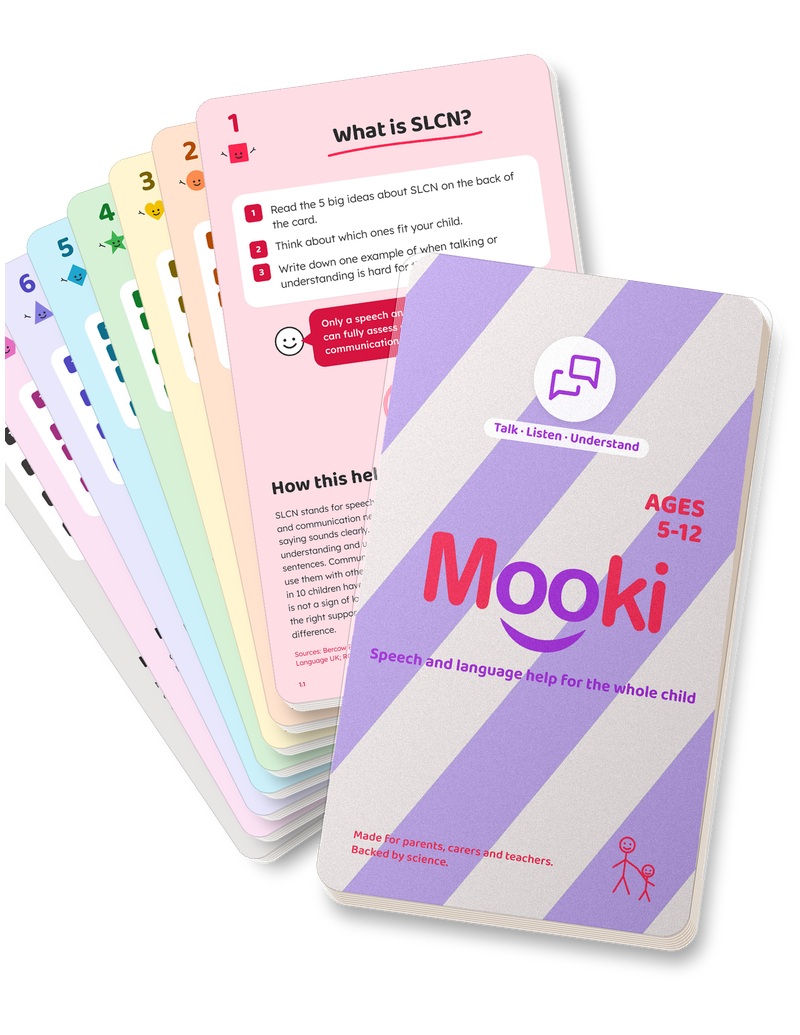
Want home and school working as one team?
Our Talk to School and Support Plan cards help you prepare for meetings and agree clear targets together. They're two of 56 ten-minute activities in the Mooki Cards Speech and Language deck.
Instant download · use on a phone or tablet, or print and fill in at home or school
How speech and language support works in UK schools
In England, the GOV.UK guide to special educational needs says support in school can include speech therapy. There are two main levels.
SEN support
Most children with speech, language and communication needs get help through SEN support. The school works with you to plan support, try it and review it. IPSEA, the special education advice charity, says schools should meet parents at least three times a year to talk about their child’s needs and progress.
Your first contact is usually your child’s class teacher and the SENCo (special educational needs co-ordinator). Speech and language therapy might come from the local NHS service, or from a therapist the school pays for.
EHCP
If your child needs more help than SEN support can give, you can ask the local council for an EHC (education, health and care) needs assessment. The GOV.UK page on EHC plans explains that anyone, including parents and teachers, can ask for this. An EHCP sets out your child’s needs and the support they must get.
The rules in Wales, Scotland and Northern Ireland are a little different, so check with your school or local council.
How school speech-language services work in the US
In the US, speech-language therapy in public schools usually comes through IDEA, the federal special education law. The American Speech-Language-Hearing Association (ASHA) describes a range of school services, from support for the whole class to individual help.
- Evaluation: You can ask your school district to evaluate your child. For children under 3, contact your state’s early intervention programme instead.
- IEP: If your child qualifies, they get an IEP (Individualized Education Program). Understood.org explains that an IEP can include related services such as speech-language therapy.
- Related services: The Center for Parent Information and Resources says the IEP must set out the services, including how much and how often. Schools can’t charge parents for related services in the IEP.
- 504 plan: Some children don’t need an IEP but do need changes in class, such as extra time to answer. These can go in a 504 plan.
What to ask your school
It’s fine to ask questions. You’re part of the team. Useful questions include:
- What are my child’s speech and language targets, and why were they chosen?
- Who will work with my child, how often and for how long?
- Is the SLT working directly with my child, or training staff to do it?
- How will you measure progress, and when will we review it?
- What can we do at home to help?
- How will you support my child in class, not just in sessions?
If something isn’t clear, ask for it in writing. Keeping a simple folder of reports and emails makes meetings much easier.
Sharing goals between home and school
Speech and language therapy works best when everyone uses the same approach. Here are some easy ways to keep in touch:
- A home-school diary where you and staff jot down wins, worries and new words.
- Photos or a quick message about weekend news, so your child has something to talk about on Monday.
- Topic word lists from school, so you can use the same words at home.
- A short chat with the SLT when targets change.
Your knowledge of your child is valuable. Tell the school what works at home, what your child enjoys and what they find hard. If you’re worried about your child’s progress, talk to the class teacher or SENCo first. You can also talk to your GP or paediatrician.
The bottom line
A speech and language therapist in school can make a real difference, especially when home and school pull together. Learn your child’s targets, ask questions and practise little and often. Small, steady steps really do add up.