Does your child refuse to do homework, every single night? Here is why homework battles happen, a calm 10-minute routine to try tonight, and how to tell when it might be something more, such as ADHD.
You ask nicely. Then you ask again. Then the tears start (theirs, and sometimes yours). If homework has become the worst part of your evening, you are not alone, and you are not a bad parent.
Most children who refuse homework are not being lazy. Something is making it feel too hard to start. Find that “something”, and the battles get smaller.
Why does my child refuse to do homework?
Homework refusal usually has a reason underneath it. Common ones include:
- Tired brain – after 6 hours of school, many children have nothing left in the tank
- Can’t get started – the task feels too big, so they avoid it altogether
- Too hard – they don’t understand the work and don’t want to look “stupid”
- Too boring – some brains find it very hard to focus on things that don’t interest them
- Worry – fear of getting it wrong, or of upsetting you
- Hunger or screens – it is hard to leave a game for spelling practice
Think about your child. Which of these sounds most like them? That is where to start.

Try it today: a 10-minute “homework starter”
This routine takes away the hardest part for most children: getting started.
- Snack and move first (5 minutes). A drink, a snack and a quick run round the garden or a dance in the kitchen.
- Set up the same spot (1 minute). Same table, same pencil pot, no TV. Children find it easier to start when the place says “work”.
- Break it down (2 minutes). Together, split the homework into tiny steps. “Write your name and the date” counts as step one.
- Set a timer for 10 minutes. Tell your child they only have to work until the timer rings. Most children keep going once they have started.
- Praise the start, not the finish. “You sat down and started straight away. That was brilliant.”
Try it for one week. Write down which nights went well, and what was different.
Want more calm 10-minute ideas?
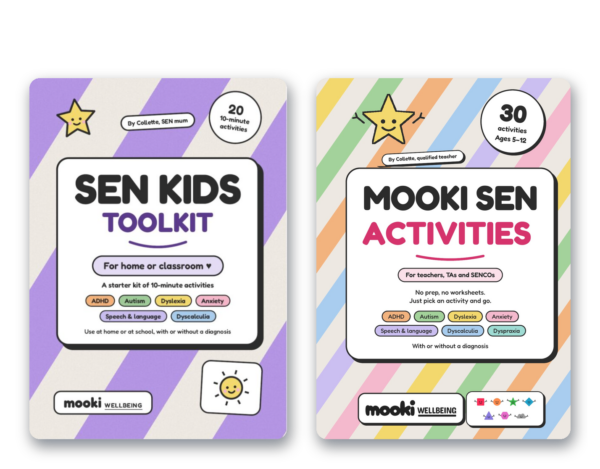
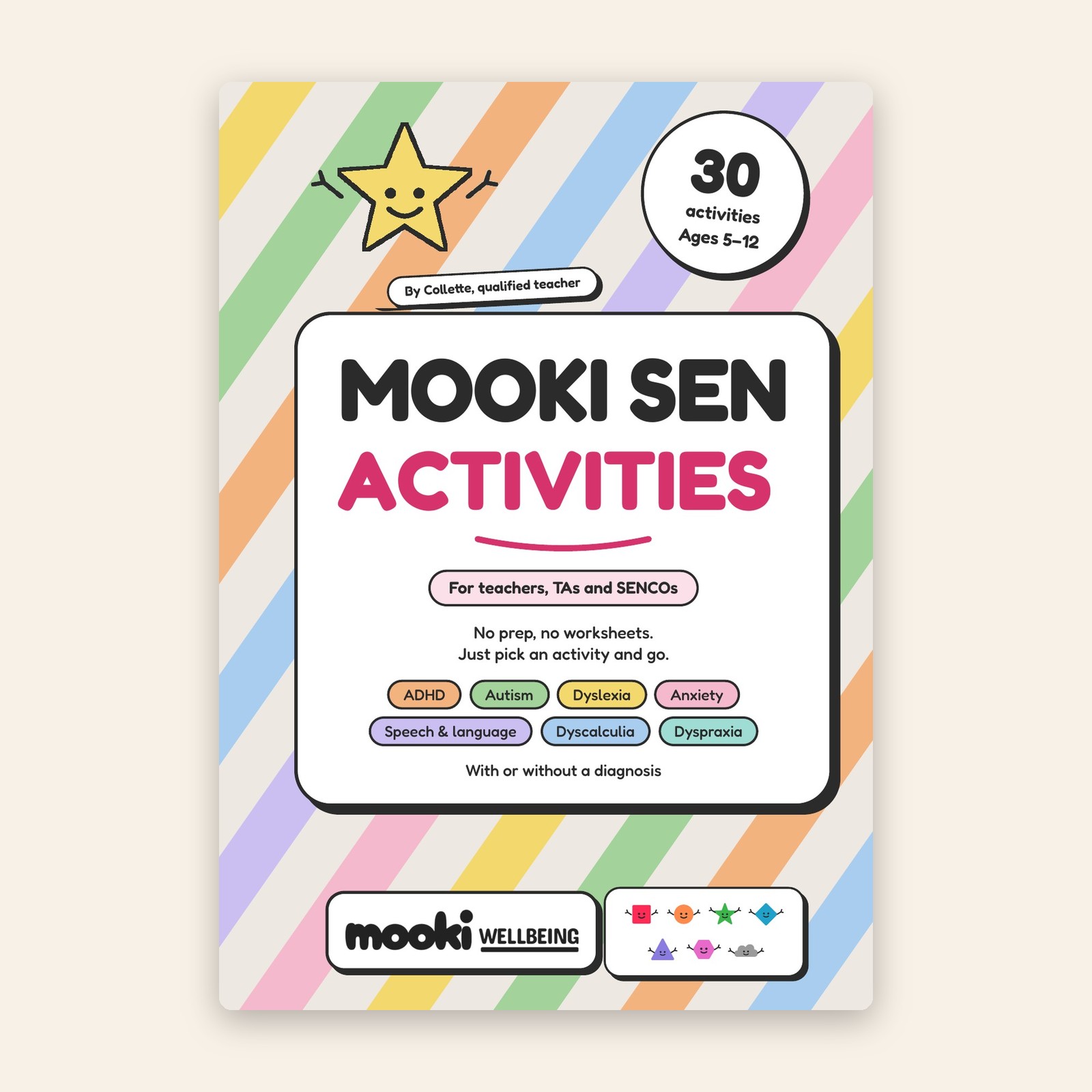
Mooki SEN Activities is one book with 30 hands-on, 10-minute activities for routines, focus, big feelings and fun ways to learn. It works for ADHD, autism, dyslexia and more, with or without a diagnosis.
Printed book or instant PDF · for home or school
More ways to stop the homework battle
The American Academy of Pediatrics homework tips for parents and CHADD’s guide to homework struggles suggest simple changes that help many children:
- Same time, every day – a fixed homework time stops the daily argument about “when”
- Use “When… then” – “When your reading is done, then you can play.” Calm, clear and fair
- Short bursts – 10 minutes of work, then a 2-minute movement break
- Sit nearby – being in the room helps many children stay on track, even if you are cooking
- One instruction at a time – “Get your book out” before “Open it at page 6”
- Talk to the teacher – if homework always takes far longer than it should, ask if it can be shortened
Our guide to ADHD advice for parents has 12 more calm strategies, including clear instructions and reward charts.
Could it be something more?
Lots of children dislike homework. That is normal. But sometimes homework refusal is a sign that a child needs extra help.
It may be worth looking more closely if, most days, for several weeks, at home and at school, your child:
- can’t get started on tasks, even ones they can do
- loses focus after a few minutes, unless it is something they love
- forgets what they were asked to do, or loses books and worksheets
- fidgets, gets up a lot or can’t sit still
- gets very upset or angry about small tasks
These can be signs of ADHD, which affects focus, planning and getting started. Read our guide to ADD and ADHD symptoms in children to learn more.
Homework refusal can also be linked to other things. A child who finds reading or maths very hard may avoid homework because of dyslexia or dyscalculia. A child who worries a lot may avoid it because of anxiety.
Many children who struggle with homework have no special educational needs at all. Only a professional can say what is going on, so this is not a diagnosis. But noticing the pattern is a great first step.
When to get help: UK and US
Keep a simple diary for 2 weeks. Write down when homework happened, how long it took and what helped. This gives school or a doctor a clear picture.
In the UK: talk to your child’s class teacher first, then the school SENCo (special educational needs coordinator). If you are worried about ADHD, your GP can talk to you about a referral. The NHS guide to ADHD in children explains what happens next.
In the US: talk to your child’s teacher and your pediatrician. You can ask the school for an evaluation, and if your child has ADHD, a 504 plan can include homework changes such as shorter assignments. The CDC’s ADHD pages explain how ADHD is diagnosed.
The bottom line
Most homework battles are about getting started, not about bad behaviour. Feed them, move them, break it down and praise the start. If the struggle carries on most days for weeks, talk to school. And for more calm, ready-made ideas, Mooki SEN Activities has 30 ten-minute activities to make tonight easier.