If your child is always “just five more minutes” and genuinely shocked when it is time to go, this guide is for you. It explains ADHD time blindness in children and gives you simple, visual tools that help at home and in class.
Time blindness is not a medical term. It is a handy way to describe something many families notice: children with ADHD often struggle to sense how much time has passed, or how long something will take.
What is time blindness?
Most of us have an inner clock. We feel roughly when ten minutes have gone by, and we plan around it. For many children with ADHD, that inner clock is quieter.
This can look like:
- Thinking a 30-minute task will take “two seconds”.
- Losing all track of time during a game or hobby.
- Not starting homework until the night before.
- Being late, even when they want to be on time.
- Getting upset when an activity ends “suddenly”.
It is not laziness or rudeness. ADHD affects the brain skills that help us plan, wait and keep track of what is coming next.
Why do children with ADHD struggle with time?
Young children all find time hard. A 5-year-old does not know how long “a week” is. But with ADHD, the gap is often bigger and lasts longer.
Some reasons:
- Now matters more than later. Children with ADHD are pulled strongly towards what is in front of them.
- Time is invisible. You cannot see a minute passing, so it is easy to forget it.
- Working memory is busy. Holding “I need to leave at 8:15” in mind while doing other things is hard.
- Hyperfocus. Deep focus on a favourite activity can make time disappear.
The good news is that we can make time visible. As ADHD coach Leslie Josel puts it in ADDitude, children need to see time to learn how to manage it.
Visual timers and clocks: make time something you can see
- Visual timers. A timer with a coloured disc that shrinks shows time running out. Your child does not need to read numbers.
- Analogue clocks. A clock face shows time moving in a way digital numbers do not. Put one in each room your child uses, including the bathroom.
- Sand timers. Great for short tasks like brushing teeth.
- Alarms with labels. A phone or speaker alarm that says “Shoes on now” is clearer than a beep.
Many parents in the ADDitude community also swear by visible clocks during screen time and warnings of how much time is left.

Want easy ways to make time visible?
Try Now and Next, Beat the Clock and Morning Routine from the Mooki ADHD deck. Each is one of 56 ten-minute activities, with simple adult steps and a chart or game for your child.
Instant download · use on a phone or tablet, or print and fill in at home or school
Try it today: a 10-minute “guess the time” game
This game helps your child build their inner clock.
- Pick three short tasks, such as putting shoes on, tidying five toys and pouring a drink.
- Ask your child to guess how long each will take. Write their guesses down.
- Time each task with a visual timer or phone.
- Compare the guesses with the real times. Laugh about the big misses.
- Try one task again and see if they can beat their time.
Play this a few times a week. Children slowly get better at guessing, and they enjoy beating the clock.
Now and next boards and countdowns
Now and next
A now and next board shows just two things: what is happening now, and what comes next. It cuts a long day into small, manageable steps. “Now: homework. Next: snack.”
Countdowns
Warn your child before changes. “Ten minutes until we leave.” Then “five minutes”, then “two minutes”. Pair the words with a visual timer so they can see it.
Picture routines
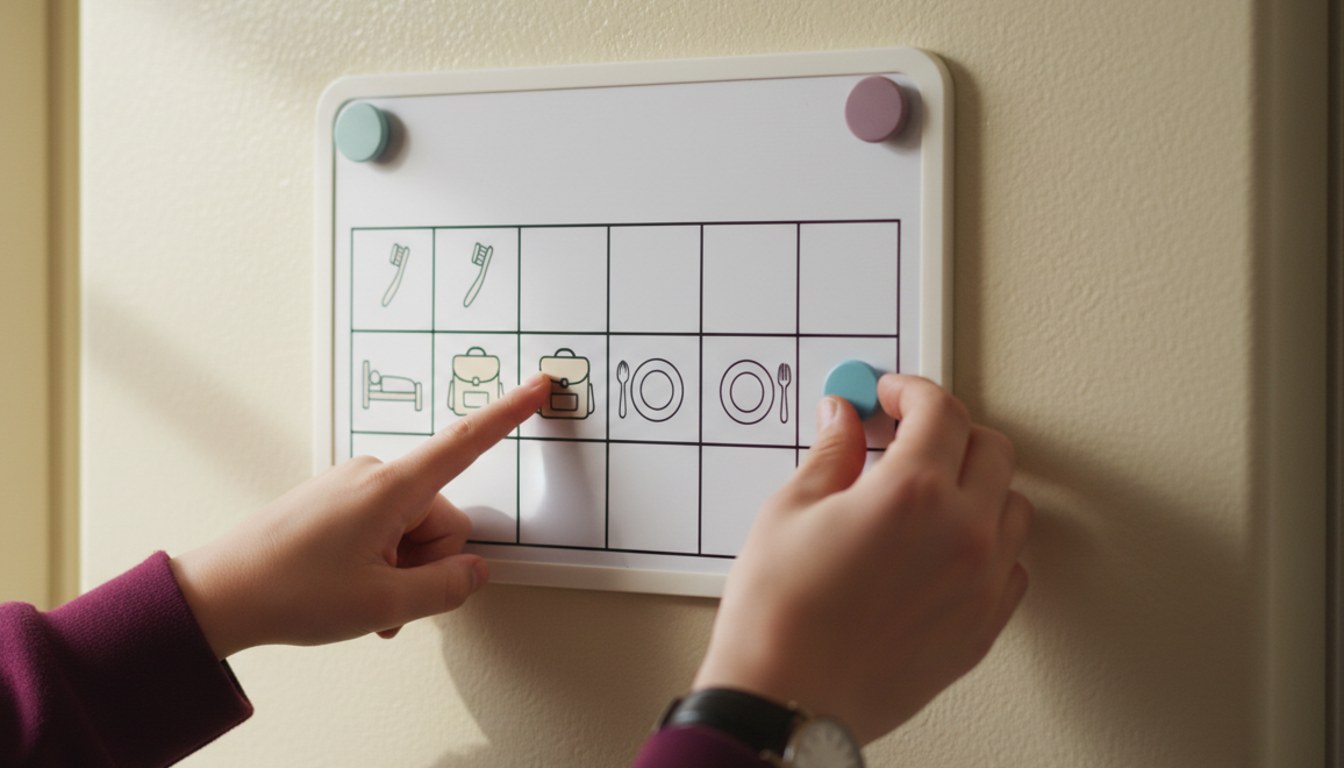
Break the morning or bedtime into steps with pictures. The NHS suggests writing a to-do list and putting it somewhere easy to see. The AAP also recommends written lists for daily tasks.
Helping with time at school
Teachers can use the same tools in class:
- A visual timer on the board during tasks.
- A now and next card on your child’s desk.
- Warnings before the end of a lesson or break.
- Breaking big tasks into chunks with mini deadlines.
- Checking in halfway through independent work.
UK guidance from NICE stresses changes to a child’s surroundings, at home and school, to reduce the impact of ADHD. In the UK, ask the SENCo whether these can go into your child’s SEN support plan. In the US, they can be written into a 504 plan or IEP.
If you’re worried about how ADHD is affecting your child’s day, talk to your GP or paediatrician, or your child’s school.
Homework, deadlines and planning ahead
Time blindness often shows up most with homework and projects. A task due “next Friday” can feel so far away that it does not feel real, until suddenly it is due tomorrow.
- Use a wall calendar. Write deadlines in big, bright letters and cross off each day together.
- Work backwards. Split a project into small steps, and give each step its own day.
- Plan short work sessions. Use a timer for 10 or 15 minutes of work, then a short movement break.
- Talk about time out loud. “We’ve got 20 minutes before dinner. That’s about one episode of your show.”
- Ask planning questions. “What’s your plan after school?” helps your child practise thinking ahead.
Over time, the aim is for your child to take on more of this planning themselves, with you there as a coach.
The bottom line
Time blindness is real, and it is not your child’s fault. By making time visible with timers, clocks, now and next boards and countdowns, you give your child the tools to manage it. With practice and patience, many children get better at feeling time.