
This guide is for parents and teachers who want to understand anxiety in kids aged 5 to 12, and to know what to say and do when worries take over.
Every child worries sometimes. Worry before a test, a new class or a trip to the dentist is a normal part of growing up. But for some kids, the worry is bigger, lasts longer and starts to get in the way of school, friends and family life. The good news is that anxiety in kids is common, well understood and treatable, and calm adults make a real difference.
What is anxiety in kids?
Anxiety is the body’s alarm system. When the brain thinks there is danger, it gets the body ready to fight, run or freeze. The heart beats faster, breathing speeds up and the tummy can feel tight or sick.
This alarm is useful when there is a real danger. In kids with anxiety, the alarm goes off too easily, too loudly or too often, even when they are safe. The NHS guide to anxiety in children says it becomes a concern when worry is strong, does not go away and starts to affect daily life.
A helpful way to explain anxiety for kids is: “Your worry alarm is trying to protect you, but sometimes it rings when there is no fire.”
How common is anxiety in kids?
Anxiety is one of the most common mental health difficulties in childhood, so you are far from alone.
- In the US, the CDC reports that around 11% of children aged 3 to 17 had a current diagnosis of anxiety in 2023 to 2024.
- In England, an NHS survey found that about one in five 8 to 16 year olds had a probable mental health condition in 2023. Anxiety is one part of that picture.
Many more children have worries that never reach a diagnosis but still make life harder. You don’t need a label to start helping.
The main kinds of worry
Anxiety can look different from child to child. The Child Mind Institute describes several kinds, including:
- Separation anxiety: strong worry about being apart from a parent or carer.
- Social anxiety: fear of being judged, embarrassed or watched by other people.
- Generalised anxiety: worry about lots of everyday things, such as schoolwork, health or being late.
- Specific fears (phobias): a very big fear of one thing, such as dogs, the dark or being sick.
- Selective mutism: a child who talks happily at home but cannot speak in some places, such as school.
Some children have more than one kind. Some autistic children and children with ADHD or learning differences also have anxiety, so it is worth keeping in mind for any child with SEN.
Try it today: a 10-minute feelings check-in
A short daily check-in helps children learn that feelings can be named, talked about and managed. Pick a calm time, such as after school snack or before bed.
- Draw a simple scale from 0 (calm) to 10 (huge worry). Ask your child to point to how they feel right now.
- Ask one open question: “What’s on your mind today?” Then listen. Try not to fix it straight away.
- Name the feeling back: “It sounds like you felt nervous when the teacher changed the groups.”
- Ask: “Where did you feel it in your body?” This builds awareness of tummy aches, tight chests and fast hearts.
- Do three slow breaths together, breathing in through the nose and out through the mouth.
- End with one thing that went well today.
Keep it light and short. The aim is a habit, not a big talk. Over time, your child gets better at noticing worry early, when it is easier to manage.
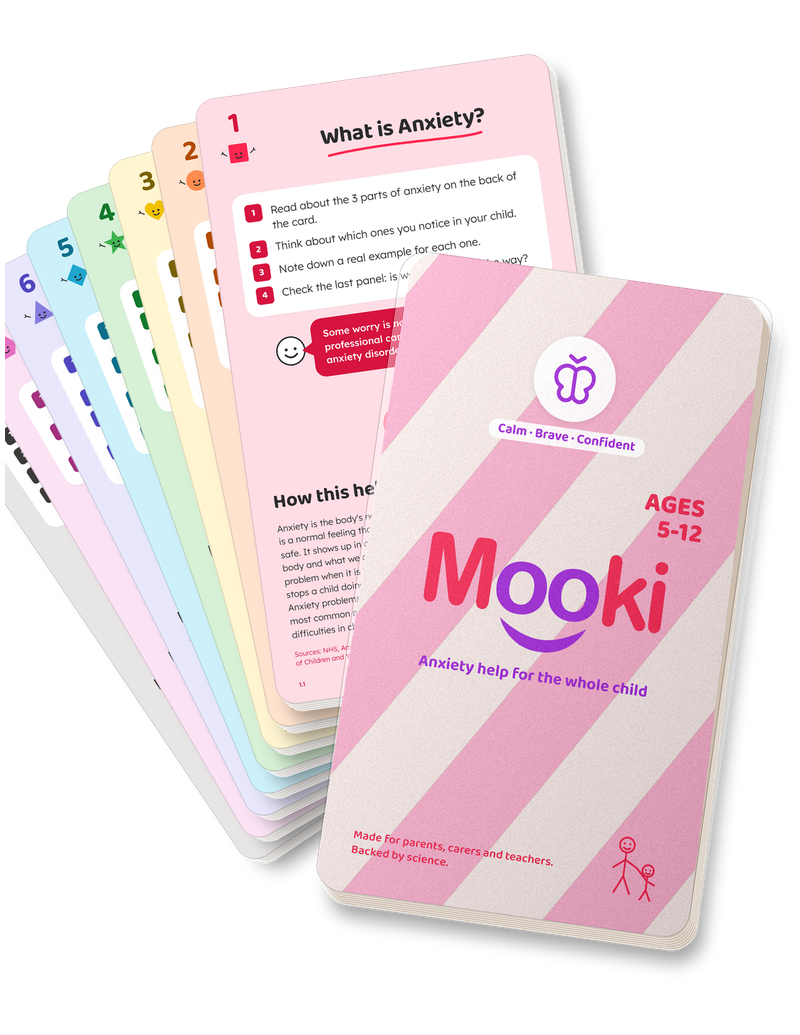
Want a simple daily way to talk about worries?
Try Feelings Check-in, Worry Thermometer and Calm Breathing from the Mooki Anxiety deck. Each is one of 56 ten-minute activities with clear adult steps and a child worksheet on the back.
Instant download · use on a phone or tablet, or print and fill in at home or school
How adults can respond to kids and anxiety
When a child is worried, our instinct is to make the bad feeling go away. That is loving, but it can sometimes keep anxiety going. These steps help instead.
Show you understand
Say what you see: “You look worried about the party.” Feeling understood calms the body. You can be kind about the feeling without agreeing that the danger is real.
Show you believe in them
Follow up with confidence: “I know this feels hard, and I know you can do it.” The Child Mind Institute’s advice on anxious children explains that the goal is to help children manage anxiety, not to remove every worry.
Take small brave steps
Avoiding scary things brings quick relief but makes the fear grow. Break a big challenge into tiny steps and praise each one. For example, a child scared of dogs might look at dog pictures, then watch a dog from across the park, then stand near a calm friend’s dog.
Keep routines steady
Predictable days help anxious children feel safe. Give warnings before changes and talk through new things ahead of time, as the NHS suggests.
Look after yourself
Children learn a lot from watching us. If you feel anxious too, that is very common and nothing to feel guilty about. Showing your child how you calm down (“I’m nervous, so I’m going to take a few slow breaths”) is powerful teaching.
When to get extra help
Talk to a professional if worry is strong, lasts for weeks, or stops your child doing everyday things like going to school, sleeping alone or seeing friends.
- In the UK: start with your GP. They can refer to CAMHS (Children and Young People’s Mental Health Services) if needed. Talk to your child’s teacher or the SENCo (special educational needs coordinator) about support in school. YoungMinds has a free parents helpline too.
- In the US: talk to your pediatrician, who can check for other causes and refer to a mental health specialist. The CDC’s page on anxiety in children explains that the first step is talking to a health care provider about an evaluation. The school counselor or school psychologist can help with support at school, which may include a 504 plan.
Talking therapies such as CBT (cognitive behavioural therapy) are often used for childhood anxiety, and many involve parents. A doctor or specialist will talk through the options with you.
The bottom line
Anxiety in kids is common, and it is not your fault or your child’s. With understanding, small brave steps and a steady routine, most children learn to handle their worries well. Start small today with a short check-in, and if you’re worried, talk to your GP or paediatrician, or your child’s school.