
If your child has been referred to a speech and language therapist in the UK, or a speech and language pathologist in the US, this guide explains what they actually do in a session and how you can help at home.
The two job titles describe the same expert. In the UK, people say speech and language therapist, often shortened to SLT or SALT. In the US, the title is speech-language pathologist, or SLP. Whichever term you know, the role of the speech and language therapist is to help your child understand, talk and connect with other people.
Free 10-minute course
Build a child’s talking confidence
Talking, turn-taking and friendships, in 3 short activities. 10 minutes a day, with free printable worksheets.
What is a speech and language therapist?
A speech and language therapist is a trained health professional who works with communication. The Royal College of Speech and Language Therapists explains that SLTs assess, diagnose and support people with speech, language and communication difficulties, as well as eating, drinking and swallowing. There are around 20,000 practising SLTs in the UK.
In the UK, “speech and language therapist” is a protected title. That means anyone using it must be registered with the Health and Care Professions Council (HCPC).
What is a speech and language pathologist?
In the US, a speech and language pathologist does the same job. The American Speech-Language-Hearing Association (ASHA) describes SLPs as the professionals who identify, assess and treat speech, language and swallowing disorders. Many SLPs hold ASHA certification, and you can search for one through ASHA’s help finding a professional page.
What do speech and language therapists do with children?
Speech and language pathology covers a wide range of needs. A children’s therapist might work with:
- Speech sounds: a child who is hard to understand, or who swaps sounds, such as “tat” for “cat”.
- Understanding: a child who struggles to follow instructions or longer sentences.
- Talking: a child who finds it hard to find words, build sentences or tell a story in order.
- Fluency: a child who stammers (stutters in the US).
- Social communication: a child who finds turn-taking, conversation or reading faces tricky.
- Voice: a child whose voice is often hoarse or strained.
They also work with children who have conditions such as developmental language disorder (DLD), autism, hearing loss, cleft palate or selective mutism.
Who else does the therapist work with?
A big part of the job is working through the adults around your child. SLTs often train parents, teachers and teaching assistants, because your child spends far more time with you than with the therapist. They also work with health visitors, GPs, paediatricians, psychologists and school SENCos (special educational needs coordinators).
What happens in a therapy session?
Every therapist works a little differently, but most sessions with children follow a similar shape.
- A warm start. The therapist chats and plays to help your child relax.
- A short check-in. They look at what you practised since last time and how it went.
- Focused practice. Your child plays games that target one skill, such as a sound, a word group or following instructions. To your child, it often just looks like play.
- Showing you how. The therapist models a strategy and lets you try it while they watch.
- Homework. You leave with one or two simple activities to do at home or school.
Sessions may happen at a clinic, at school, at nursery or online. Some children have a block of weekly sessions, then a break to practise. Others mainly get a plan that school staff carry out, with the therapist checking in.
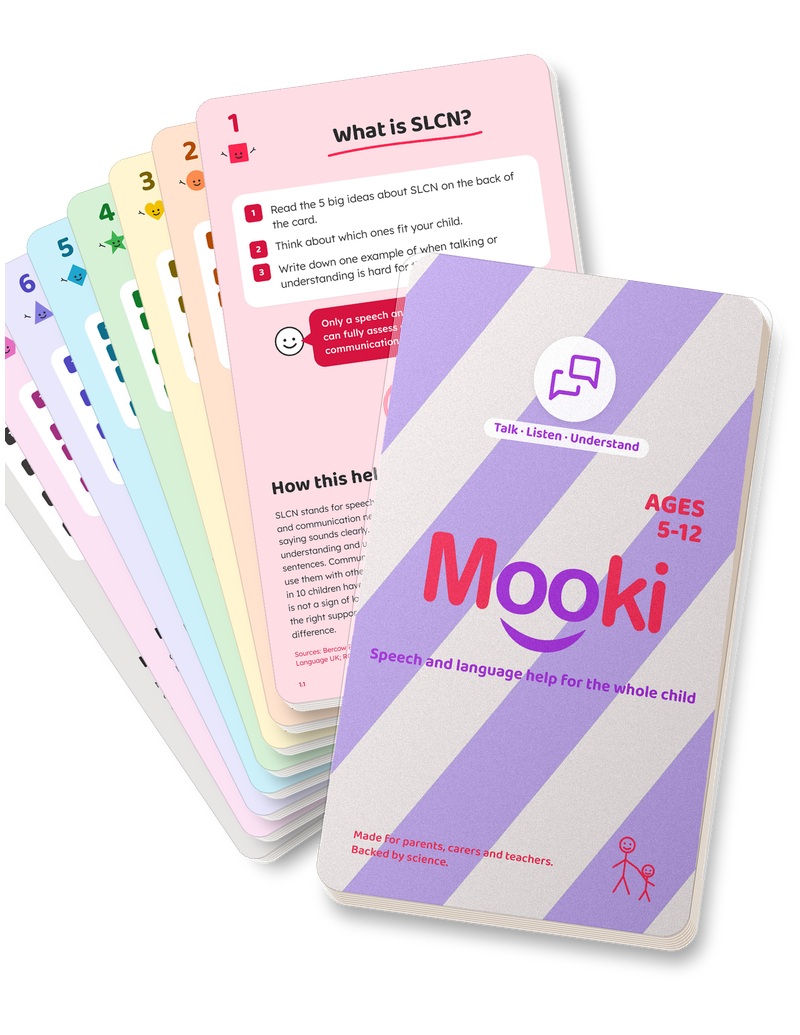
Want to get the most from every therapy session?
The Working with Your SLT card helps you track goals, questions and home practice, and Model and Expand shows you an easy way to back up therapy. It's one of 56 ten-minute activities in the deck.
Instant download · use on a phone or tablet, or print and fill in at home or school
Try it today: a 10-minute “practice like a therapist” routine
You don’t need special equipment to back up your child’s therapy. Try this short routine once a day, at a calm time.
- Pick one target. Use the goal your therapist gave you, such as the “k” sound or naming feelings.
- Get down to their level. Sit face to face so your child can see your mouth.
- Play for 5 minutes. Choose a game your child enjoys, like a picture hunt or a toy shop, and slip in the target lots of times.
- Model, don’t correct. If your child says “tar” for “car”, say it back the right way: “Yes, a red car!”
- Stop while it’s fun. Finish with praise for effort, such as “You tried really hard with that sound.”
Little and often works better than one long session at the weekend.
How can parents help speech and language therapy work?
You are a key part of the team. Research backs this up: an older but still widely quoted (2003) Cochrane review of speech and language therapy for children found that therapy delivered by trained parents did about as well as therapy delivered by clinicians in the studies it looked at.
Here are some easy ways to help:
- Ask questions. It’s fine to ask “What is the goal?” and “What does good progress look like?”
- Keep a short notebook. Write down new words, tricky moments and what helped.
- Share with school. Pass the therapist’s advice to your child’s teacher, so everyone uses the same strategies.
- Use everyday moments. Bath time, car journeys and cooking are great for talking.
- Keep it positive. Children learn best when talking feels safe and fun.
The NHS guide to helping your child learn to talk has more ideas by age, such as adding a word or two to your child’s short sentences.
How do I see a speech and language therapist?
In the UK
You can usually get NHS speech and language therapy for free. A GP, health visitor, nursery or school can refer your child, and in many areas you can refer your child yourself. The RCSLT has a guide on how to find a speech and language therapist, including NHS and independent (private) options. If your child has an education, health and care plan (EHCP), speech and language therapy may be written into it.
In the US
For children under 3, your pediatrician can refer you to your state’s Early Intervention program, which is free or low-cost for children who qualify, or you can contact it yourself. From age 3, your local public school district can evaluate your child and may offer speech therapy through an IEP (Individualized Education Program). You can also see a private SLP.
If you’re worried about your child’s talking, talk to your GP or pediatrician, or your child’s school.
The bottom line
A speech and language therapist (or speech and language pathologist) is a communication expert who helps your child understand, talk and connect, mostly through play. The real magic happens between sessions, in the small daily chats you share. Ask questions, practise little and often, and celebrate every small step. If you’d like a simple way to keep track of goals and questions, the Working with Your SLT card in the Mooki Cards Speech and Language deck was made for exactly that.