Is my child bad at maths, or is it dyscalculia? If that question keeps you up at night, this guide will help. You’ll learn the difference between normal ups and downs and a lasting difficulty, what to track over a term, and when it’s time to talk to school.
Lots of children find maths hard at some point. A child struggling with maths isn’t automatically a child with dyscalculia. But some children do have a real, specific difficulty with numbers, and they need the right kind of help. Here’s how to tell the difference.
Why some children fall behind in maths
There are many reasons a child might be behind in maths, and most of them are not dyscalculia. The British Dyslexia Association notes that around a quarter of people have some kind of maths learning difficulty, while about 6% have dyscalculia. It lists other causes, such as missed school, maths anxiety and difficult past experiences of learning maths.
Common reasons a child might be slow at maths include:
- Missed teaching: illness, a house move or gaps in schooling.
- Maths anxiety: worry that blocks thinking, even when the child understands.
- Other learning differences: such as dyslexia, ADHD or language difficulties.
- Speed of the curriculum: some children simply need more time and practice.
- Tiredness, hunger or worries at home or school.
- Dyscalculia: a specific, lasting difficulty with understanding numbers.
Normal variation vs persistent difficulty
The key difference is how a child responds to good teaching and extra practice.
| Usually normal variation | Could be dyscalculia |
|---|---|
| Catches up with a bit of extra help | Stays stuck despite extra help |
| Forgets a fact, then remembers with a reminder | Learns a fact, then loses it again and again |
| Struggles with one new topic | Struggles with basic number ideas across topics |
| Can estimate and spot silly answers | Can’t tell if an answer makes sense |
| Finds maths hard but copes with money and time | Everyday maths, like money and time, is also hard |
| Some worry about tests | Ongoing dread and avoidance of anything with numbers |
When to worry about your child’s maths
It’s worth looking more closely if:
- Your child is well behind classmates in basic number skills, not just new topics.
- Extra help at school hasn’t made much difference over a term or more.
- They still count in ones for simple sums when classmates have moved on.
- Number facts don’t stick, however much you practise.
- They find it hard to say which of two numbers is bigger.
- Maths is causing real distress, like tears, tummy aches or refusing school.
As a rough guide, in England the Department for Education’s maths guidance expects children to be fluent in adding and taking away within 10 during Year 1, with this secured in Year 2 (around age 6 to 7, or 1st grade in the US). A child in Year 3 or 4 who is still very unsure about these facts may need a closer look.
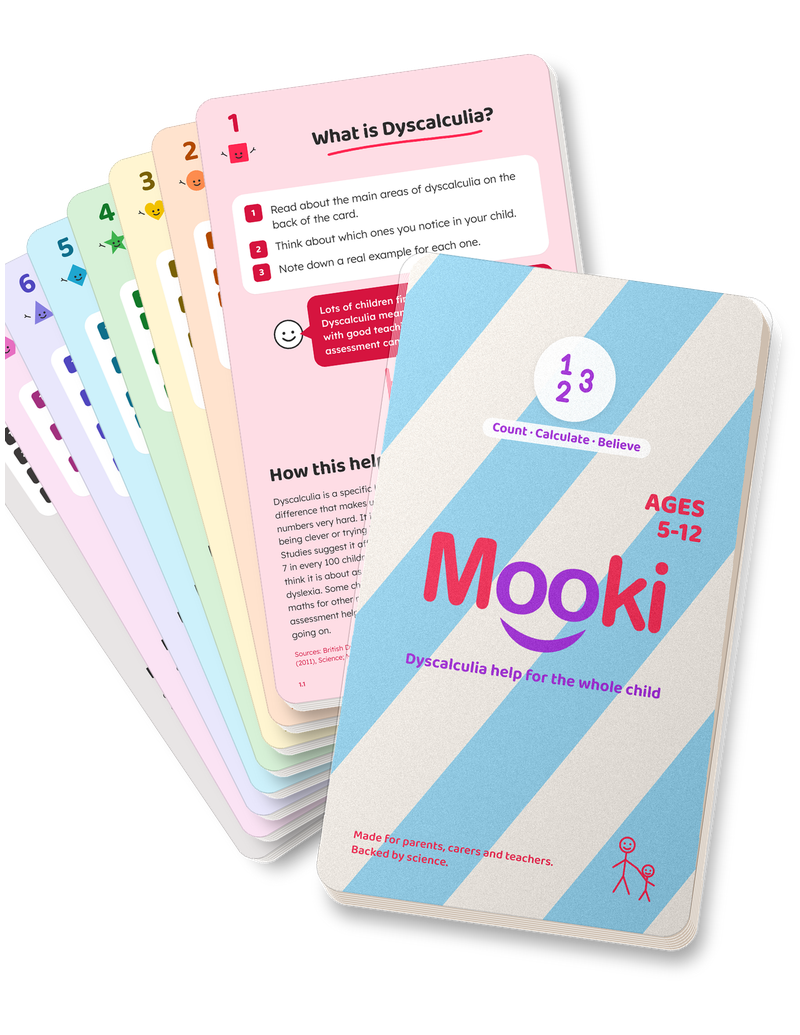
Spot the patterns in just ten minutes a day
Maths Detective shows where your child's skills break down, Maths Wins Ladder tracks progress, and Home-School Diary keeps school in the loop. Each is one of 56 ten-minute activities in the Mooki Cards dyscalculia deck.
Instant download · use on a phone or tablet, or print and fill in at home or school
What to track over a term
Watching for a whole school term (roughly three months) gives you a much clearer picture than one bad week. Understood suggests observing your child, taking notes on patterns and sharing them with the teacher.
Each week, jot down a few quick notes:
- What maths they did: for example, adding to 10, telling the time, coins.
- How they did it: counting on fingers, counting from one, just knowing.
- What stuck: could they still do it a few days later?
- How they felt: calm, frustrated, tearful, proud.
- Everyday maths: money, time, games, cooking.
- What helped: objects, drawings, extra time, breaks.
At the end of the term, look back. Are you seeing steady progress, even if it’s slow? Or the same struggles week after week?
Try it today: a 10-minute pattern-spotting session
Short, regular sessions can reveal a lot about how your child thinks. Try this once or twice a week, and keep your notes from each one.
- Start easy. Ask your child to count out 8 objects. Notice whether they touch each one and know the total.
- Compare. Write two numbers, such as 17 and 71. Ask which is bigger and how they know.
- Add. Ask “What’s 6 + 3?” Watch: do they know it, count on from 6, or count all from 1?
- Explain. Ask “How did you work it out?” Listen without correcting.
- Finish on a win. End with something they can do well.
Over a few weeks, you’ll start to see patterns. Maybe your child is fine with objects but lost with written numbers. Maybe they get it one day and forget it the next. These clues are really helpful for school.
How to talk to school
Book a meeting with your child’s teacher and bring your notes. Try asking:
- How does my child’s maths compare with what’s expected for their age?
- What extra help have they had, and has it made a difference?
- Do you see the same patterns I see at home?
- Could there be something more, like dyscalculia?
In the UK, if your child needs more help, the school should follow a cycle of assess, plan, do and review, known as the graduated approach. Ask to involve the SENCo. A formal dyscalculia assessment is usually done by a specialist teacher or educational psychologist.
In the US, ask your child’s teacher about extra maths support and whether an evaluation would help. Public schools can evaluate children for free under IDEA, as Understood explains.
If maths is affecting your child’s mood, sleep or wellbeing, talk to your GP or paediatrician too.
Keep maths positive meanwhile
Whatever the cause, these will help:
- Short, calm practice most days.
- Hands-on maths with real objects.
- Board games, card games and everyday maths like cooking.
- Praise for effort and good thinking, not speed.
- Kind words about mistakes.
Ten-minute activities, like those in Mooki Cards, can give you a simple routine and help you notice patterns as you go.
The bottom line
Lots of children find maths hard for a while, and many catch up with time and support. Dyscalculia is different: the struggles with basic number sense last, even with good help. Track what you see over a term, share it with school, and keep maths at home kind and playful. You know your child best, and your notes really count.