If you’re trying to work out ADHD and autism, and whether your child might have one, the other or both, this guide compares the traits side by side, explains why they so often go together, and shows how to ask for an assessment of both.
ADHD and autism are both neurodevelopmental differences. That means they affect how the brain develops and works from birth. They are different conditions, but they share some features, and many children have both. Some people call this combination AuDHD.
ADHD vs autism: the basics
Autism affects how a child communicates, relates to others and experiences the world through their senses. Autistic children often prefer routine and have deep, focused interests. The NHS explains autism as a difference in how the brain develops.
ADHD (attention deficit hyperactivity disorder) affects attention, activity levels and impulse control. Children with ADHD may find it hard to focus on tasks that don’t interest them, sit still or wait their turn. The NHS guide to ADHD in children describes the two main groups of signs: inattention, and hyperactivity and impulsiveness.
Neither is caused by parenting, and neither is about laziness or low intelligence.
ADD vs autism
You may hear “ADD”. This is an older term for ADHD without obvious hyperactivity. Today, doctors use ADHD for all types, including the mainly inattentive type. So when people search “ADD vs autism”, they usually mean inattentive ADHD compared with autism. Read more about ADD vs ADHD and the 3 types of ADHD.
ADHD and autism difference: a side-by-side guide
The same behaviour can have different reasons behind it. This table shows some common examples.
| Trait | Often in ADHD | Often in autism |
|---|---|---|
| Attention | Drifts easily, hard to stay on less interesting tasks | Deep focus on chosen interests, hard to shift attention away |
| Routines | May find routines hard to stick to, likes novelty | Often prefers sameness, upset by unexpected change |
| Social | Interrupts, talks a lot, misses cues because of impulsiveness | May find social rules confusing, prefers direct communication |
| Conversation | Jumps between topics | May talk at length about one topic |
| Sensory | May seek movement and stimulation | Often strongly sensitive, or less sensitive, to sound, light or touch |
| Movement | Fidgets, restless, finds sitting still hard | May use repeated movements (stimming) to stay calm or focused |
| Meltdowns | Often linked to frustration or boredom | Often linked to overload or change |
These are patterns, not rules. Every child is different.
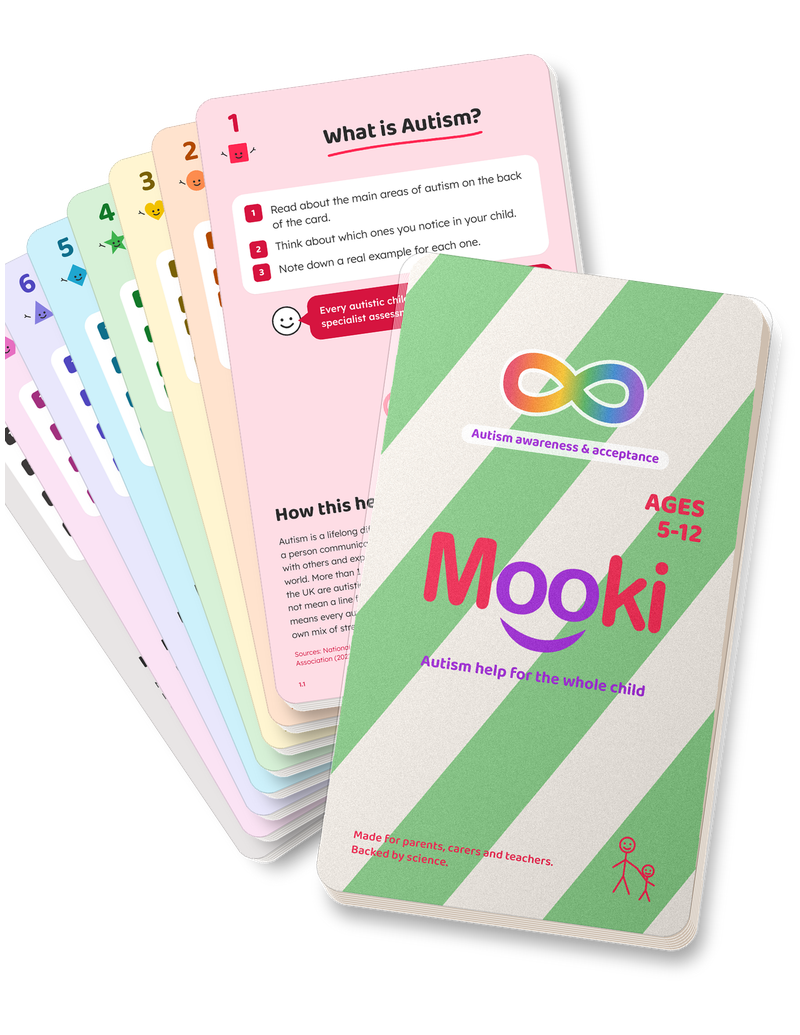
Want tools that help with both focus and calm?
Mooki's My Energy Battery, Sensory Breaks and Break It Down cards support regulation and focus for autistic and AuDHD children. Each is one of 56 ten-minute activities in the Autism deck.
Instant download · use on a phone or tablet, or print and fill in at home or school
ADHD autism symptoms that overlap
Some traits appear in both, which is why it can be hard to tell them apart.
- Difficulty with attention, though for different reasons
- Restlessness and fidgeting
- Big emotional reactions
- Trouble with friendships
- Sensory differences
- Difficulty with planning, organising and starting tasks
The CDC’s list of autism signs includes hyperactivity, impulsivity and inattention as characteristics some autistic children have. This overlap is one reason both conditions need careful assessment.
ADHD and autism comorbidity: why they go together
“Comorbidity” is a medical word meaning two conditions happen together. ADHD and autism go together often. CHADD, the US ADHD organisation, says ADHD is the most common co-occurring condition in autistic children, and that more than half of autistic people show some signs of ADHD. The NHS also notes that ADHD is more common in autistic people.
Researchers are still learning why. Both conditions tend to run in families, and both involve differences in how the brain develops. Until 2013, the main US diagnostic manual did not allow doctors to diagnose both in the same child. The current US diagnostic criteria allow autism to be diagnosed alongside another neurodevelopmental condition, so more children are being recognised.
Having both can mean a child has competing needs. For example, the ADHD side may crave new things, while the autistic side needs things to stay the same. Understanding this tug-of-war can make life a lot easier for everyone.
Signs your child may have both
When a child is both autistic and has ADHD, the two can pull in different directions. You might notice:
- craving routine, but finding it very hard to remember or follow it
- wanting friends, but finding both the social rules and waiting for a turn hard
- deep focus on a special interest, but little focus on anything else
- seeking movement and noise one minute, and being overwhelmed by it the next
- big emotional reactions after school, when they have been holding it together all day
ADHD and Asperger’s: why the term is no longer used
You may have heard of ADHD and Asperger’s together. Asperger syndrome was once given as a separate diagnosis, alongside autism. Since the DSM-5 in 2013, it has been included in the single diagnosis of autism (autism spectrum disorder), as Autism Spectrum Australia explains. People diagnosed before then may still use the term, and that is their choice.
You may also hear functioning labels, such as calling a child “high” or “low” functioning. Many autistic people and professionals now avoid these labels. They can hide real struggles in children who seem to cope, and overlook strengths in children who need more support. It is more helpful to describe what a child finds easy and what they need help with.
Try it today: a 10-minute energy check
This simple activity helps your child notice their own energy and what they need, which supports both ADHD and autistic children.
- Draw a battery with five sections on a piece of paper.
- Ask your child to colour in how full their battery feels right now.
- Talk about what drains it: noise, waiting, lots of talking, homework.
- Talk about what fills it up: a favourite interest, moving, quiet time, a snack.
- Choose one “battery filler” to do right now for five minutes.
- Pin the battery on the fridge to use again tomorrow.
Children with AuDHD often need both movement breaks and quiet breaks. This activity helps you find which one they need in the moment.
No time to draw it? Print the free Energy Battery worksheet and colour it in together.
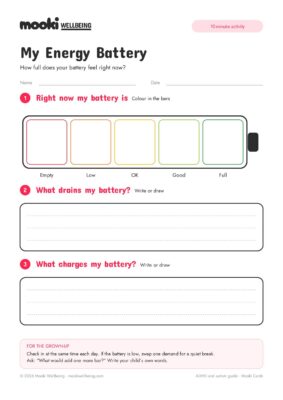
This sheet is a taste of the My Energy Battery card. The full card in the Mooki Autism deck adds grown-up steps and battery-filler ideas, alongside 55 more ten-minute activities.

Support that works for ADHD and autistic brains
The Now and Next, Tackle Transitions and Feelings Check-in cards suit children with ADHD who are also autistic, with clear visual steps. Each is one of 56 ten-minute activities in the Mooki ADHD deck.
Instant download · use on a phone or tablet, or print and fill in at home or school
How to ask for assessment of both
If you think your child may have ADHD, autism or both, ask for both to be considered. It’s okay to say this clearly.
In the UK
Start with your child’s teacher and SENCo, then your GP. Ask the GP to consider both ADHD and autism when making a referral. Some areas have a joint neurodevelopmental pathway, while others assess ADHD and autism separately. The NHS autism assessment team checks for conditions that often occur alongside autism, such as ADHD. In England, you may be able to use Right to Choose to pick a service with a shorter wait.
In the US
Talk to your pediatrician and ask for an evaluation that looks at both conditions. A developmental pediatrician, child psychologist or psychiatrist can assess both. Your school can also evaluate your child for an IEP or 504 plan, whatever the diagnosis.
If a diagnosis is made, a doctor or specialist will talk through support options with you, based on NICE guidance in the UK or AAP guidance in the US.
If you’re worried, talk to your GP or paediatrician, or your child’s school. You can also read what autism is and try a free ADHD online checklist to note what you see.
The bottom line
ADHD and autism are different, but they overlap and often go together. Looking at the reasons behind a behaviour helps you understand what your child needs. If you suspect both, ask for both to be assessed. A child with AuDHD has a unique mix of strengths, and the right support can help them shine. The Mooki Autism deck and Mooki ADHD deck each have 56 ten-minute activities to help with calm, focus and routines.