
Want staff to really feel why breaking tasks down helps pupils with SEN? Here’s a 10-minute staff training activity you can run at your next INSET or staff meeting, why chunking works, and simple ways teachers and TAs can use it in every lesson.
“Just break it down” is one of the most common bits of SEN advice. But many staff have never felt what a big, unbroken task is like for a pupil with ADHD, autism, dyslexia or a language need. Once they’ve felt it, they rarely forget it.
The Break It Down card, found in both the Mooki ADHD deck and the Mooki Autism deck, gives teachers and TAs a ready-made way to split any task into small, clear steps.
Why does breaking tasks down help SEN pupils?
Many pupils with SEN find it hard to hold several instructions in their head at once. This is called working memory. A long instruction like “Get your book, write the date, underline it, read the question and answer in full sentences” can be gone before they’ve found their pencil.
Breaking tasks down helps because:
- less to remember – one step at a time frees up working memory for the actual learning
- easier to start – a small first step feels possible, so pupils are less likely to avoid the task
- less worry – pupils can see the end, so the task feels safer
- more success – each finished step is a small win, which builds confidence
- easier to spot gaps – you can see exactly which step a pupil is stuck on
This is part of scaffolding, one of the “five-a-day” approaches in the Education Endowment Foundation’s SEND guidance. The aim is to remove the scaffold bit by bit, so pupils learn to break tasks down for themselves.
Try it today: a 10-minute staff training activity
You need: a timer, paper and pens, and one slide or sheet with a long instruction on it.
- Give the big task (2 minutes). Read this aloud once, quickly, with no slide: “Fold your paper into four. In the top left box, write your name backwards. In the top right, draw a house with three windows and a red door. Bottom left, write the 7 times table to 7 times 5, skipping 7 times 3. Bottom right, write three words that rhyme with ‘light’ but don’t use the letter ‘i’. You have 2 minutes. Go.”
- Notice the feelings (2 minutes). Stop. Ask staff how it felt. Write their words on the board. You’ll usually hear “panicky”, “I gave up”, “I copied my neighbour” and “I didn’t hear the second bit”.
- Try it chunked (3 minutes). Now show the same task as four numbered steps on a slide, one step at a time, with a tick box for each. Give a short time for each step.
- Compare (2 minutes). Ask, “What changed?” Link their answers to pupils in their class who shut down, copy, chat or walk around when tasks feel too big.
- Commit (1 minute). Each person writes one lesson this week where they will break a task into numbered steps.
This activity works because staff feel the overload themselves. It’s the same feeling many pupils have several times a day.
Want a ready-made way to break tasks down?
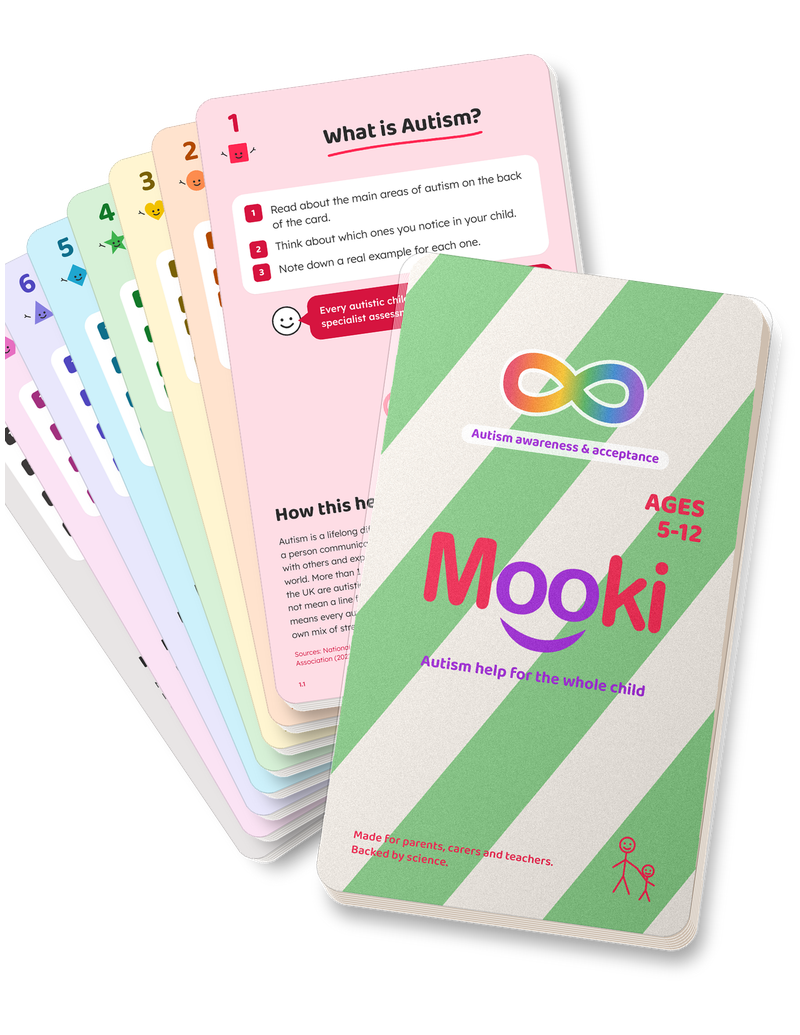
The Break It Down card walks you through splitting any task into small, clear steps, with a printable step sheet for pupils to tick off. Pair it with Now and Next. Both are among 56 ten-minute activities in the Mooki Autism deck, and Break It Down is also in the Mooki ADHD deck.
Instant download · use on a phone, tablet or class whiteboard, or print for your pupils
How to break a task down in any lesson
Try these simple ways to chunk tasks:
- Number the steps – write 3 to 5 steps on the board and leave them there
- One step per line – give step sheets with a tick box for each step
- Show what “done” looks like – a finished example helps pupils who struggle to imagine the end
- Cut the page – fold or cover a worksheet so only one part shows at a time
- Use “first, then” – “First, write the title. Then, tick it off”
- Time each step – a short visual timer for each chunk helps pupils who lose track of time
For a pupil who struggles to get going at all, the Get Started card in the Mooki ADHD deck has tips for that tricky first minute.
How TAs can use task breakdown well
TAs often do the breaking down for a pupil. That’s a great start. The next step is teaching the pupil to do it themselves:
- in week 1, the TA writes the steps
- in week 2, the TA and pupil write the steps together
- in week 3, the pupil writes the steps and the TA checks them
This matches the EEF’s advice on teaching assistants, which says TAs should help pupils become independent learners.
Working with parents
Breaking tasks down works at home too. It helps with homework, getting dressed and tidying up. Share the steps you use in class, so parents can use the same words. A simple “first, then” card in the book bag can help with the morning routine.
When to involve the SENCo or outside help
Talk to your SENCo (special education teacher in the US) if a pupil:
- still can’t start or finish tasks after a few weeks of chunking
- seems to forget instructions straight away, even short ones
- often seems lost, worried or upset during independent work
These can be signs of ADHD, autism, a language need or a learning difficulty. In the US, chunking tasks is often written into a 504 plan; see our 504 accommodations for ADHD. Our guides to accommodations for ADHD, quick activities for kids with ADHD and helping a pupil with autism and ADHD stay focused have more ideas.
The bottom line
Breaking tasks down is one of the simplest, most powerful things any teacher or TA can do. Let staff feel the overload once, and they’ll chunk tasks for life. For ready-made step sheets, the Mooki Autism deck and Mooki ADHD deck both include the Break It Down card.