
If you have just heard the word autism for the first time, or you teach a child who is autistic, this guide is for you. You will get a clear, kind explanation of what autism is, what it can look like in children, and simple things that help at home and in class.
Autism is talked about a lot, but it is often explained badly. Some explanations focus only on problems. Others are so vague they don’t help at all. This post sits in the middle: honest about the challenges, and just as honest about the strengths.
Free 10-minute course
Autism meltdowns and calm
A calm-down kit and a meltdown plan, in 3 short activities. 10 minutes a day, with free printable worksheets.
What is autism?
Autism is a lifelong difference in how a person’s brain develops. It shapes how they experience the world, how they communicate, and how they take in sights, sounds, smells, tastes and touch. The NHS explains autism as a difference, not an illness, and something a person is born with.
Autism is not caused by parenting, screens or anything a parent did. Research shows autism often runs in families.
Autism is common. The National Autistic Society says more than 1 in 100 people in the UK are autistic. In the US, the CDC reports that about 1 in 31 eight-year-olds has been identified as autistic.
Autism vs autism spectrum disorder: what do the words mean?
You will see a few different terms, and they all describe the same thing.
- Autism spectrum disorder (ASD) is the medical term doctors use in a diagnosis. ASD is the abbreviation for autism you will see on reports.
- Autism spectrum condition (ASC) is used by some UK services, as “condition” feels less negative.
- Autistic or on the autism spectrum is how many people describe themselves.
“Spectrum” does not mean a line from “a little bit autistic” to “very autistic”. It means every autistic person has their own mix of strengths and challenges. Two autistic children can look very different.
A note on language: many autistic people prefer identity-first language, so “autistic child” rather than “a child with autism”, because being autistic is part of who they are. Others prefer person-first. If you are not sure, ask the person, or follow your child’s lead as they grow.
All about autism: strengths and differences
Autism is diagnosed by looking at two main areas. It also often brings real strengths. Here is a simple overview.
Communication and social interaction
- Taking words literally, or missing sarcasm and hints
- Finding eye contact uncomfortable
- Talking a lot about a favourite topic, or using few words
- Finding unwritten social rules confusing
- Being honest, direct and loyal in friendships
Routines, interests and senses
- Liking things to be the same, and finding change hard
- Deep, focused interests, from trains to animals to maths
- Repeated movements, often called stimming, which can help with calm and focus
- Being very sensitive, or less sensitive, to noise, light, textures or smells
Many autistic children also have great memory for detail, strong pattern-spotting skills and real passion for what they love. The National Autistic Society’s guide to sensory processing is a good next read if senses seem to be a big part of your child’s day.
Autism is not a learning disability, although some autistic people do have one. Around a third of autistic people also have a learning disability, according to the National Autistic Society. ADHD, anxiety and sleep difficulties are also more common in autistic children.
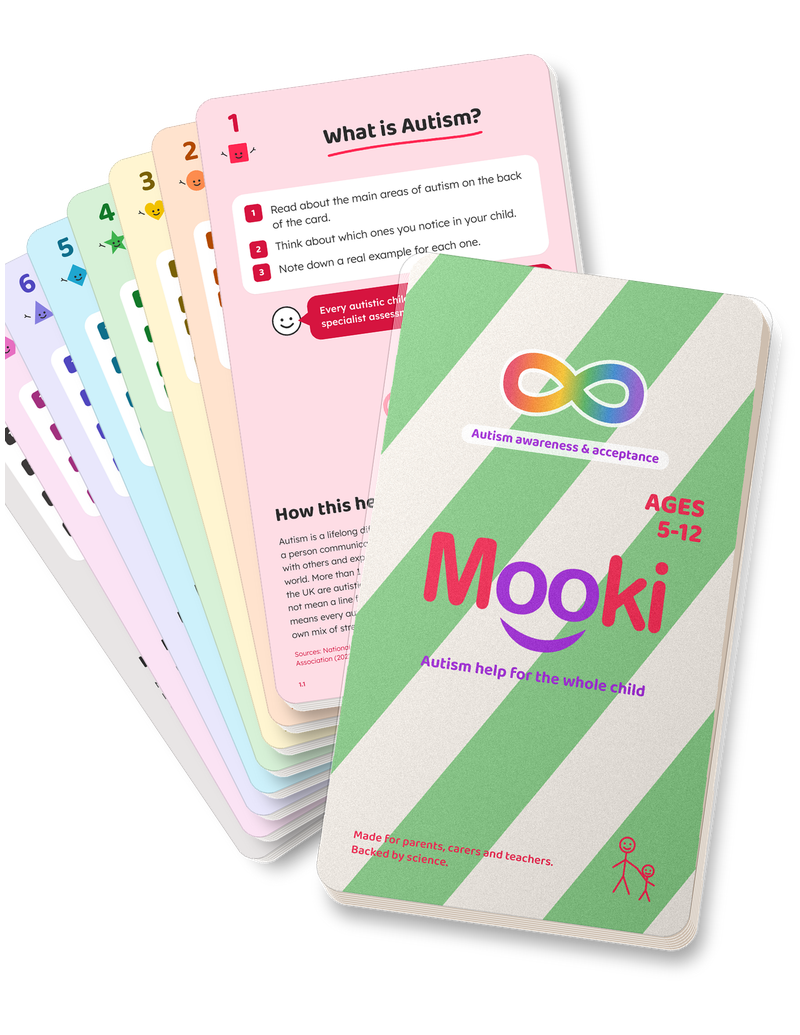
Want simple ways to help your autistic child every day?
Mooki's What is Autism?, Feelings Check-in and Calm Down Kit cards turn these ideas into easy steps. Each is one of 56 ten-minute activities in the Autism deck, with a worksheet or chart for your child.
Instant download · use on a phone or tablet, or print and fill in at home or school
What helps at home and in class
Small changes make a big difference. You do not need special equipment. You need predictability, calm and a way for your child to tell you how they feel.
Make the day predictable
- Use a simple visual timetable with pictures for the day ahead.
- Warn your child before changes: “In five minutes we will stop and put shoes on.”
- Use “now and next” language: “Now reading, next snack.”
The National Autistic Society explains why routine and predictability help many autistic people feel safe.
Help with feelings
- Name feelings in calm moments, not just in hard ones.
- Use a feelings chart or scale so your child can point instead of talk.
- Make a calm space with soft light and fewer sounds.
Keep communication clear
- Say your child’s name first, then give one instruction at a time.
- Use short, literal sentences, and allow time to process.
- Accept all ways of communicating: words, pictures, signs or pointing.
Try it today: a 10-minute feelings check-in
This is a gentle way to help your child notice and share how they feel. It works at home after school or in class first thing.
- Draw or print five faces: happy, calm, worried, cross and tired.
- Sit side by side, not face to face. This often feels easier.
- Point to how you feel first and say one short reason: “I feel tired because I walked a long way.”
- Invite your child to point to their face. Don’t push for a reason.
- If they choose a hard feeling, say: “Thank you for telling me.” Offer one calm idea, like a drink or a quiet sit.
- Finish with something they enjoy, such as a few minutes on their favourite topic.
Do this at the same time each day for a week. Over time, many children start to use the faces on their own.
Getting support in the UK and the US
If you think your child may be autistic, the first step is a conversation. You don’t need to be sure.
In the UK
Talk to your GP, your health visitor if your child is under five, or the SENCo (special educational needs coordinator) at school or nursery. The NHS signs of autism in children page is a helpful list to bring along. Schools can give SEN support without a diagnosis, and some children later get an education, health and care plan (EHCP).
In the US
Talk to your pediatrician, who can screen and refer for a full evaluation. Children under three can be referred to your state’s early intervention program. From age three, your local school district can evaluate your child for special education, which may lead to an IEP. The CDC’s guide to screening and diagnosis explains each step.
A diagnosis is not a label that limits your child. For many families, it opens the door to understanding and support.
If you’re worried, talk to your GP or paediatrician, or your child’s school.
The bottom line
Autism is a different way of experiencing the world, not a broken one. Your autistic child has strengths to build on and needs that deserve support. With predictable routines, clear communication and a calm adult beside them, they can thrive. You are already doing the most important thing: trying to understand.