Six weeks into Reception and your autistic child is already struggling? Here’s what’s normal in the first term, the signs your child needs more support, a 10-minute “school story” to make tonight, and how to ask school for help early.
You’re not alone. Starting school is a huge change for any 4 or 5 year old. For autistic children, it can be overwhelming. New people, a new building, new routines, lots of noise and long days all at once. By half-term, many parents are worried.
Some wobbles are normal. But if your child is struggling a lot, it’s best to ask for help early. The Visual Timetable and Talk to School cards in the Mooki Autism deck can help you both.
What’s normal when an autistic child starts school?
The National Autistic Society says starting school is a time of enormous change for autistic pupils. In the first few weeks, it’s common for children to:
- be very tired after school
- have more meltdowns at home
- cry or cling at drop-off
- not want to talk about their day
- be fussier with food or clothes
These often settle as routines become familiar. Giving your child calm, quiet time after school can really help.

Signs your autistic child needs more support at school
It may be time to ask for more help if, after the first few weeks, your child:
- is very distressed most days – screaming, hiding or refusing to go in
- is melting down at school – or the school calls you often
- isn’t eating or drinking – at lunch or snack time
- isn’t using the toilet – or is having lots of accidents
- isn’t joining in – sits alone, wanders or seems lost most of the time
- is losing skills – talking less, or finding things harder than before
- is exhausted – falling asleep early, or too tired for anything after school
Also look out for children who seem “fine” at school but fall apart at home. Many autistic children mask (hide their struggles) all day, then let it out where they feel safe. Our guide to autistic burnout in children explains more.
Try it today: a 10-minute school story
A short “school story” helps your child know what to expect. Make it this evening.
- Take photos (3 minutes). Use photos of school: the gate, the classroom, the teacher, the toilets, the lunch hall. Ask school for some, or find them on the school website.
- Put them in order (2 minutes). Line them up in the order of the day: arrive, coat on peg, carpet, play, lunch, home time.
- Add simple words (2 minutes). Write one short sentence for each, like “I hang my coat on my peg” or “Mummy picks me up at 3 o’clock.”
- Add a calm step (2 minutes). Include what your child can do if they feel worried, like “I can show my teacher my break card.”
- Read it together (1 minute). Read it before bed and in the morning. Keep it calm and short.
Want ready-made visuals for school?
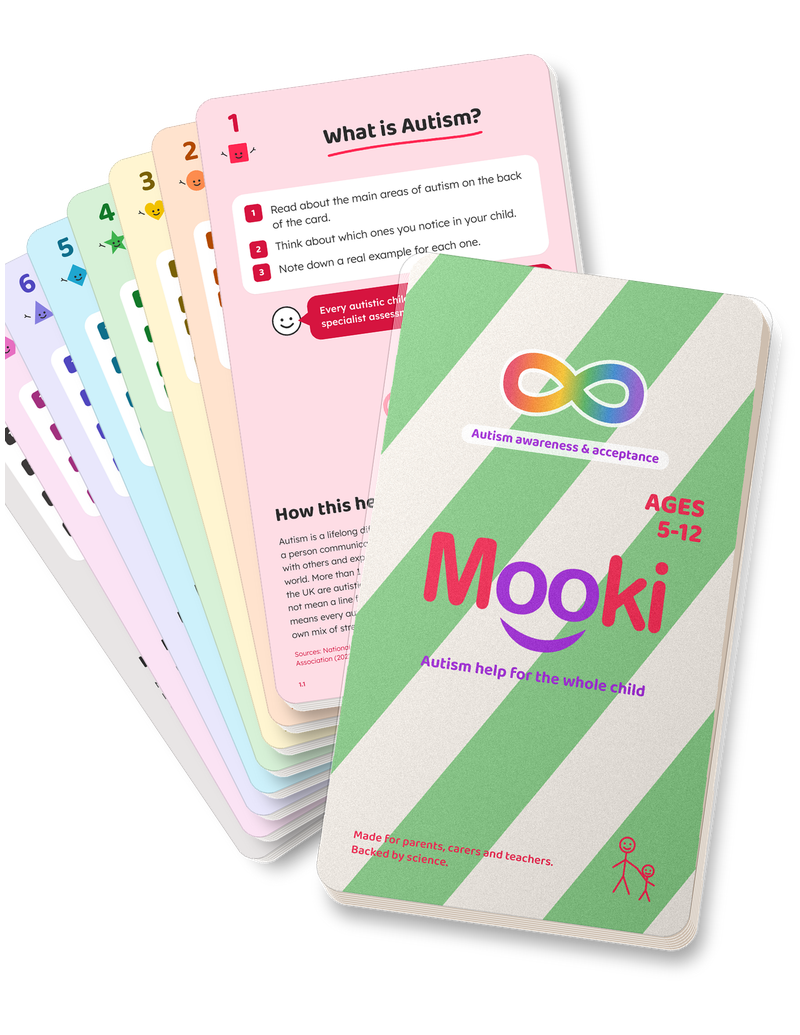
The Visual Timetable, Countdown to Change and Social Stories cards help your child know what’s coming next and feel safer at school. The Home-School Diary card keeps you and school working together. Each is one of 56 ten-minute activities in the Mooki Autism deck.
Instant download · use on a phone or tablet, or print and fill in
How to ask school for help early
You don’t need a diagnosis to get support. Ask for a meeting with the class teacher and SENCo (special educational needs coordinator). You could ask for:
- a visual timetable – on the wall and on your child’s table
- a named adult – someone your child can go to when worried
- a quiet space – a calm corner or tent to use when overwhelmed
- warnings before changes – like a supply teacher, trip or assembly
- help at lunch and toilets – where many children struggle
- a short daily update – a home-school diary or quick message
In England, schools use a cycle of assess, plan, do, review. Our guide to how schools spot pupils who need SEN support explains it. If support isn’t enough, you can ask the council for an EHC needs assessment. The government’s guide to children with special educational needs explains how.
How to help at home
At home, try to:
- keep mornings calm and the same – same order, same words, plenty of time
- give quiet time after school – a snack, a dark room or a favourite show
- don’t ask lots of questions – try “I wonder what you had for lunch” instead of “How was your day?”
- keep weekends quiet – especially in the first term
- get plenty of sleep – tired children find school much harder
Could it be something more?
If your child doesn’t have a diagnosis yet, but you’re seeing many of these signs, it may be worth asking about an autism assessment. Our guides to autism signs when starting school and signs of autism in children may help.
If the main problem is drop-off, see our guide to separation anxiety in kids.
When to get help: UK and US
In the UK: talk to the SENCo, and your GP or health visitor if you’d like an assessment. Your local SENDIASS service gives free, impartial advice about school support.
In the US: talk to your child’s kindergarten teacher and ask about an evaluation for an IEP or 504 plan. Your pediatrician can also help.
The bottom line
Starting school is a big change, and some wobbles are normal. But if your autistic child is very distressed, exhausted or losing skills, ask for help early. Visuals, a safe person and a calm space make a big difference. You know your child best. For ready-made visuals, the Mooki Autism deck has 56 ten-minute cards, including Visual Timetable and Talk to School.