If you’re trying to understand anxiety in kids with ADHD, or wondering whether your child’s restlessness is ADHD or anxiety, this guide explains how the two overlap, how to tell them apart, and practical strategies that help with both.
ADHD and anxiety often show up together. They can also look surprisingly alike. A child who can’t sit still, can’t focus and melts down before school might have ADHD, anxiety, or both.
Why do ADHD and anxiety often go together?
The NHS says people with ADHD often have other conditions too, including anxiety, and may be more likely to experience mental health problems such as anxiety or depression. You can read this on the NHS page about ADHD in children. The NHS page on anxiety disorders in children also says children with ADHD are more likely to have problems with anxiety. In the US, the CDC’s ADHD data from a national parent survey found that about 4 in 10 children with ADHD also had anxiety.
There are a few reasons this makes sense:
- Daily life is harder. Forgetting things, losing things and getting told off more often can leave a child on edge.
- School can feel unpredictable. If it’s hard to follow instructions or finish work, every lesson can feel like a test.
- Big feelings are harder to manage. YoungMinds’ guide to ADHD notes that struggling to manage feelings can leave children feeling low or more worried.
- Friendships can be tricky, which adds social worry.
ADHD is a difference in how the brain works, not laziness or bad parenting. And anxiety is not a sign of weakness. Both deserve understanding and support.

ADHD vs anxiety: how to tell them apart
Both can cause restlessness, poor concentration, irritability and sleep problems. The NHS notes that when a doctor assesses a child for ADHD, they may consider other conditions that cause similar symptoms, including anxiety. That’s why it’s a job for professionals, not a quiz. But some patterns can help you notice what’s going on.
| What you see | More like ADHD | More like anxiety |
|---|---|---|
| Can’t concentrate | Mind wanders to anything interesting, in most settings | Mind is busy with worries, often linked to certain situations |
| Restless or fidgety | Usually there from a young age, even when happy and relaxed | Gets worse in stressful situations, eases when calm |
| Avoids tasks | Finds the task boring or hard to start | Fears getting it wrong or being judged |
| Sleep problems | Body and brain feel “on” at bedtime | Lies awake going over worries |
| Outbursts | Quick, impulsive, often over fast | Build up from worry or fear of a situation |
A child can have both. In that case, you might see ADHD signs all the time, with anxiety signs piling on in certain places, like school or busy events.
Try it today: a 10-minute “what’s behind it?” diary
Use this for a week to spot patterns you can share with school or a doctor.
- Pick one behaviour (2 minutes), such as homework meltdowns or trouble settling at bedtime.
- Note when it happens (3 minutes a day). Write down where, when, who was there and what happened just before.
- Ask your child (3 minutes). At a calm time, ask: “What was going on in your head then?” Worries often sound like “What if…” or “I’ll get it wrong.”
- Look for patterns (2 minutes). Does it happen everywhere, or mostly in certain situations? Is your child distracted, or worried?
Take the diary to your GP, paediatrician or school. It’s far more useful than trying to remember everything in an appointment.
Is it worry, or something else?
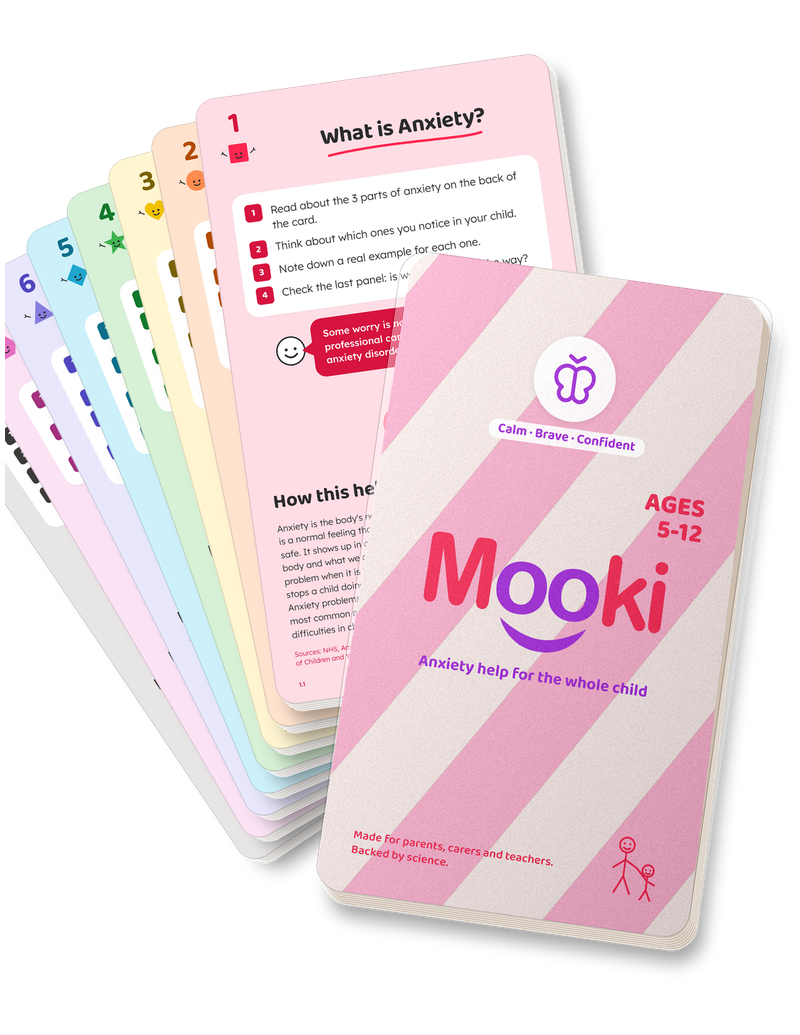
Worry Detective, Calm Breathing and Classroom Tweaks help you spot what sits behind the behaviour and calm your child's body. Each is one of 56 ten-minute activities in the Mooki Anxiety deck.
Instant download · use on a phone or tablet, or print and fill in at home or school
Strategies that help with both ADHD and anxiety
The good news is that many strategies help with both. They make the day more predictable and give your child ways to calm their body.
Make the day predictable
- Use a visual timetable for mornings, after school and bedtime.
- Give warnings before changes: “Five more minutes, then shoes on.”
- Break big tasks into small steps, with a tick box for each one.
Calm the body
- Teach slow breathing. The NHS suggests three deep breaths, in for a count of three and out for three, in its guide to anxiety in children.
- Build in movement breaks. Many children with ADHD focus and feel calmer after moving.
- Offer a quiet fidget, such as a stress ball, during homework or listening time.
Answer the worries
- Listen first, then help your child test the worry: “What’s the worst that could happen? What would you do?”
- Avoid too much reassurance. Help your child find their own answers instead.
- Praise effort and courage, not only results: “You started your homework even though you were nervous.”
Getting support at school
Children with ADHD and anxiety often need small changes at school. These might include a seat away from distractions, movement breaks, a safe person to talk to, or a quiet space when things feel too much.
In the UK: talk to the class teacher and the SENCo about SEN support. If anxiety is affecting attendance, YoungMinds’ advice on school anxiety has practical ideas for working with the school.
In the US: ask about a 504 plan, which can include accommodations such as breaks and extra time. If your child needs specialised teaching, ask for an evaluation for an IEP under IDEA.
Getting the right diagnosis
If you think your child may have ADHD, anxiety or both, start with your GP in the UK or your pediatrician in the US. They can refer you for an assessment.
It really matters to get both conditions looked at, because the support plan may be different. The NIMH notes that when ADHD comes with other conditions, such as anxiety, both can be harder to diagnose and treat. For ADHD, a doctor or specialist will talk through the options recommended in NICE guidance (UK) or the AAP’s ADHD guideline (US), and anxiety may need its own support too, often a talking therapy. If your child already has an ADHD diagnosis and you notice new worries, mention them at your next review rather than waiting.
The bottom line
ADHD and anxiety often travel together, and they can be hard to tell apart. Look for patterns, keep a simple diary, and share what you notice with school and your GP or paediatrician. With a predictable routine, ways to calm the body and plenty of praise for brave steps, your child can feel more settled and more confident.