If your toddler or pre-schooler isn’t talking much and you’re wondering whether it’s a speech delay or autism, this calm guide is for you. You’ll learn the key differences to watch for, what to do next and why an assessment matters.
Many parents of a 3 year old with speech delay worry about autism, often after late nights reading online. Some children have a speech delay that’s not autism, some are autistic, and some have both. The good news is that there are clear clues to look for, and help is available whichever it turns out to be.
Why speech delay and autism can look alike
A late-talking child and a young autistic child may both say few words. That’s why it’s so easy to mix them up.
Late talking is very common. The American Academy of Pediatrics (AAP) says language delays are the most common type of developmental delay, and that 1 in 5 children learn to talk or use words later than others their age.
The key difference is usually not how many words a child says. It’s how they connect and communicate in other ways, such as looking, pointing, showing and playing.
Signs that point more to a speech or language delay
A child with a speech or language delay usually wants to communicate and finds other ways to do it. They might:
- Point to show you something interesting, such as a plane in the sky.
- Bring you toys to show you, not just for help.
- Look at you to share a funny or exciting moment.
- Respond when you call their name.
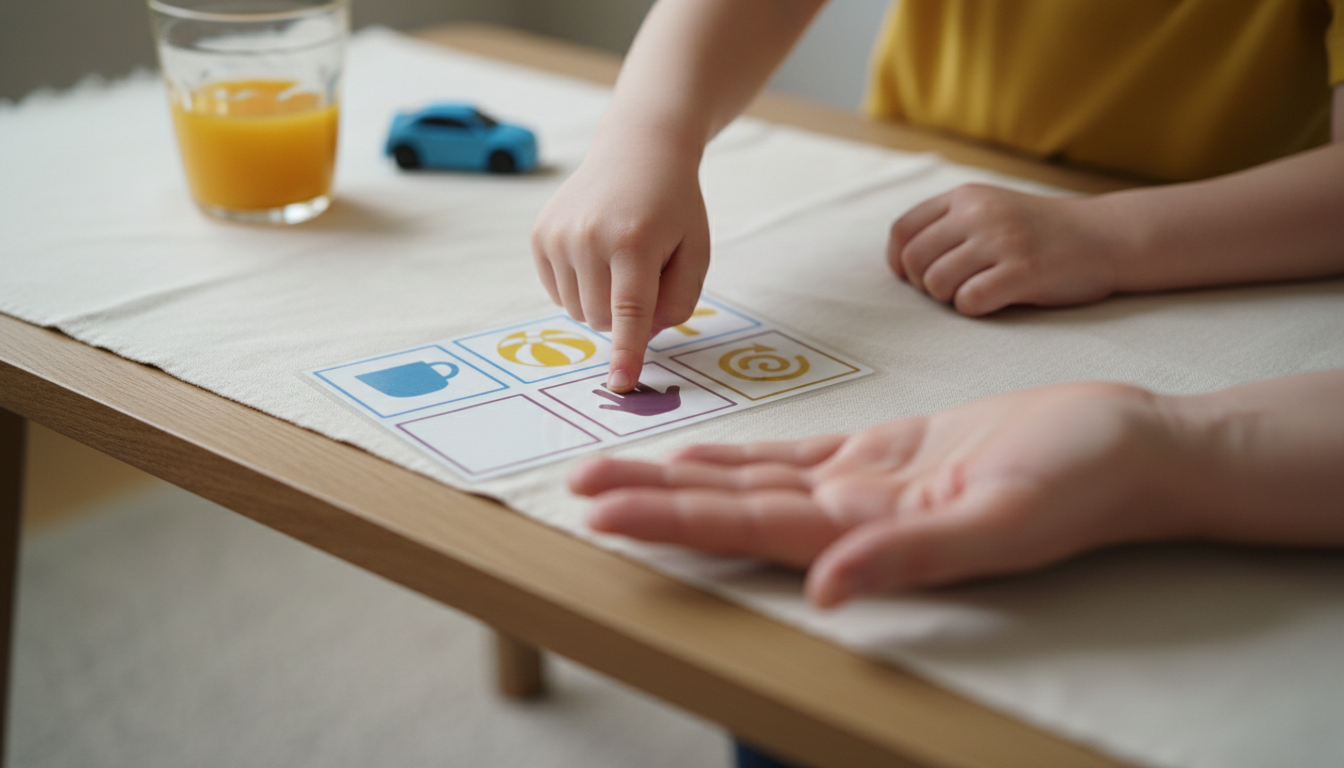
- Use gestures such as waving, nodding or shaking their head.
- Enjoy pretend play, such as feeding a teddy.
- Understand more than they can say.
- Get frustrated when you don’t understand them.
Try it today: 10 minutes of watch-and-wonder play
This simple activity helps you notice how your child communicates, so you can share clear examples with a professional.
- Sit on the floor with a few favourite toys and a picture book.
- Follow your child’s lead for 10 minutes. Don’t quiz them.
- Notice: Do they look at you to share fun? Do they point, show or bring you things? Do they turn when you say their name?
- Try a simple game, such as peekaboo or rolling a ball back and forth. Do they wait for their turn?
- Write down what you saw straight after. A short phone video can help too.
Want to spot and share the signs with confidence?
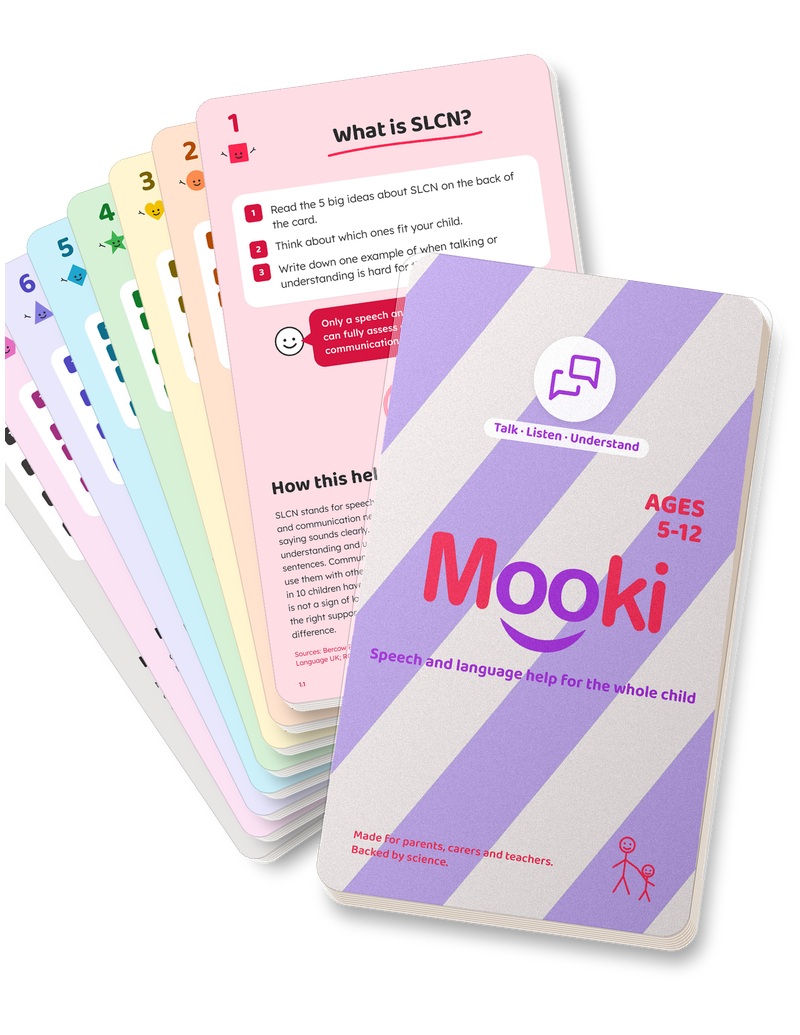
Our Spot the Signs and Talk Detective cards help you notice how your child communicates and record clear examples to share. They're two of 56 ten-minute activities in the Mooki Cards Speech and Language deck.
Instant download · use on a phone or tablet, or print and fill in at home or school
Early autism signs to look out for
Autism is a lifelong difference in how a person experiences the world, communicates and connects with others. Many autistic people prefer identity-first language (“autistic child”), so we use it here.
The CDC’s list of autism signs includes:
- Not responding to their name by 9 months.
- Using few or no gestures, such as waving, by 12 months.
- Not showing you things they like by 15 months.
- Not pointing to show you something interesting by 18 months.
- Avoiding or not keeping eye contact.
The NHS guide to autism signs in children also mentions repeating words or phrases, talking at people rather than with them, strong interests and getting upset by changes to routine.
The AAP adds that you should tell your child’s doctor if your child can say the alphabet or TV jingles but doesn’t use words to ask for things. Always mention it if your child stops talking or doing things they used to do.
| More like a speech or language delay | Could be early signs of autism |
|---|---|
| Points and shows to share interest | Rarely points or shows things to share |
| Usually responds to their name | Often doesn’t respond to their name |
| Uses gestures to get their message across | Uses few gestures |
| Enjoys back-and-forth games like peekaboo | Less interested in shared games |
| Plays pretend with toys | Plays in repeated ways, such as lining things up |
Remember, no single sign means autism. Every child is different, and this table is a guide, not a test.
Why an assessment matters, and what to do next
Whatever you notice, only a proper assessment can tell you what’s going on. It matters because:
- Hearing comes first. A hearing test checks that your child can hear speech clearly.
- Help can start early. Your child doesn’t need a diagnosis to get speech and language support.
- It might be both. Some autistic children also have a language delay or disorder.
- The right support depends on the reason. Help for a late talker and help for an autistic child can look different.
If your child’s doctor says “wait and see” but you’re still worried, the AAP says it’s OK to ask for a second opinion.
If you’re worried, talk to your GP or paediatrician, or your child’s nursery or school.
In the UK:
- Talk to your health visitor or GP. They can refer your child for a hearing test and to speech and language therapy. In many areas, you can also contact speech and language therapy yourself.
- If autism is a possibility, your GP can refer your child for an autism assessment. The NHS follows NICE guidance on recognising and referring autism in under 19s.
- If your child is at nursery, talk to the SENCo (special educational needs co-ordinator).
In the US:
- Talk to your pediatrician. They may use a questionnaire, order a hearing test and refer you to a speech-language pathologist.
- For children under 3, you can contact your state’s early intervention programme yourself. For children aged 3 and over, contact your local school district.
While you wait: what helps either way
The same everyday strategies help both late talkers and autistic children:
- Get down to their level and follow their interests.
- Use short, simple phrases, just a little longer than what your child says.
- Comment rather than question. Say “Big truck!” rather than “What’s that?”
- Wait. Give your child time to respond in any way, with a look, sound, gesture or word.
- Value all communication, including pointing, signing and pictures. The National Autistic Society says all forms of communication are valid.
The bottom line
A 3 year old who isn’t talking much isn’t always autistic, and an autistic child isn’t “behind” in every way. Look at the whole picture: pointing, showing, sharing and play. Trust your instincts, ask for an assessment and keep playing and talking together. Whatever the answer, you’re giving your child a great start.