This guide is for primary teachers and teaching assistants who want simple speech and language strategies that work for the whole class. You’ll find quick wins for instructions, visuals, wait time and vocabulary, plus a handy checklist.
Most classrooms include children who find talking and understanding hard. The good news is that the strategies that help them help everyone, and many take no extra time at all.
Why speech and language strategies matter in every classroom
Speech, language and communication needs (SLCN) are very common. Speech and Language UK says developmental language disorder (DLD) alone affects about two children in every classroom. Many more have speech sound difficulties, stammering or delayed language.
These needs are often hidden. A child who doesn’t follow instructions may look like they’re not listening or being difficult, when really they haven’t understood. Building good habits into everyday teaching means fewer children fall through the gaps.

Quick wins for giving instructions
Instructions are where many children with SLCN get lost. Try these:
- Get attention first. Say the child’s name and wait until they look before you speak.
- Chunk it. Give one or two steps at a time, not five.
- Keep the order. Say steps in the order they happen. Avoid “before” and “after”, which can be confusing.
- Show it. Point, model or hold up the object as you speak.
- Check understanding. Ask a child to show you what to do first, rather than asking “Does everyone understand?”
Speech and Language UK’s primary strategies give this example: “Pack away your things. Now push in your chairs and line up by the door.”
Try it today: a 10-minute classroom walk
Look at your classroom through the eyes of a child who struggles with language. Speech and Language UK calls this a communication-supportive environment, and suggests a learning walk to check it.
- Stand by the door. Can a child see what’s happening today on a visual timetable?
- Look at your walls. Are key topic words displayed with pictures?
- Check equipment. Are trays and boxes labelled with words and pictures?
- Listen. Is there background noise you could reduce?
- Look at seating. Can children who need it see your face and the board easily?
Pick one change to make this week. Small tweaks add up.
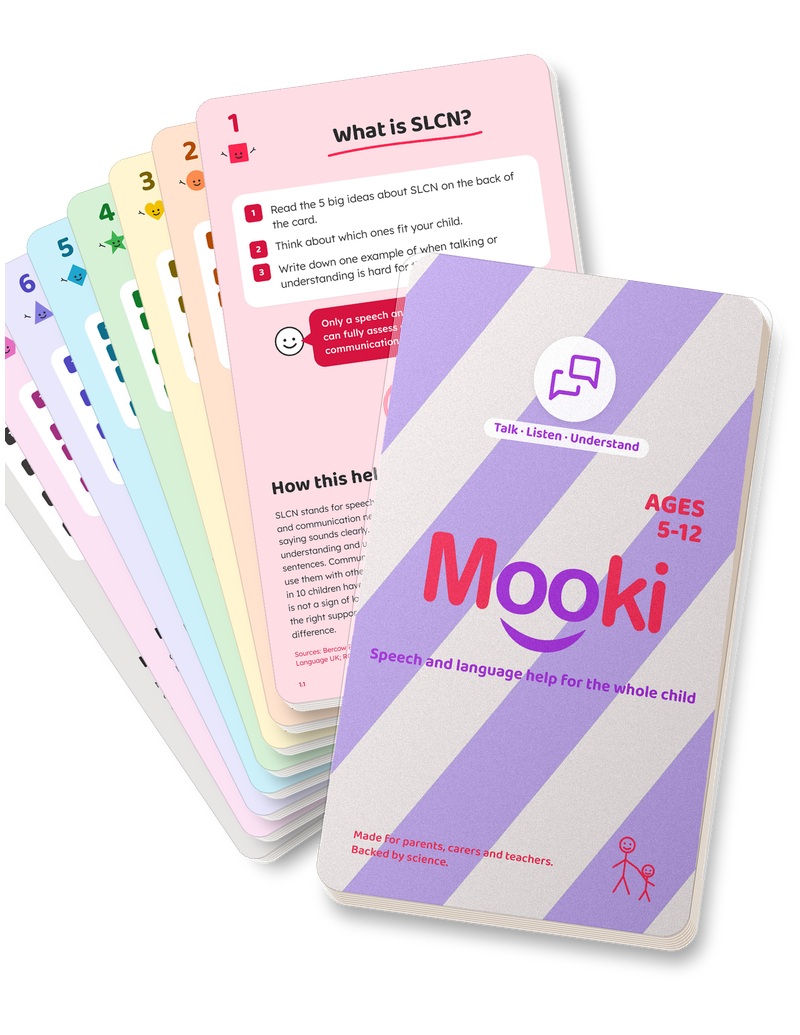
Want classroom tweaks that help every child?
Our Classroom Tweaks, Follow Instructions and Word Webs cards give you ready-made ideas to support talking and understanding. They're three of 56 ten-minute activities in the Mooki Cards Speech and Language deck.
Instant download · use on a phone or tablet, or print and fill in at home or school
Visual supports and word walls
Spoken words disappear the moment they’re said. Visuals stay put, giving children time to understand and remember.
Speech and Language UK’s guide to visual supports explains that pictures, objects, gestures, signs and written words all help. It also reassures that visuals won’t stop children from talking. Useful ideas include:
- A visual timetable for the day, referred to often.
- Word walls with topic words and pictures.
- Now and next boards for children who find change hard.
- Signing systems such as Makaton or Signalong.
- Objects and real items when introducing new ideas.
Wait time, questions and new words
Two of the most powerful speech and language intervention ideas cost nothing: slowing down and teaching words on purpose.
Wait time and better questions
Children with SLCN often need longer to process what they hear and plan what to say.
- Give thinking time. Count to ten in your head before repeating or rephrasing.
- Use talk partners. Let children share ideas with a partner before answering in front of the class.
- Choose your question type. Open questions (“Tell me about…”) encourage longer answers but are harder. Choice questions (“Was it the boy or the dog?”) give support.
- Offer sentence starters, such as “I think that…” or “I agree because…”.
- Model, don’t correct. If a child says “I goed to the park,” reply “Yes, you went to the park.”
Teaching vocabulary
Children with language difficulties often need to hear a new word many times before it sticks.
- Pick key words for each topic and teach them directly.
- Make words memorable. Clap the syllables, say the first sound, act it out and draw it.
- Build word webs. Link new words to what children already know.
- Repeat and revisit. Use new words across lessons and the school week.
- Share words home so families can use them too.
These are great speech and language activities for KS1 (Key Stage 1, Years 1 and 2, roughly kindergarten to first grade in the US) and work well right up to Year 6.
Speech and language checklist for teachers
Use this quick checklist when planning your classroom:
- I get attention before giving instructions.
- I give short instructions in the right order.
- I use visuals alongside talk.
- I give thinking time before expecting answers.
- I teach new words directly and revisit them.
- I plan talk partner and small group opportunities.
- I keep background noise low when children need to listen.
- I share strategies with parents.
Working with the SENCo, SLT and parents
If a child still struggles despite good classroom support, talk to your SENCo (special educational needs co-ordinator). In England, they may need SEN support, with targeted speech and language interventions in small groups. IPSEA notes that schools should meet parents at least three times a year to discuss SEN and progress. A speech and language therapist (SLT) may assess the child and suggest targets. The Royal College of Speech and Language Therapists explains that SLTs in schools also train staff and help make classrooms “communication friendly”.
In the US, a child may get speech-language services through an IEP or classroom changes through a 504 plan. Talk to the school team about an evaluation.
If parents raise worries, encourage them to talk to their GP or paediatrician too.
The bottom line
Good speech and language strategies are simply good teaching. Get attention, keep instructions short, show as well as tell, and give time to think. Small changes to your classroom can help every child feel understood and ready to learn.