3 minute read · By Collette, SEN mum and teacher
Happening right now? Do this.2 minutes
- Keep everyone safe. Move things away, or move others out of the room.
- Say very little. Lower your voice and slow down.
- Turn things down and wait. Less noise, light and demands. Stay close. It will pass.
If meltdowns are becoming unmanageable, like hitting out or your child hurting themselves, you don’t have to cope alone. See getting extra help below.
Words that help
You’re not doing anything wrong. A meltdown isn’t bad behaviour. It’s your child’s body saying “too much”.
It will pass, and it does get easier. Below you’ll find simple things that help, an idea to try on a calmer day, and other parents who really understand.

Afterwards10 minutes
- Once things are calm, offer comfort: a drink, a snack, a blanket, a cuddle if they want one.
- Let them rest. Meltdowns are exhausting.
- Save the talking for later, when everyone is calm.
Meltdown or tantrum? The quick answer
Tantrum
Your child wants something. It often stops when they get it, or when nobody’s watching.
Meltdown
Your child is overwhelmed and has lost control. It carries on even if you give in.
Shutdown
The quiet version: your child goes still, silent or “switched off”.
Later, on a calm day
Help to avoid future meltdowns
Big feelings build up before a meltdown. Two calm activities help you spot them early.
From Mooki Cards · On your phone · Nothing to print
1. Spot the triggers10 minutes
What sets off big feelings?
How can we tell it’s building?
- Sit together at a calm time and tap the things that often set off big feelings. There are no wrong answers.
- Read the tip for each one, and pick one to try this week.
- Then tap the signs you notice when feelings are building, and read what to do for each.
Spotting it early is the key. Knowing the triggers and the signs means you can plan ahead, or step in before a meltdown starts.
Prefer paper? Print the triggers sheet
2. Give the feelings a number10 minutes
Show your child: “Which number are you at?”
Tap a number.
- Look at the numbers together, from 1 (calm) to 5 (exploding).
- Tap a number and ask: “What does your body feel like at this number?” Let your child tap all that fit.
- Do each number. Your child’s own feelings thermometer builds up underneath, with what helps at each one.
- Use the numbers in the day: “Are you at a 2 or a 4?”
Act early. It’s much easier to calm down from a 2 or a 3 than from a 5.
Prefer paper? Print the thermometer sheet
When you’re ready for more
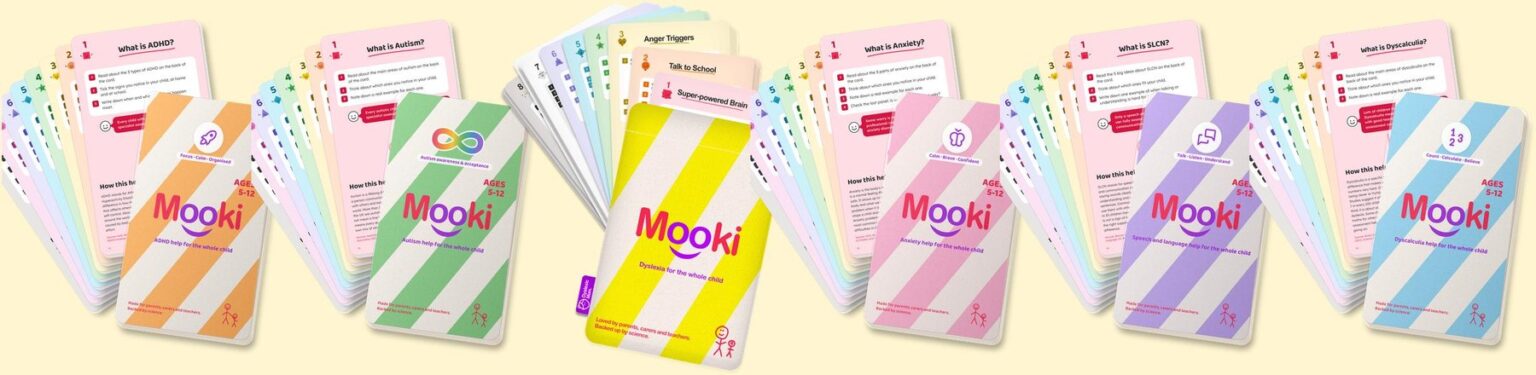
Today’s activities are from Mooki Cards
For any child with big feelings, with or without a diagnosis. There are six decks, so you can pick the one closest to what your child finds hard: ADHD, autism, anxiety, dyslexia, speech and language, or dyscalculia.
Each deck gives you:
- A section on understanding the need, in plain words, so you know what’s going on for your child.
- Calm, 10-minute activities to help, like the two above.
- Everything on your phone, with nothing to print.
Could a special need be behind the meltdowns?
Any child can melt down when they’re overwhelmed. But if it’s happening a lot, it’s sometimes linked to a special educational need. Tap one to see the signs:
- Autism: noise, change or too much going on can quickly feel like too much.
- ADHD: big feelings that flare up fast, especially when asked to stop something.
- Anxiety: worries building up quietly until they spill over.
- Sensory differences: strong reactions to sounds, clothes, food or crowds. These often go along with autism or ADHD.
- Speech and language needs: frustration when they can’t find the words.
- Dyslexia and other learning needs: holding it together at school all day, then letting it out at home.
Not sure? That’s okay, lots of parents are in the same place. You don’t need a diagnosis to use anything on this page. Our Is it SEN? guide has simple checklists. If you’re wondering, have a chat with your school’s SENCo or your GP (or health visitor for under-5s). They can talk it through with you and help you work out what’s going on.
When to get more help
If meltdowns are becoming unmanageable, like hitting out or your child hurting themselves, it’s time to get some extra help. You don’t have to work it out alone. These can help:
- Your GP, who can refer to CAMHS or a children’s service.
- Your school’s SENCo, and your local SENDIASS for free advice.
- YoungMinds Parents Helpline, free on 0808 802 5544 (weekdays 9.30am to 4pm), or webchat on their website.
In the US, talk to your pediatrician or school psychologist.
You don’t have to do this alone
Talk to other parents who really get it in our free Facebook group, Stressed SEN Mums: Find Your Calm. It’s a kind, friendly space to share the hard days and the small wins.
Want to understand it more? Read the full guide
What is a tantrum?
A tantrum is a burst of frustration, usually when a child wants something and can’t have it, or can’t yet find the words. The NHS says temper tantrums usually start at around 18 months and become far less common by age 4, as children learn to talk. During a tantrum, a child still has some control. They may check whether you are watching, and the tantrum often stops when they get what they want or are distracted.
What is an autism meltdown?
A meltdown is not a choice. It happens when an autistic child becomes so overwhelmed that they lose control of their behaviour. The NHS describes meltdowns as something that can happen when a child feels very overwhelmed or upset. The National Autistic Society is clear that a meltdown is not a tantrum and not naughty behaviour. Common triggers include sensory overload (noise, bright lights, crowds, smells or scratchy clothes), sudden change, holding it together all day at school, communication stress, and tiredness, hunger or pain.
What is a shutdown?
A shutdown is the quiet version of overwhelm. Instead of exploding, the child withdraws. They may go silent, stop responding, hide under a blanket or seem “switched off”. Shutdowns are easy to miss, especially in quiet children, but they need the same care as a meltdown.
Tantrum vs meltdown vs shutdown at a glance
| Feature | Tantrum | Meltdown | Shutdown |
|---|---|---|---|
| What it is | Frustration with a goal | Overwhelm, loss of control | Overwhelm, withdrawal |
| Does an audience matter? | Often | No | No |
| Does giving in stop it? | Often | No | No |
| What helps | Calm limits, distraction | Safety, less input, time | Quiet, space, time |
| Afterwards | Back to normal fairly fast | Exhausted, may need rest | Tired, slow to re-engage |
The stages of a meltdown
You may see “6 stages of autism meltdown” online. Most guides describe the same pattern in three parts. Build-up (rumble): fidgeting, pacing, covering ears, getting louder or quieter. This is the best time to step in. Peak: shouting, crying, running or hitting out. Your job now is safety, not teaching. Recovery: your child may be exhausted, tearful or very quiet, and needs rest and reassurance, not a lecture.
If your child becomes aggressive
An aggressive child with autism is usually a frightened, overwhelmed child. Protect yourself and others, give space if you can, and keep your voice low. Don’t hit back or shout. If aggression is frequent or someone is getting hurt, ask for help. The NICE guideline on behaviour that challenges recommends finding out what triggers the behaviour before choosing support.
ADHD meltdown vs autism meltdown
Children with ADHD can also have big emotional explosions, often linked to impulsivity, frustration or being asked to stop something they enjoy. They may flare up and settle quickly. Autism meltdowns are more often caused by sensory overload, change or a build-up of stress. Some children are both, so it helps to look at the trigger each time rather than the label.
2 year old tantrums and autism
Lots of 2 year olds have frequent tantrums, so tantrums alone are not a sign of autism. Talk to your health visitor or GP (or pediatrician in the US) if tantrums come with other signs of autism, such as not responding to their name, little interest in other children, or very strong reactions to sound or touch.
Make a 10-minute calm plan together
When everyone is calm, fill in a simple plan together, using pictures for younger children: my warning signs, three things that often lead to a meltdown, what helps me, what grown-ups can do (“Talk less”, “Stay near”), and what I like afterwards. Keep a copy on the fridge or your phone, and share it with school.
Support for you
YoungMinds has support for parents worried about a child’s wellbeing, and the AAP’s guide to understanding autism helps US families. If you need a breather yourself, try our calm moments for SEN parents.