Is dyscalculia a learning disability, a disability, or SEN? The answer depends on where you live and who is asking. This guide untangles the UK and US labels and explains what each one can unlock at school.
Labels can feel confusing, and some parents worry they will hold a child back. In practice, the right label is often the key that opens the door to support.
Is dyscalculia a learning disability? The short answer
- In the UK: dyscalculia is called a specific learning difficulty (SpLD). It is not a “learning disability”, which in the UK means a general difficulty with learning and everyday life.
- In the US: dyscalculia is usually called a specific learning disability (SLD) in math. Here, “learning disability” does not mean low intelligence.
So the same child might be described as having an SpLD in Manchester and an SLD in Michigan. Both labels describe the same thing: a specific difficulty with numbers in a child who may be doing well in other areas.
UK: dyscalculia as a specific learning difficulty
The British Dyslexia Association publishes the SASC (2025) definition of a specific learning difficulty in mathematics, which assessors use when diagnosing dyscalculia. A specialist teacher or educational psychologist can carry out this assessment.
Is dyscalculia SEN?
Yes, it can be. A child has special educational needs if they need extra or different help to learn. The gov.uk guide to special educational needs explains the two main levels:
- SEN support: extra help in school, organised by the SENCo.
- An EHC plan (education, health and care plan): a legal plan for children with more complex needs.
A formal diagnosis is not needed for SEN support. Schools should respond to a child’s needs, not wait for a label.
Is dyscalculia a disability under UK law?
It might be. Under the Equality Act 2010 definition of disability, a condition counts if it has a “substantial” (more than minor or trivial) and “long-term” (12 months or more) effect on daily life. Whether dyscalculia meets this depends on how much it affects the individual child. If it does, schools must make reasonable adjustments.
US: dyscalculia as a specific learning disability
Under IDEA, the US special education law, a specific learning disability can show up as difficulty with math, as well as reading, writing and other skills. The IDEA rules for identifying an SLD list “mathematics calculation” and “mathematics problem solving” as separate areas.
Many schools don’t use the word “dyscalculia” on paperwork. They might write “specific learning disability in math” instead. Doctors and psychologists may use the medical term from the DSM-5-TR: “specific learning disorder with impairment in mathematics”.
What each label unlocks at school
| Label or plan | Where | What it can give |
|---|---|---|
| SEN support | UK (England) | Extra help in school, reviewed regularly with parents |
| EHC plan | UK (England) | Legally binding support for more complex needs |
| IEP | US | Specialised teaching and goals under IDEA |
| 504 plan | US | Accommodations such as extra time or a calculator |
In the US, Section 504 covers students whose impairment substantially limits a major life activity, and learning counts as one. The US Department of Education’s Section 504 FAQ names specific learning disabilities among the conditions covered.
Try it today: explain the label to your child
Children often hear these words before anyone explains them. Spend 10 minutes on a calm chat:
- Say, “Your brain is great at lots of things. Numbers are just trickier for it.”
- Ask your child to name three things they are good at. Write them down.
- Explain that the label helps teachers know how to help, like glasses help eyes.
- Invite questions, and keep the tone light and positive.
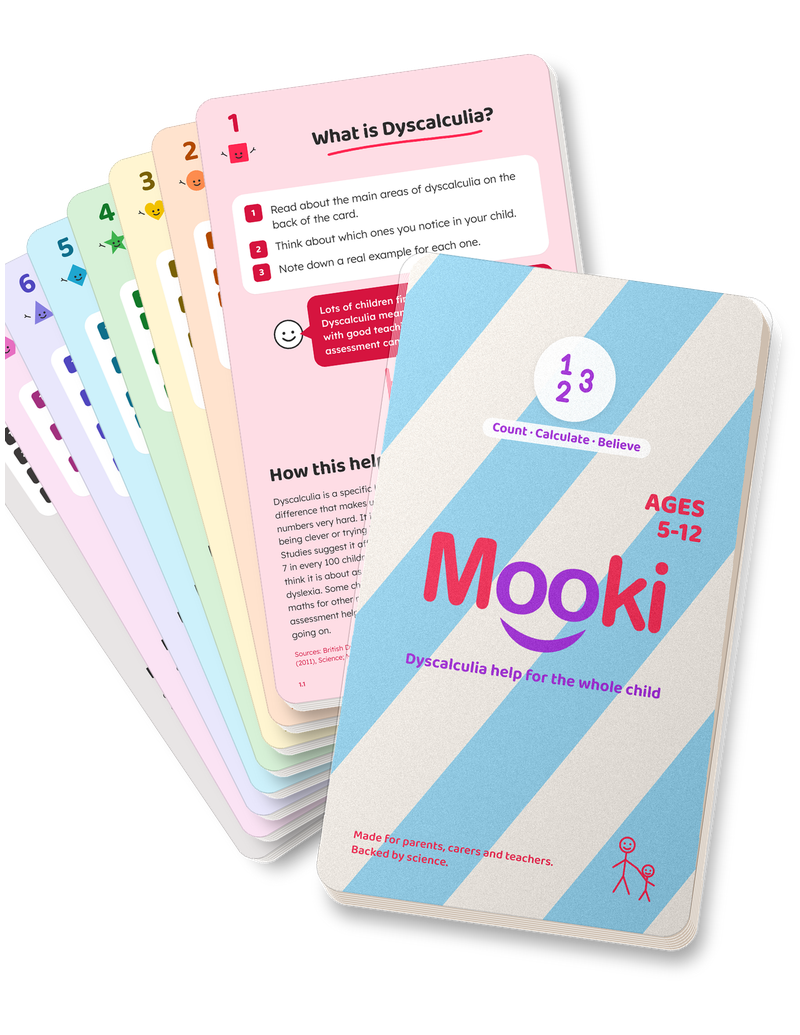
How do you explain dyscalculia to your child?
Explain Dyscalculia helps you talk about it in kind, simple words, and Talk to School helps you ask for the right support. Each is one of 56 ten-minute activities in the Dyscalculia deck.
Instant download · use on a phone or tablet, or print and fill in at home or school
Do you need a diagnosis to get help?
Not always. In the UK, schools should give SEN support based on need, with or without a formal assessment. A diagnosis can still be helpful. It explains why your child finds maths hard, and it can support requests for exam access arrangements or an EHC needs assessment later on.
In the US, public schools must evaluate children suspected of having a disability, free of charge. Understood’s dyscalculia overview explains that a specialist evaluation is the only way to diagnose dyscalculia, and that schools carry these out for free under IDEA.
Words matter: talking about dyscalculia
Whatever the paperwork says, dyscalculia is a difference in how the brain handles numbers. It is not laziness, and it says nothing about how bright your child is. Many families prefer “learning difference” in everyday talk, and use the formal label when asking for support. Both are fine.
If you’re unsure which route is right, talk to your child’s teacher, the SENCo (UK) or the school psychologist (US). These questions can help you get started:
- “Where is my child’s maths compared with others in the class?”
- “What extra help are they getting now, and how often?”
- “Is my child on the SEN register?” (UK) or “Would an evaluation be helpful?” (US)
- “How will we know if the support is working?”
- “What can I do at home to back up what you do in class?”
Write down the answers and agree a date to check in again. A shared plan keeps everyone pulling in the same direction.
The bottom line
In the UK, dyscalculia is a specific learning difficulty and can count as SEN. In the US, it is a specific learning disability in math under IDEA. Different words, same child: and in both countries, the label is simply a tool to get your child the help they deserve.