How do you support a non-verbal autistic pupil in the classroom? Here’s how to understand their communication, set up visuals and choices, include them in lessons, a 10-minute choice-making activity to try today, and how to work with parents and therapists.
Having a pupil who doesn’t use speech can feel daunting at first. You may worry you won’t know what they need, or that they’ll miss out on learning. But every pupil communicates. Your job is to find out how, and give them more ways to do it.
The Offer Choices and Visual Timetable cards in the Mooki Autism deck are a simple place to start.
What does “non-verbal” mean?
“Non-verbal” usually means a pupil uses little or no spoken language. Many autistic people prefer the words “non-speaking” or “minimally speaking”. That’s because many use other kinds of communication, and some can use some words at some times.
Important things to remember:
- not speaking doesn’t mean not understanding – many non-speaking pupils understand far more than they can say
- behaviour is communication – pulling you to the door, pushing work away or hand-flapping can all be messages
- speech can vary – some pupils can talk on good days but lose words when tired, stressed or overloaded
- talk to them, not about them – always assume they can hear and understand you
How to communicate with a non-verbal autistic pupil
Try these everyday strategies:
- Say less – use short, clear phrases, like “Coat on” instead of “Can you go and get your coat now please?”
- Show as you say – point, gesture or hold up a picture or object
- Wait – count to 10 in your head after you ask something, to give time to process and respond
- Offer choices – hold up two options, like “apple or banana?”, and let them point, look or take one
- Use their way – if they use signs, pictures, a communication book or a device, learn it and use it too
- Model, don’t test – use their system yourself, without asking them to “say” or “show” things on demand
Visuals and AAC in the classroom
AAC means augmentative and alternative communication. It’s any way of communicating that adds to or replaces speech. It includes signing, pictures, communication books, and apps or speech-generating devices.
The American Speech-Language-Hearing Association says AAC doesn’t stop children learning to talk, and it can support speech. Our guide to AAC devices for autism explains low-tech and high-tech options.
Some pupils use PECS (the Picture Exchange Communication System). According to Pyramid Educational Consultants, who developed PECS, pupils start by handing over a single picture to ask for something they want, and build up to sentences and comments. Some go on to develop speech, and others move on to a speech-generating device.
Try it today: in class – a 10-minute choice-making activity
Choice-making builds communication and helps the pupil feel in control.
- Pick 2 options (1 minute). Choose two things the pupil likes, like two toys, two snacks or two activities.
- Show and say (2 minutes). Hold both up. Say, “Bubbles or music?” Point to each one as you say it.
- Wait (2 minutes). Wait calmly. Accept any clear choice: pointing, reaching, looking, picking up a picture or using their device.
- Give it straight away (2 minutes). Say the word as you give it: “Bubbles.” This links the choice to the word.
- Repeat across the day (3 minutes). Offer one more choice at snack, one in a lesson and one at home time. Use pictures or symbols when you can.
Over time, add more choices, then use choices in lessons, like “red pen or blue pen?” or “maths on the table or on the floor?”.
Want ready-made visuals and choice boards?
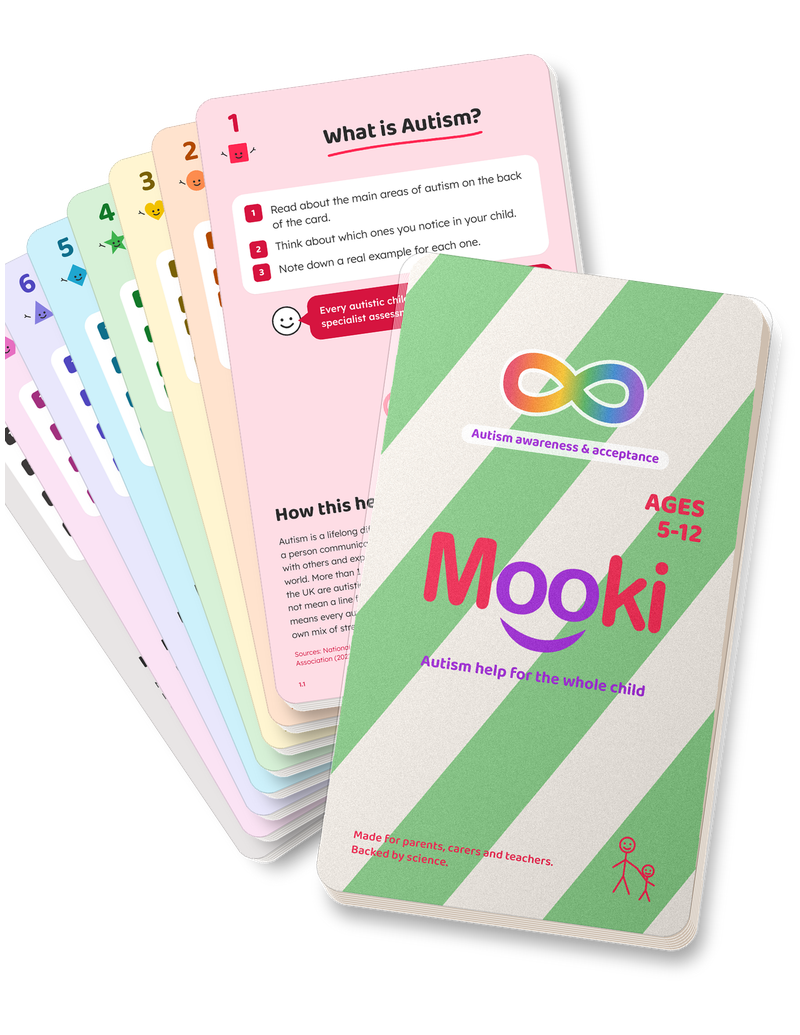
The Offer Choices, Visual Timetable and Now and Next cards give you simple steps and printable visuals to help non-speaking pupils understand their day and tell you what they want. Each is one of 56 ten-minute activities in the Mooki Autism deck. The When Words Won’t Come card in the Mooki Speech and Language deck helps too.
Instant download · use on a phone, tablet or class whiteboard, or print for your pupils
How to include a non-verbal autistic pupil in lessons
Being non-speaking shouldn’t mean being left out of learning. Try to:
- give other ways to answer – pointing, sorting, matching, choosing from cards, or using their device
- prepare vocabulary – add key topic words to their communication system before the lesson
- use real objects – especially for new ideas in science, maths and topic work
- plan for the group – give them a clear role in group work, like holding the timer or choosing the next card
- show the day – use a visual timetable with “now and next”, so changes don’t come as a shock
Pupils who aren’t speaking may also be more easily overwhelmed by noise. Our guide to creating a calming SEND classroom has ideas.
What about secondary school?
The same strategies work for older pupils, but keep visuals age-appropriate. Use photos, real symbols or text instead of cartoon pictures, and let the pupil choose how they look. Teach peers how the pupil communicates, so they can join in. Make sure every subject teacher knows the pupil’s communication system, not just the SEN team.
Working with parents and therapists
Parents are the experts on how their child communicates. Ask them:
- how their child shows “yes”, “no”, “more” and “stop”
- what upsets them, and how they show it
- what words, signs or symbols they use at home
Work closely with the pupil’s speech and language therapist (speech-language pathologist in the US). Use the same system and the same symbols at home and school. A home-school diary with photos helps the pupil share their day.
When to involve the SENCo or outside help
Talk to your SENCo (special education teacher in the US) if a pupil:
- doesn’t yet have a way to communicate their basic needs
- is often distressed, and you can’t work out why
- isn’t seeing a speech and language therapist
Our guides to speech, language and communication needs and speech and language therapy explain what support looks like.
The bottom line
Every pupil communicates. Say less, show more, wait longer and offer choices. Learn the pupil’s way of communicating and use it yourself. You know your pupils best. For ready-made visuals, the Mooki Autism deck has 56 ten-minute cards, including Offer Choices and Visual Timetable.