
Wondering whether your child needs speech and language therapy? This plain-English guide explains what it is, who it helps, what the evidence says, and how to practise at home between sessions.
Lots of parents ask the same question: “Is my child’s talking just a bit behind, or do they need help?” Knowing what speech and language therapy for children involves can make that decision feel much less daunting.
Free 10-minute course
Build a child’s talking confidence
Talking, turn-taking and friendships, in 3 short activities. 10 minutes a day, with free printable worksheets.
What is speech and language therapy?
Speech and language therapy is support for children and adults who find it hard to communicate. It is given by a trained speech and language therapist (SLT), called a speech-language pathologist (SLP) in the US.
For children, therapy usually focuses on everyday skills: understanding what people say, finding the right words, making speech sounds clearly, speaking smoothly and taking part in conversations. According to the Royal College of Speech and Language Therapists, SLTs also help with eating, drinking and swallowing.
Paediatric speech and language therapy is mostly play-based. Your child may think they are just playing games, while the therapist is carefully building one skill at a time.
Who needs speech and language therapy?
Children of all ages can benefit. Some common reasons for a referral include:
- Late talking: a toddler who says very few words or isn’t joining words together.
- Unclear speech: a child who is hard for others to understand after age 3 or 4.
- Trouble understanding: a child who often seems not to listen, or only follows part of an instruction.
- Stammering: getting stuck on sounds or words.
- Language difficulties at school: struggling to explain ideas, retell a story or learn new vocabulary.
- Social communication differences: finding conversation, turn-taking or play with others hard.
Some children have a named condition, such as developmental language disorder (DLD), autism, hearing loss or cleft palate. Others don’t, and that’s fine too. A child doesn’t need a diagnosis to get help.
Signs your child may need an assessment
Every child develops at their own pace, but it’s worth asking for advice if your child:
- isn’t using single words by around 18 months
- isn’t joining two words together by age 2
- is often not understood by people outside the family by age 3
- gets very frustrated when trying to talk
- has stopped using words they used to say
Checklists like the CDC milestone checklists can help you spot whether your child is on track. If you’re worried, talk to your health visitor or GP in the UK, or your pediatrician in the US.
Does speech and language therapy work?
Yes, for many children it does. An older but still widely quoted Cochrane review from 2003 pulled together 25 trials of therapy for children with speech and language delay or disorder. It found positive effects for speech sound difficulties and for expressive vocabulary (the words children use). There was little evidence either way for therapy aimed at understanding language, and the authors called for more research.
The same review found that therapy delivered by trained parents worked about as well as therapy delivered by clinicians. That is good news: what you do at home really matters.
The NHS page on stammering also notes that early advice is important, as therapy often works well in the pre-school years.
How can you keep therapy going at home?
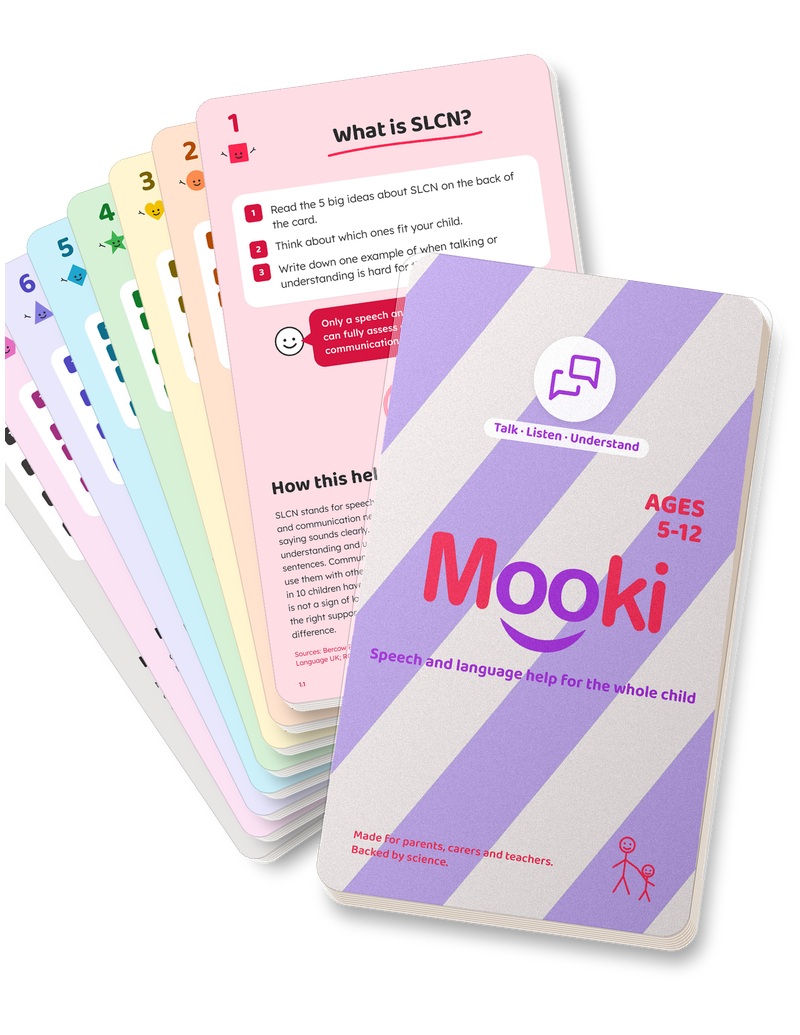
Working with Your SLT keeps goals and home practice in one place, and Sound Play turns speech sounds into a game. It's one of 56 ten-minute activities in the Speech and Language deck.
Instant download · use on a phone or tablet, or print and fill in at home or school
Try it today: a 10-minute practice between sessions
Your therapist will give you targets. Here’s a simple way to practise them in just ten minutes.
- Choose a quiet spot. Turn off the TV and put phones away.
- Warm up (2 minutes). Sing a favourite song or play a quick copying game.
- Target time (6 minutes). Use a game your child loves, such as posting cards in a box, and bring in the target sound or words lots of times.
- Wrap up (2 minutes). Say what went well: “You remembered to use your ‘s’ sound in ‘sun’!”
Keep a little note of how it went, then share it at your next appointment. If something felt too hard, tell the therapist. They can make it easier.
Making the most of therapy at home
Therapy sessions are short, so the real progress happens in daily life. These habits help:
- Talk about what your child is doing. Describe their play: “You’re building a tall tower!”
- Add one more word. If your child says “dog”, you could say “big dog” or “dog running”.
- Give time to answer. Count to five in your head before jumping in.
- Read together every day. Talk about the pictures, not just the words.
- Turn off background noise. The NHS guide to helping your child learn to talk suggests switching off background TV and radio.
- Praise effort, not perfection. Making mistakes is part of learning to talk.
How to get speech and language therapy
UK
Most children get free help through NHS community speech and language therapy. You can ask your health visitor, GP or your child’s school for a referral, and many areas let parents self-refer. At school, the SENCo can arrange support. If your child needs a lot of help, therapy can be included in an education, health and care plan (EHCP).
US
For children under 3, your state’s Early Intervention program can assess your child, and services are free or low-cost for children who qualify. From age 3, your public school district can evaluate your child, and speech therapy may be part of an IEP. You can find a certified therapist through ASHA.
The bottom line
Speech and language therapy helps children understand, talk and connect with others, and the evidence shows it can make a real difference. You don’t need to wait for a diagnosis to ask for help. Short, regular practice at home is one of the most powerful things you can do. The Working with Your SLT card in the Mooki Cards deck is a handy way to keep your child’s goals and home practice in one place.