Looking for word lists to help your dyslexic child read, write and spell? Here are word lists for practising word sounds, syllables and rhymes, with a 10-minute game for each, plus links to the 100 most common words.
Word lists are a quick, cheap way to practise reading, writing and spelling at home. You can use them time and time again, so there’s no need to buy lots of phonics books and flashcards.
Practising sounds, syllables and rhymes builds phonological awareness, the skill of hearing and working with the sounds in words. The British Dyslexia Association explains that this is the area dyslexic children most often find hard.
Start with the 100 most common words, then use the lists below.
Free 10-minute course
Help a dyslexic child learn new spellings
Read, write and remember new words, in 3 short activities. 10 minutes a day, with free printable worksheets.
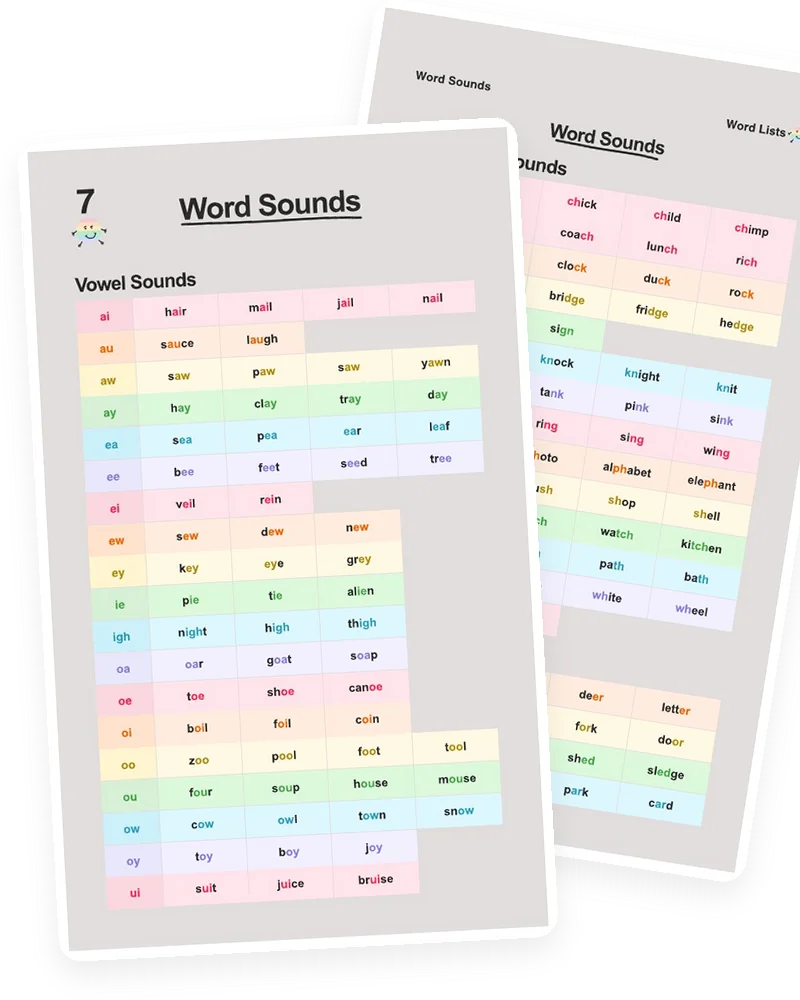
Word sounds word list
Short words with 3 sounds are perfect for practising sounding out and blending. Try these:
- a sounds: cat, hat, map, bag, jam, van
- e sounds: bed, pen, red, leg, net, hen
- i sounds: pig, sit, bin, lip, fix, zip
- o sounds: dog, hot, pot, log, mop, box
- u sounds: sun, bus, cup, mug, hut, rug
For 10-minute word sound games, see:
- Practise phonics sounds with rhyming
- Start and end sounds game
- Blending sounds game
- The foundations of reading
Try it today:
- Pick a short word from the list, for example dog. Say each sound slowly: “d… o… g”.
- Ask your child to say the sounds back to you, then say the whole word.
Syllables word list
Practise words with 1, 2 and 3 syllables. Clapping out the syllables in words helps dyslexic children break longer words into chunks.
- 1 syllable: cat, dog, sun, tree, book, frog
- 2 syllables: rab-bit, win-dow, pen-cil, tea-cher, mon-key, gar-den
- 3 syllables: el-e-phant, ba-na-na, di-no-saur, but-ter-fly, kan-ga-roo, com-pu-ter
Learn more: a learning words game to practise syllables.

Try it today:
- Say a word and clap once for each syllable. For example: cat (1 clap), rab-bit (2 claps), el-e-phant (3 claps).
- Ask your child to pick a word and clap it for you.
Rhyming words list
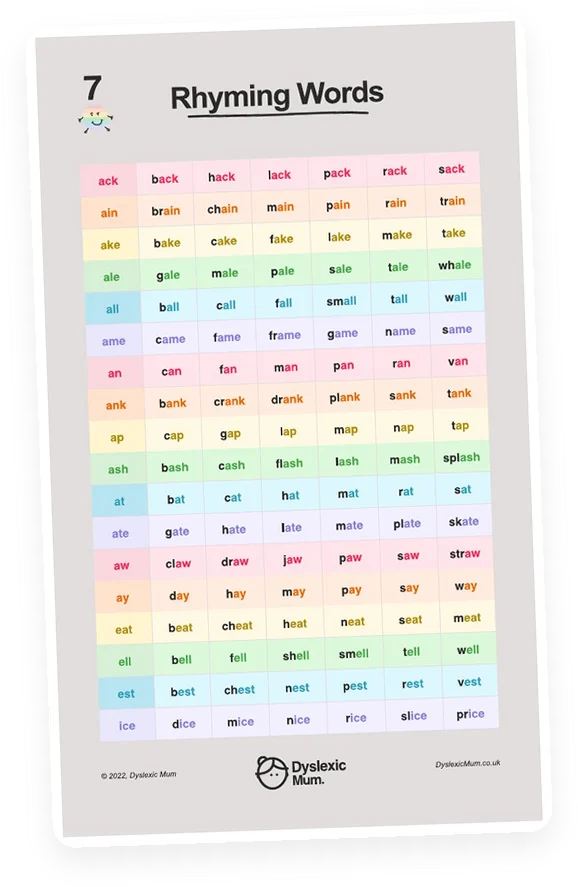
Practise words that rhyme. Rhyming helps your child hear the patterns in words, which helps with reading and spelling.
- -at: cat, hat, mat, sat, bat, rat
- -un: sun, fun, run, bun
- -ig: pig, big, dig, wig, fig
- -op: hop, mop, top, pop, stop
- -ake: cake, bake, lake, make, snake
Learn more: Rhyming Tag game.
Try it today:
- Say a short word, for example sun. Ask your child to think of a word that rhymes, like fun or run.
- Take turns. See how many rhyming words you can find together.
Get all 3 word lists, plus 53 more activities
The Word Sounds, Syllables and Rhyming Words cards have everything in one place: ready-made word lists and steps for you on the front and a picture activity for your child on the back. Each one is one of 56 ten-minute activities in the Mooki Cards deck.
Instant download · use on a phone or tablet, or print and fill in
Could it be something more?
Lots of young children find sounds and rhymes tricky at first. But if your child still can’t hear rhymes or break words into sounds after lots of practice, check the signs of dyslexia in 5 to 10 year olds.
If your child finds it hard to say sounds clearly, or other people struggle to understand them, they may have a speech, language and communication need. A speech and language therapist can help.
More helpful articles
- 100 words every dyslexic child needs to learn
- Words that are hard for dyslexics to read and spell
- 200+ free phonics worksheets
- Reading support for your child (British Dyslexia Association)
The bottom line
Word lists for sounds, syllables and rhymes are a simple way to build the skills dyslexic children find hardest. Use one list a day, in short, fun games. The Mooki Cards deck has 56 ten-minute activities, including Word Sounds, Syllables and Rhyming Words, with ready-made word lists you can use again and again.