If you think your child might have dyscalculia and you live in the US, you can ask the public school for a free dyscalculia evaluation. This guide explains how to ask, who does the testing, what the scores mean, and how to keep maths (math) fun at home while you wait.
Asking for an evaluation can feel daunting. You might worry about making a fuss. But you know your child best, and the law gives you a clear right to ask.
Your right to a free evaluation under IDEA
IDEA (the Individuals with Disabilities Education Act) is the US special education law. It says that a parent, or the school, can request an initial evaluation to find out whether a child has a disability and needs special education.
The evaluation is free. The school needs your written consent before it starts. Once you give consent, federal rules say the evaluation must be done within 60 days, or within your state’s own timeline if it has one.
Under IDEA, dyscalculia usually falls under “specific learning disability” (SLD). The rules for identifying an SLD list both “mathematics calculation” and “mathematics problem solving” as areas that can be affected.
Signs it may be time to ask
Every child learns at their own pace, but these signs, lasting for months despite extra help, are worth raising:
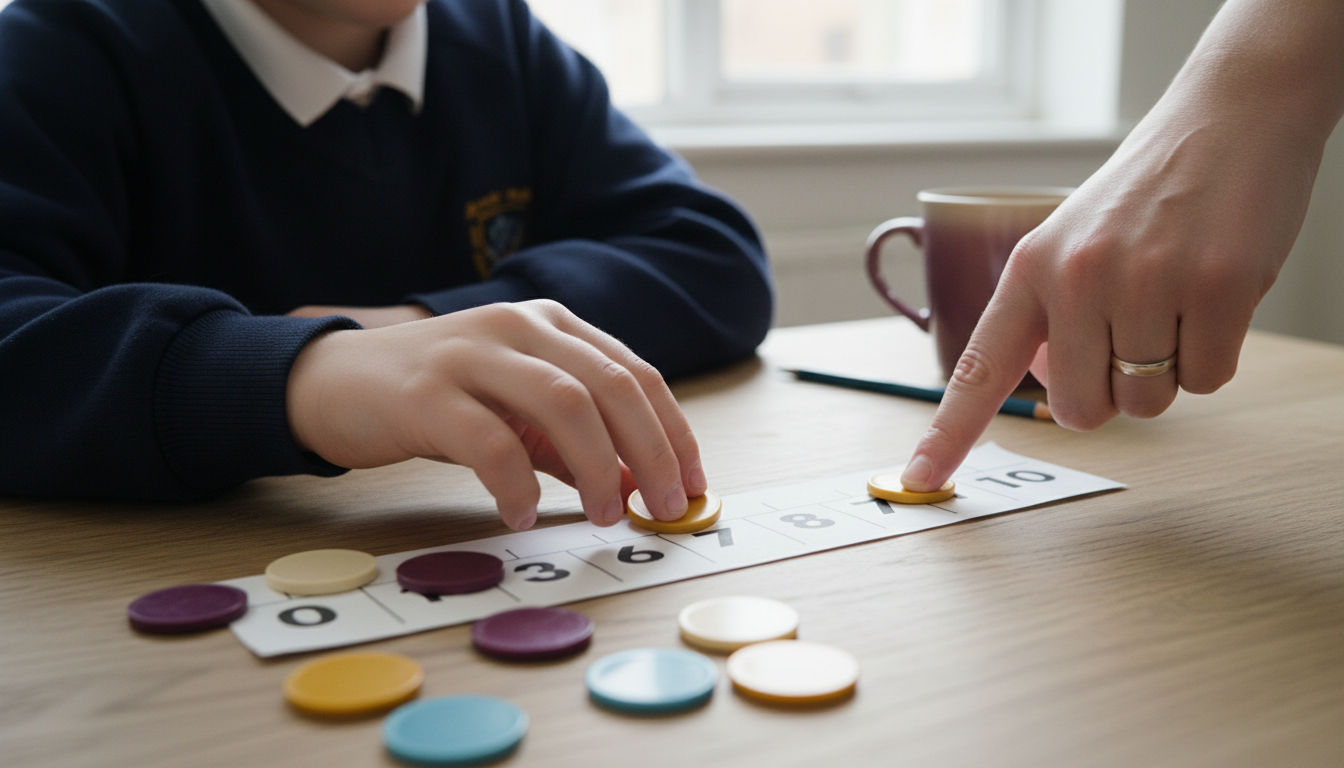
- Counting every object one by one, long after classmates “just see” small amounts.
- Struggling to remember basic facts like 3 + 4, even after lots of practice.
- Mixing up place value, money or time.
- Strong worry or upset around maths lessons and homework.
Try it today: write your request letter
Always ask in writing, by email or letter, and keep a copy. It creates a clear record of the date. Send it to the principal or the special education director. A short request letter can be done in 10 minutes:
- Say what you want: “I am requesting a full evaluation for special education services for my child, [name], in grade [X].”
- Say why: give two or three examples, such as “She still counts on her fingers to add 2 + 3” or “He can’t tell which of two numbers is bigger.”
- Say what you’ve tried: extra help, tutoring or home practice, and what happened.
- Ask for next steps: “Please send me the consent form and let me know the next steps.”
Attach any work samples or teacher comments that show the difficulty. If the school says no, it should explain why in writing.
Keep maths playful while you wait
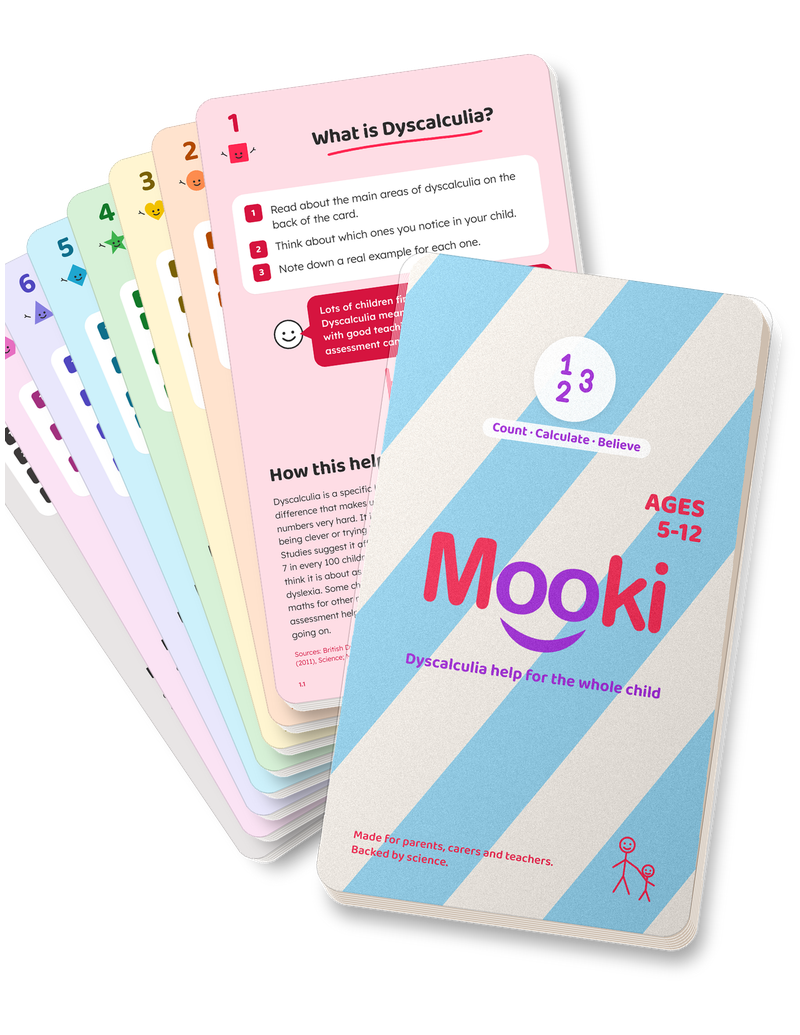
Board Games, Maths Walk and Cooking Maths turn everyday moments into relaxed number practice while you wait for the evaluation. Each is one of 56 ten-minute activities in the Dyscalculia deck.
Instant download · use on a phone or tablet, or print and fill in at home or school
How is dyscalculia diagnosed? Who does the testing
The evaluation is done by a team. It often includes a school psychologist, a special education teacher and your child’s classroom teacher. You are part of the team too.
Understood’s guide to dyscalculia in children explains that a full evaluation takes a few hours, usually spread over several days. Tests may include maths sections of the Woodcock-Johnson or WIAT, and sometimes the Feifer Assessment of Mathematics. The team will usually also look at:
- Basic number sense, such as counting and comparing amounts.
- Maths fact fluency and calculation.
- Word problems and reasoning.
- Memory, attention, language and reading, since dyscalculia often comes with other differences.
- Classroom observations and how your child has responded to extra help.
States cannot require a gap between IQ and achievement to identify a learning disability. They must allow schools to look at how a child responds to research-based teaching, as the IDEA rules on SLD criteria explain.
What do the scores mean?
The report can look like a sea of numbers. A few terms help:
- Standard score: on most of these tests, 100 is exactly average. Scores a little above or below are still in the average range.
- Percentile: shows how your child did compared with others the same age. The 25th percentile means they scored higher than about 25 out of every 100 children their age.
- Subtest scores: show strengths and weaknesses. A big dip in maths, with stronger scores elsewhere, is a common pattern in dyscalculia.
Ask for a copy of the report before the meeting, so you have time to read it. It is fine to say, “Can you explain what this score means for my child in class?”
After the evaluation: next steps
The team meets with you to decide whether your child qualifies for special education. If they do, the next step is an IEP (Individualized Education Program). If your child doesn’t qualify under IDEA, they may still get accommodations through a 504 plan.
If you disagree with the school’s evaluation, you can ask for an Independent Educational Evaluation (IEE) by an outside expert. The Center for Parent Information and Resources guide to IEEs explains when the school must pay for one.
Keep maths playful at home
Waiting for an evaluation can take weeks. In the meantime, keep maths at home light, so your child doesn’t start to dread numbers.
- Play board games with dice and numbered squares.
- Count steps, cars or birds on a walk.
- Measure and pour together when cooking.
- Praise effort and clever thinking, not just right answers.
If you have wider worries about your child’s development or wellbeing, your pediatrician is a good person to talk to as well.
The bottom line
You have the right to ask your child’s public school for a free evaluation, and asking in writing is the best first step. The results can open the door to an IEP or 504 plan. Meanwhile, playful maths at home keeps your child’s confidence growing while the paperwork catches up.