Help a dyslexic child improve reading and writing by building a strong foundation in English.
Children who can read, write and spell basic words will find it easier to learn new information.
If a dyslexic child has gaps in their learning, start by helping them relearn basic words before introducing more difficult tasks.
This approach is based on scientific research, “Reading Development & dyslexia”.
Free 10-minute course
Help a dyslexic child learn word sounds
Fun sound puzzles, in 3 short activities. 10 minutes a day, with free printable worksheets.
Try it today
- Check – write down a few short words, such as “at” and “in”. Ask your child to read and spell each one.
- Spot the gaps – note any words they find hard.
- Practise – pick one tricky word and practise it a little every day.
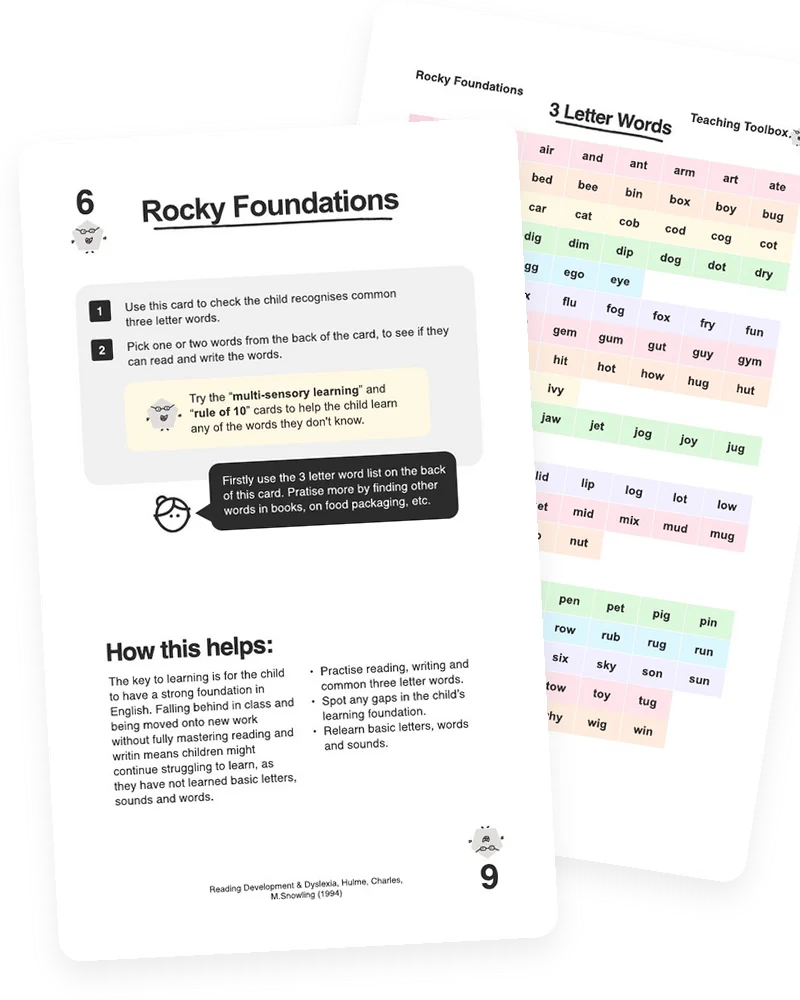
Want to build strong foundations, step by step?
The Rocky Foundations card gives you ready-made steps on the front and a picture activity for your child on the back. Everything is in one place. It’s one of 56 ten-minute activities in the Mooki Cards deck.
Instant download · use on a phone or tablet, or print and fill in
Struggling with rocky foundations
Read how having rocky foundations in reading and writing affected the Dyslexic Mum when learning at school:
A parent’s story
“As a child, I struggled at school with learning to read and write. My teacher used to say the more you read, the better your writing and spelling will be. Well, I read, I loved reading, yet I never got any better.
The problem was that I had never mastered the basics of reading and writing. I had rocky foundations: my knowledge of basic two- and three-letter words was patchy, and that made it harder for me to learn new things.”
And as an adult:
“Dyslexia still affects me every day, but I’ve learned lots of tricks to get by. I couldn’t have done my teaching jobs without a spell checker. When I write letters, I guess where the commas and full stops go. When I read a new word, I find it very hard to sound out, so I ask someone to say it out loud to help me remember it.
Many of my problems come from big gaps in my learning at school. Dyslexia made it hard for me to learn, and rather than helping me catch up, teachers simply moved me on to new work. Some even punished me by making me stand in the corridor during lessons, so I missed even more. That’s why my foundations in reading and writing are still rocky today.”
Learn basic 1, 2, 3 letter words
When checking basic words with a dyslexic child, look for any gaps in their learning.
Use multi-sensory learning and the Rule of 10 to help them relearn basic words in a dyslexia-friendly way.
See links to more helpful activities below: