If you’ve heard the term developmental language disorder (DLD) and want to know what it means for your child, this guide is for you. You’ll find clear signs to look for at home and school, how DLD differs from dyslexia, and practical ways to help.
DLD is one of the most common childhood conditions that most people have never heard of. Knowing about it can help you spot it, get support and explain it to others.
What is developmental language disorder?
Developmental language disorder is a long-term difficulty with understanding and using spoken language. There is no obvious cause, such as hearing loss or another known condition. Children with DLD often have lots of ideas, but find it hard to put them into words or to follow what others say.
A few key facts:
- DLD is not caused by parenting, screen time or anything you did.
- It is not a sign of low intelligence. Children with DLD can be bright, creative and capable.
- It is a difference in how the brain learns language. Research suggests genes play a part.
- It is lifelong, but the right support makes a big difference.
DLD signs at home and school
Every child with DLD is different. Signs can also change as your child grows. Look out for patterns that carry on over time.
Understanding language
- Struggles to follow instructions, especially long ones.
- Finds it hard to answer questions, or answers a different question.
- Seems not to listen, when really they haven’t understood.
- Has trouble learning and remembering new words.
Using language
- Uses short or muddled sentences for their age.
- Makes lots of grammar mistakes, such as missing word endings.
- Struggles to find the right word and says “thing” or “that one” a lot.
- Finds it hard to tell a story or explain what happened in order.
Learning and friendships
- Finds reading comprehension and writing hard.
- Struggles in group chats and playground games.
- Gets frustrated, upset or withdrawn, especially in busy, wordy situations.
In the early years (UK Reception, or kindergarten in the US), DLD may look like a child who isn’t speaking in full sentences, struggles to find words or has conversations that don’t quite make sense.
Try it today: a 10-minute word game
New words are often tricky for children with DLD, so make them memorable.
- Pick one useful word from this week, such as “enormous” or “melt”.
- Say it clearly and clap out the syllables together.
- Talk about what it means, using an object, picture or action.
- Think of words that go with it (melt: ice, chocolate, sun, hot).
- Take turns using it in a sentence. Put a drawing of it on the fridge and use it again during the week.
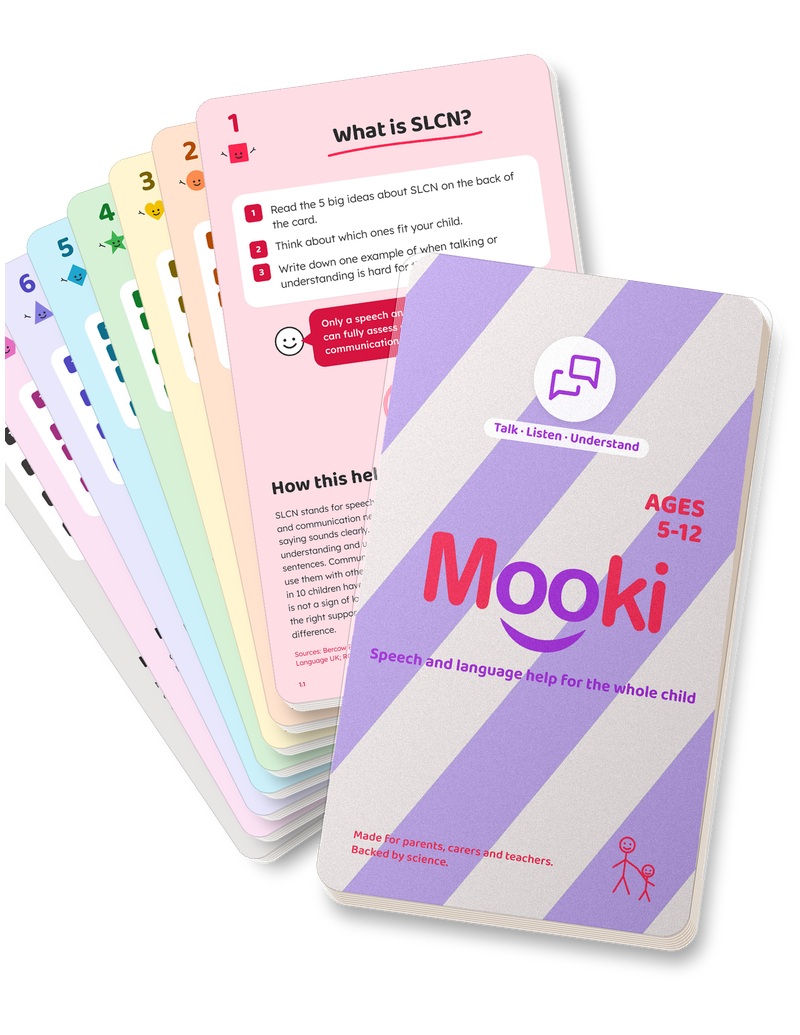
How can you explain DLD and build new words?
Our What is DLD? and Word of the Week cards make DLD easy to understand and new words easier to learn. They're two of 56 ten-minute activities in the Mooki Cards Speech and Language deck.
Instant download · use on a phone or tablet, or print and fill in at home or school
DLD vs dyslexia: what’s the difference?
DLD and dyslexia are different, but they often overlap.
| DLD | Dyslexia |
|---|---|
| Mainly affects spoken language: understanding and talking | Mainly affects reading and spelling words accurately |
| Can affect vocabulary, grammar, storytelling and conversation | Linked to difficulties with sounds in words and memory |
| Often shows up before school | Often noticed when reading starts |
Many children have both. A research review by Adlof and Hogan explains that children with dyslexia often have wider language difficulties too. So if your child has a dyslexia diagnosis but also struggles to understand or explain things, ask whether their spoken language has been checked.
How common is DLD, and how is it diagnosed?
DLD is surprisingly common. A large UK study of children starting school (Norbury and colleagues, 2016) found that about 7.6% of 4 to 5 year olds had a language disorder with no known cause. That’s about 2 children in every class of 30.
The Royal College of Speech and Language Therapists and Speech and Language UK both use this figure. Speech and Language UK calls DLD a hidden disability, so many children are missed, or their struggles are put down to behaviour or not trying.
DLD’s old name: specific language impairment
You may have heard of “specific language impairment” (SLI). In 2017, an international group of experts in a study called CATALISE agreed to use the term “developmental language disorder” instead. The charity RADLD explains that DLD is the new term that replaced SLI.
CATALISE also agreed that DLD can happen alongside other conditions, such as ADHD. A child doesn’t need a big gap between their language and other skills to be diagnosed.
Getting a diagnosis
DLD is usually identified by a speech and language therapist (SLT) after a detailed assessment. They’ll also want to rule out hearing difficulties and other causes. It’s often confirmed around school age, once it’s clear that difficulties are lasting.
If you’re worried, talk to your GP or paediatrician, or your child’s school.
In the UK:
- Ask your GP, health visitor or school about a referral to the NHS speech and language therapy service.
- Talk to the school SENCo (special educational needs co-ordinator) about SEN support. If your child needs more help, you can ask about an EHCP (education, health and care plan).
- The charity Afasic supports parents of children with DLD and other speech and language needs.
In the US:
- Talk to your pediatrician, who can refer you to a speech-language pathologist (SLP).
- Ask your school district for an evaluation. Under IDEA, a child may qualify for an IEP under “speech or language impairment”.
- Note that DLD may be called “language disorder” in some reports.
Everyday ways to support your child
Small changes help a lot:
- Get their attention first. Say their name and wait until they look.
- Keep instructions short and give them in the order they should happen.
- Show as well as tell. Use gestures, pictures and real objects.
- Give extra thinking time. Count to ten in your head before repeating.
- Check understanding by asking them to show you, not just “Do you understand?”
- Build on their strengths, whether that’s drawing, sport, building or music.
The bottom line
Developmental language disorder is common, hidden and lifelong, but it is not a dead end. With understanding at home and the right support at school, children with DLD can learn, make friends and thrive. You’re already helping just by learning about it.