If you’ve heard about the 3 levels of autism and wondered what they mean for your child, this guide explains the US support levels, how UK diagnosis differs, why old labels have been retired, and why support needs can change from day to day.
Parents often come across terms like “level 2”, “mild autism” or “Asperger’s” and feel confused. Some are current, some are out of date, and some were never official. Let’s untangle them.
What are the 3 levels of autism?
The three levels come from the DSM-5, the diagnostic manual used mainly in the US. When a child is diagnosed with autism spectrum disorder (ASD), the clinician can also describe how much support they need in two areas: social communication, and restricted or repetitive behaviours.
The CDC’s summary of the DSM-5 criteria sets out the three levels:
| Level | Official wording | What it might look like |
|---|---|---|
| Level 1 | Requires support | Can talk in full sentences but finds conversations, flexibility and change hard without support |
| Level 2 | Requires substantial support | Clear differences in communication, and routines or repeated behaviours that affect daily life, even with support in place |
| Level 3 | Requires very substantial support | Very limited speech or social interaction, and great difficulty coping with change |
The examples in the right-hand column are simple illustrations, not the clinical definitions.
Important points about levels:
- They describe support needs, not intelligence, value or potential.
- A child can be at a different level for communication than for routines and behaviour.
- Levels can change as a child grows, learns and gets support.
Types of autism: is there more than one?
Today, there is just one diagnosis: autism spectrum disorder. The old “types of autism” were folded into it.
Under the older DSM-IV manual, US doctors could diagnose several separate conditions, including autistic disorder, Asperger’s disorder and PDD-NOS. The DSM-5 combined them, so each is now seen as a form of autism rather than a separate condition. The CDC notes that children with a well-established earlier diagnosis of any of these should now be given an ASD diagnosis.
The World Health Organization’s ICD-11, used in the UK and many other countries, also uses a single autism spectrum disorder diagnosis. The National Autistic Society explains that UK teams base a diagnosis on either the DSM-5 or ICD-11.
What about “5 levels of autism” or “3 types of autism”?
You may see these phrases online. They are not official. Some websites mix up old diagnoses, support levels and personal opinions. If someone uses them, it’s fine to ask what they mean.
UK practice: one diagnosis, described in detail
In the UK, NHS teams usually give a single diagnosis of autism, sometimes called autism spectrum disorder (ASD) or autism spectrum condition (ASC). They don’t usually give a level.
Instead, the assessment report describes your child’s individual profile: their strengths, their difficulties and the support they need. NICE guidance asks teams to share a written report explaining the findings. This detailed picture is often more useful than a number, especially for schools writing a support plan or an EHCP.
If your family moves between the UK and US, you may find one report has a level and another doesn’t. That’s normal.
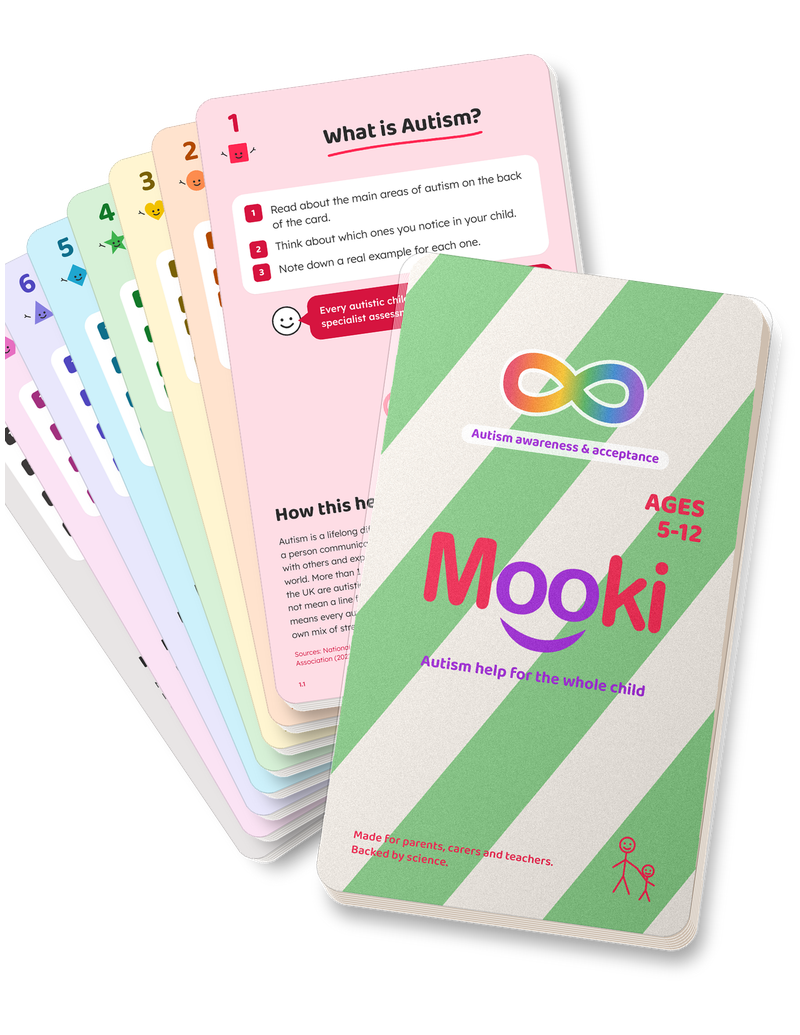
Want to focus on your child's strengths and needs?
Mooki's My Strengths, Support Plan and My Energy Battery cards help you build a clear, positive picture of what your child needs each day. Each is one of 56 ten-minute activities in the Autism deck.
Instant download · use on a phone or tablet, or print and fill in at home or school
Why old labels like Asperger’s are retired
Asperger’s
Asperger syndrome was used for autistic people without a language delay or learning disability. It is no longer a diagnosis in the DSM-5 or ICD-11. The National Autistic Society notes that Asperger syndrome is no longer used as a diagnostic term. Some adults diagnosed with it years ago still use the word for themselves, and that’s their choice.
“Mild autism” and “severe autism”
These words are common, but they’re not diagnoses. They also miss how autism really works. A child described as “mild” may be very good with words but still struggle hugely with anxiety, sensory overload and exhaustion. A child described as “severe” may have many strengths that go unseen.
Functioning labels
You may still hear children described as “high” or “low” functioning. Many autistic people and professionals now avoid these labels because:
- They are based on how a child looks to others, not on what they find hard.
- “High” can lead to needs being ignored.
- “Low” can lead to strengths and potential being ignored.
The National Autistic Society instead talks about varying support needs and a “spiky profile”, where a person may be very skilled in one area and need lots of help in another. This is a more accurate and respectful way to describe autism.
Why support needs vary from day to day
Support needs are not fixed. The same child can need very different support on different days, or even at different times of day. Things that can change it include:
- Tiredness, illness or hunger
- Sensory overload, such as a noisy trip or a busy classroom
- Changes to routine, like a supply teacher or a holiday
- Stress and anxiety
- Masking, which uses up a lot of energy
The NAS guide to sensory processing explains that sensitivity can shift with tiredness, stress and illness. So a child who copes well on Monday may need much more help by Friday.
Try it today: a 10-minute “good day, hard day” chart
This helps you and your child notice what affects their support needs.
- Draw two columns: “Good day” and “Hard day”.
- Together, list what makes a day feel good, such as enough sleep, a favourite lunch or time for an interest.
- Then list what makes a day feel hard, such as loud places, surprises or being tired.
- Add one helpful thing for hard days: a quiet space, a movement break, or fewer demands.
- Share the chart with your child’s school.
The bottom line
Levels, labels and types can be confusing, but your child is not a number. Whether their report has a level or not, what matters is a clear picture of their strengths and the support they need, which can change from day to day. If you’re worried, talk to your GP or paediatrician, or your child’s school. Focus on what helps your child feel safe, understood and able to thrive.