If your child has been referred for an autism assessment, or you’re wondering what age autism is diagnosed, this guide walks you through a UK NHS assessment step by step, explains tools like the ADOS, ADI-R and 3di, and shows how to prepare your child.
Waiting for an assessment can feel like a long, uncertain road. Knowing what will happen, and why, makes it far less daunting for you and your child. Let’s go through it together.
What age is autism diagnosed?
Autism can be diagnosed at any age, from toddlers to adults. The US National Institute of Mental Health explains that signs generally appear in the first two years of life.
The CDC says that by age two, a diagnosis by an experienced professional can be considered reliable. However, many children are not diagnosed until much later. Children whose signs are quieter, including many girls and children who mask, may not be diagnosed until primary school age or later.
So the age of autism diagnosis varies a lot. There is no “too early” to ask questions and no “too late” to get answers.
The UK NHS route: step by step
1. Referral
Talk to your GP, health visitor (for under-fives) or your child’s school or SENCo. Any of them may be able to refer your child to the local autism or child development team. The NHS autism assessments page explains the process. If a referral is turned down, you can ask another GP for a second opinion.
2. Waiting
NICE guidance says an autism assessment should start within three months of referral. In reality, many families wait much longer. In England, the Right to Choose may let you pick a different NHS-funded service with a shorter wait.
While you wait, your child can still get support at school. SEN support does not need a diagnosis.
3. Information gathering
The team may send questionnaires to you and to your child’s nursery or school. They may ask for reports from other professionals, such as a speech and language therapist.
4. The assessment
The assessment is carried out by a team of professionals, often over more than one appointment. NICE says the core team should include a paediatrician or child psychiatrist, a speech and language therapist and a psychologist. They will:
- Ask about your child’s development from birth
- Watch your child play, talk and interact
- Check for other conditions, such as ADHD
- Look at reports from nursery or school, and may visit to observe
5. Feedback and report
You’ll meet the team to hear the outcome and the reasons for it. You should get a written report describing your child’s strengths and needs, and a copy goes to your GP.
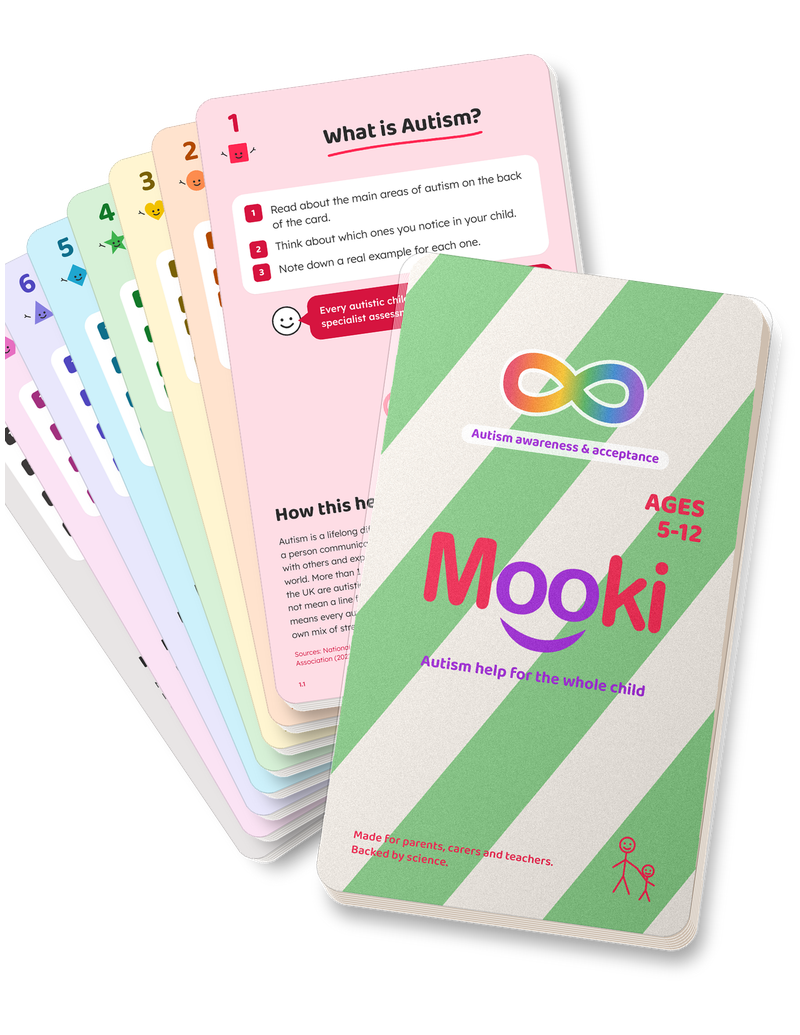
Want to help your child feel ready for appointments?
Mooki's Getting Assessed, Doctor and Dentist and Social Stories cards help your child know what to expect and feel calmer. Each is one of 56 ten-minute activities in the Autism deck.
Instant download · use on a phone or tablet, or print and fill in at home or school
ADOS, ADI-R and 3di autism tools explained
Teams often use structured tools to collect information in a consistent way. The National Autistic Society lists the most common ones. NICE is clear that no tool should be used on its own to diagnose autism. Clinical judgement and information from many sources matter most.
ADOS autism assessment
The Autism Diagnostic Observation Schedule (ADOS-2) is a play-based observation with your child. A trained professional uses toys, books and activities to see how your child communicates, plays and interacts. According to the publisher, there are different modules for different ages and language levels, and each takes around 40 to 60 minutes. To a child, it usually feels like a play session.
ADI-R autism interview
The Autism Diagnostic Interview, Revised (ADI-R) is a detailed interview with you, the parent or carer. It asks about your child’s early development, communication, play and behaviour. It can be long, so it helps to look back at baby books, photos and videos before the appointment.
3di autism interview
The Developmental, Dimensional and Diagnostic Interview (3di) is another parent interview, used with children and young people. It is computer-assisted, so the clinician enters your answers as you go. Like the ADI-R, it looks at your child’s development and current behaviour.
Not every service uses every tool. Some use other tools, such as DISCO, or none at all. That’s fine. What matters is a thorough, careful assessment.
How to prepare your child
Many children feel nervous about new places and new people. A little preparation goes a long way.
- Explain simply. “We’re going to meet some people who want to find out how your brain works best, so they can help.”
- Show pictures. Look at the building or the team online if photos are available.
- Make a visual plan for the day: car, waiting room, play with a lady, home, treat.
- Pack comfort items: ear defenders, a fidget toy, snacks, a favourite book.
- Ask for adjustments. The National Autistic Society suggests asking the team for reasonable adjustments, such as a quiet room or a shorter session.
- Let them be themselves. There are no right or wrong answers.
Try it today: a 10-minute appointment rehearsal
- Draw four simple pictures: car, waiting room, playing with a new grown-up, going home.
- Lay them out in order and talk through each one.
- Play “appointments” with teddies. Teddy waits, then plays with a new person.
- Let your child be the doctor and you be the patient.
- Add one calm strategy, like squeezing hands or deep breaths.
- Keep the pictures to use on the day.
No time to draw them? Print the free Appointment Story worksheet, with the four boxes ready for pictures.

This sheet is just one page. The Mooki Autism deck has 56 ten-minute activities like this, each with simple grown-up steps and a worksheet for your child.
The US route in brief
In the US, start with your pediatrician, who can screen and refer to a developmental pediatrician, child psychologist or specialist team. Evaluations often use similar tools, including the ADOS-2. Children under three can also be evaluated through early intervention, and older children through their school district. A medical diagnosis and school eligibility for an IEP are separate processes.
If you’re worried, talk to your GP or paediatrician, or your child’s school.
The bottom line
An autism assessment is about understanding your child, not judging them or you. It looks at the whole child, using observation, your knowledge and reports from school. Prepare your child gently, ask for adjustments, and remember there are no wrong answers. Whatever the outcome, you’ll come away with a clearer picture of how to help your child thrive.