
Worried about your dyslexic child sitting their Year 6 SATs? Yes, dyslexic children can get up to 25% extra time in KS2 SATs, plus other help like a reader or a scribe. But it isn’t automatic. Here is what help is available, how to get it, and how to prepare your child.
Children who need it can get access arrangements in their Key Stage 2 SATs. For dyslexic children, these can include:
- up to 25% extra time
- coloured overlays
- modified large-print test papers
- a computer to type their answers
- a scribe, who writes down their answers
- a reader, who reads questions aloud (but not in the reading test)
- rest breaks
- a transcript, where an adult copies out work that is hard to read
The British Dyslexia Association has more about exam access arrangements.
Free 10-minute course
Help a child understand their dyslexia
Explain dyslexia simply and positively, in 3 short activities. 10 minutes a day, with free printable worksheets.
How to get extra time in SATs for dyslexic kids
Dyslexic children do not get extra time automatically. The school, usually the SENCo (special educational needs coordinator), decides what help your child needs and applies for it where needed.
- The school must follow the rules and deadlines set by the Standards and Testing Agency. Applications for extra time are usually made in the spring term, before the tests in May.
- Any help should match what your child normally gets in class. For example, a child who usually uses a reader or a laptop in lessons can usually use one in the tests.
- Your child doesn’t need a formal dyslexia diagnosis. The school needs evidence that your child needs the support. A diagnosis can help, but it isn’t required.
Check the latest government rules in the key stage 2 assessment and reporting arrangements.
Why dyslexic children can get extra time
Dyslexia can make reading, writing and processing information slower. Extra time and other support give your child a fair chance to show what they know. Dyslexic children may need help if they have:
- difficulty reading
- difficulty writing
- difficulty concentrating
- slow processing
Try it today: 10 minutes to plan for SATs
- List what helps (3 minutes). Write down the support your child uses in class or at home, like extra time, a reading ruler or a laptop.
- Ask your child (3 minutes). What do they find hardest in tests? Running out of time, reading the questions, or writing answers?
- Email the SENCo (4 minutes). Share your list and ask: “What access arrangements will my child have for SATs, and do you need to apply for any?” Ask early in Year 6.
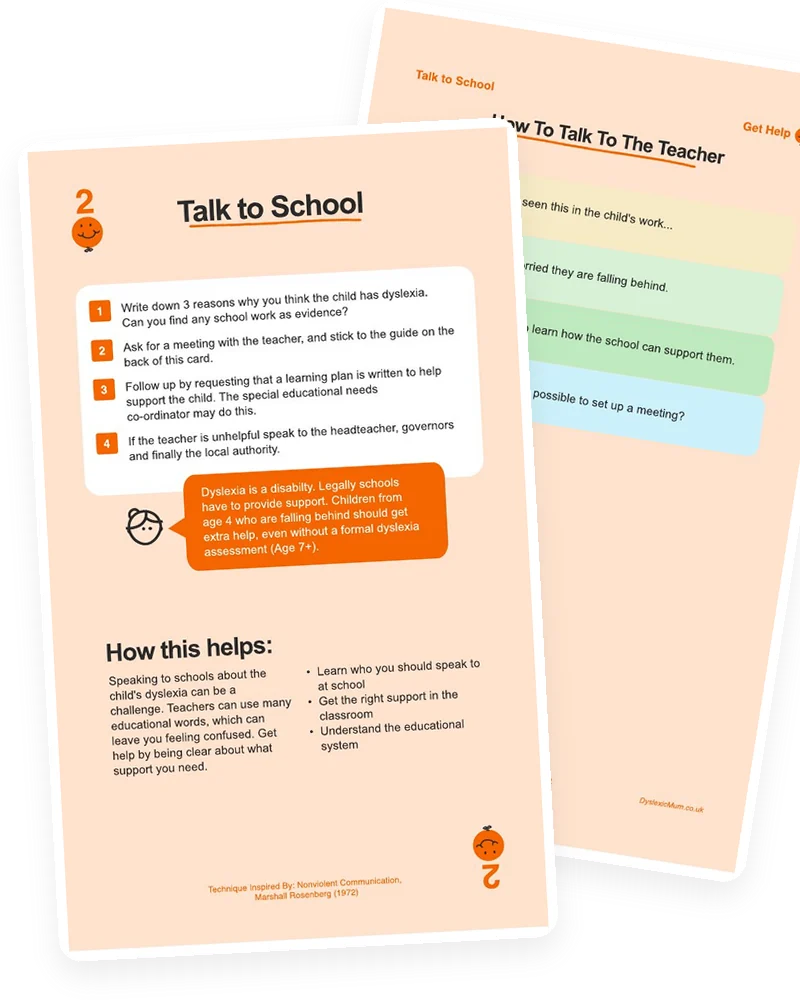
Want help talking to school about support?
The Talk to School card helps you plan what to say and ask, with steps for you on the front and an activity for your child on the back. Pair it with the Reasonable Adjustments card for ideas of what to ask for. Both are among 56 ten-minute activities in the Mooki Cards deck.
Instant download · use on a phone or tablet, or print and fill in
Do dyslexic children have to take SATs?
Most dyslexic children take the Year 6 SATs, with the right support. Children who are working below the overall standard of the tests don’t have to take them. Your child’s headteacher decides, and the school can talk you through it.
SATs are about how schools are doing, not a pass or fail for your child. If your child is anxious, remind them to do their best, and that it’s fine to find some questions hard.
What are SATs?
SATs are national tests that children in England take at the end of primary school. They check how children are doing against the national curriculum, and the results are used to measure schools.
What to expect in Year 6 SATs. Children are tested on:
- English reading
- English grammar, punctuation and spelling
- math (arithmetic and reasoning)
Teachers also assess writing and science through classwork during the year.
What about Year 2 SATs? The Key Stage 1 tests in Year 2 became optional for schools from 2023/24, so many children no longer sit them.
In the US, the same idea is called testing accommodations. Extra time, a reader or a separate room can be written into your child’s IEP or 504 plan for state tests.
Could it be something more?
If your child runs out of time in tests because they can’t stay focused, read about the 3 types of ADHD. If math is much harder than reading, read about dyscalculia symptoms. If tests make your child very worried or unwell, read about anxiety in kids.
Helpful articles
- Practise past SATs papers
- How to get dyslexia help from school
- Reasonable adjustments in the classroom
- Top 10 online reading programs
- Dyslexia myths and facts
The bottom line
Dyslexic children can get up to 25% extra time and other support in Year 6 SATs, but the school has to arrange it. Talk to the SENCo early, and make sure the help matches what your child uses in class. For ready-made ways to talk to school and build your child’s confidence, the Mooki Cards deck has 56 ten-minute activities, including Talk to School.