Understand the types of help available in the classroom for children with dyslexia.
Teachers can make changes to help dyslexic students learn more effectively. These changes are called ‘Reasonable Adjustments.’
Changes to help children with dyslexia may include using multi-sensory learning techniques or allowing extra time during exams.
In the UK, reasonable adjustments are a legal right for dyslexic children under the Equality Act.
Free 10-minute course
Help a child understand their dyslexia
Explain dyslexia simply and positively, in 3 short activities. 10 minutes a day, with free printable worksheets.
Try it today
Find out what help your child needs in class. It only takes a few minutes:
- Ask – ask your child what they find hardest at school. Is it reading, writing or keeping up?
- Note it – write down 1 or 2 changes that could help, such as extra time or multi-sensory learning.
- Share it – talk to the class teacher about these changes.
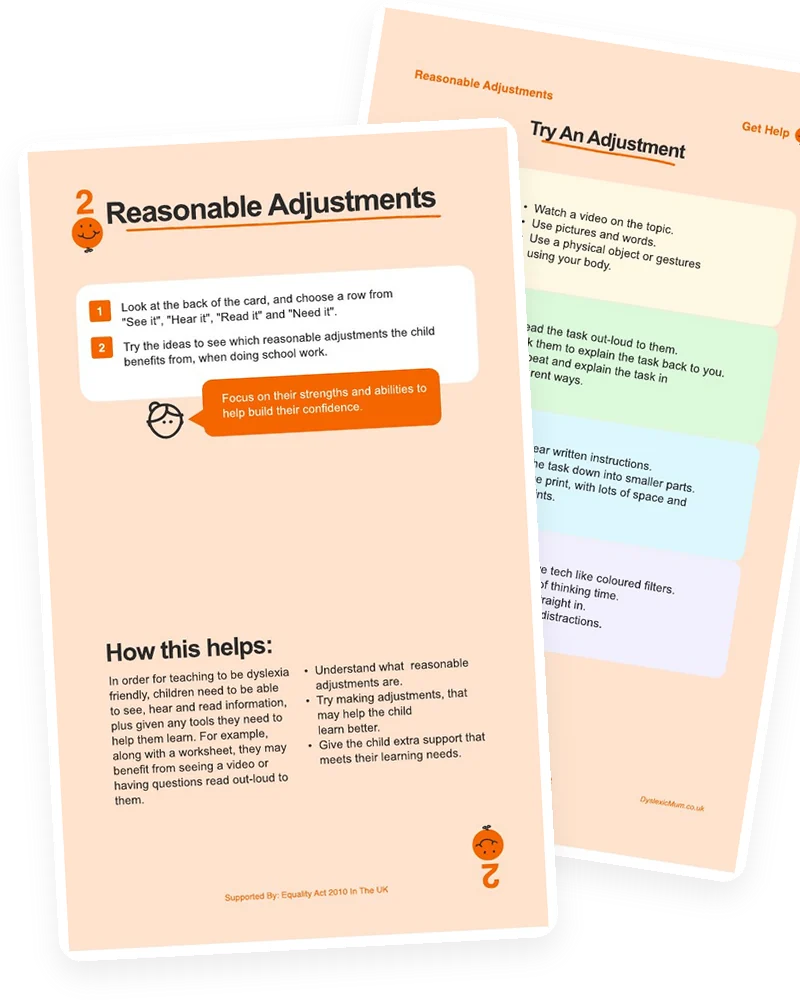
Want all 8 adjustments on one card?
The Reasonable Adjustments card has all 8 classroom changes, with simple steps for you on the front and a picture activity for your child on the back. Everything is in one place. It’s one of 56 ten-minute activities in the Mooki Cards deck.
Instant download · use on a phone or tablet, or print and fill in
Albert Einstein famously said: “Everybody is a genius. But if you judge a fish by its ability to climb a tree, it will live its whole life believing that it is stupid”.
Read about the Dyslexic Mum’s experience of how not being given reasonable adjustments in class affected her confidence:
“When I attended school, it was an unhappy, unrewarding experience. Even then, as a young child, I knew something was not right, that I was different. Even when I tried my hardest in class, I still seemed to get into trouble. I was made to feel stupid and lazy by the teachers.
I know now I am dyslexic. Like many dyslexic children, I was not stupid, I just needed to be taught differently, in a dyslexic-friendly way.”
For teachers: Dyslexia interventions and screening tools for schools and How to teach phonics in an autism unit