This teacher’s guide sets out practical accommodations for autism in the primary classroom: simple adjustments that help autistic pupils feel safe, calm and ready to learn, and that often help the whole class too.
In the UK we usually say “reasonable adjustments” and in the US “accommodations for students with autism”. They mean the same thing: changes to how a pupil learns, not what they learn. Most cost little or nothing.
Many autistic people prefer identity-first language, so we say “autistic pupils” here.
Why adjustments matter
Autistic pupils often work much harder than their classmates just to get through the day: processing noise and light, decoding instructions and coping with change. When that load gets too high, learning stops and stress shows up as shutdowns, meltdowns or refusal.
The NICE guideline on supporting autistic children recommends thinking about sensory needs such as lighting and noise, giving enough personal space, using visual supports, and adding structure so that things feel less unpredictable. The NHS suggests parents ask schools for adjustments like a quiet area, extra time and help communicating.

Visual supports and predictability
- Visual timetable: show the day in pictures or words, and move or remove each item as it’s done.
- Now and next board: for pupils who find a whole day too much, show just two steps.
- Warn before changes: tell the pupil early about a supply teacher, assembly or fire drill. Use a picture or a short written note.
- Visual instructions: write steps on the board or a card, rather than only saying them.
- Clear endings: use a timer so the pupil knows when an activity will finish.
Quiet spaces and sensory adjustments
Many autistic pupils have sensory differences. The National Autistic Society’s guide to sensory processing explains how a pupil can be over-sensitive to some things and under-sensitive to others. Small changes can make a big difference.
- A quiet space: a corner, tent or small room where the pupil can go to calm down, with a simple “break card” to ask.
- Seating: away from doors, windows, the hand dryer or the busy carpet edge.
- Noise: allow ear defenders, and warn before loud activities.
- Lighting: reduce glare and flickering lights where you can.
- Clothing: flexibility on uniform textures, if school policy allows.
- Lunch and breaks: offer a quieter place to eat or a structured lunchtime club.
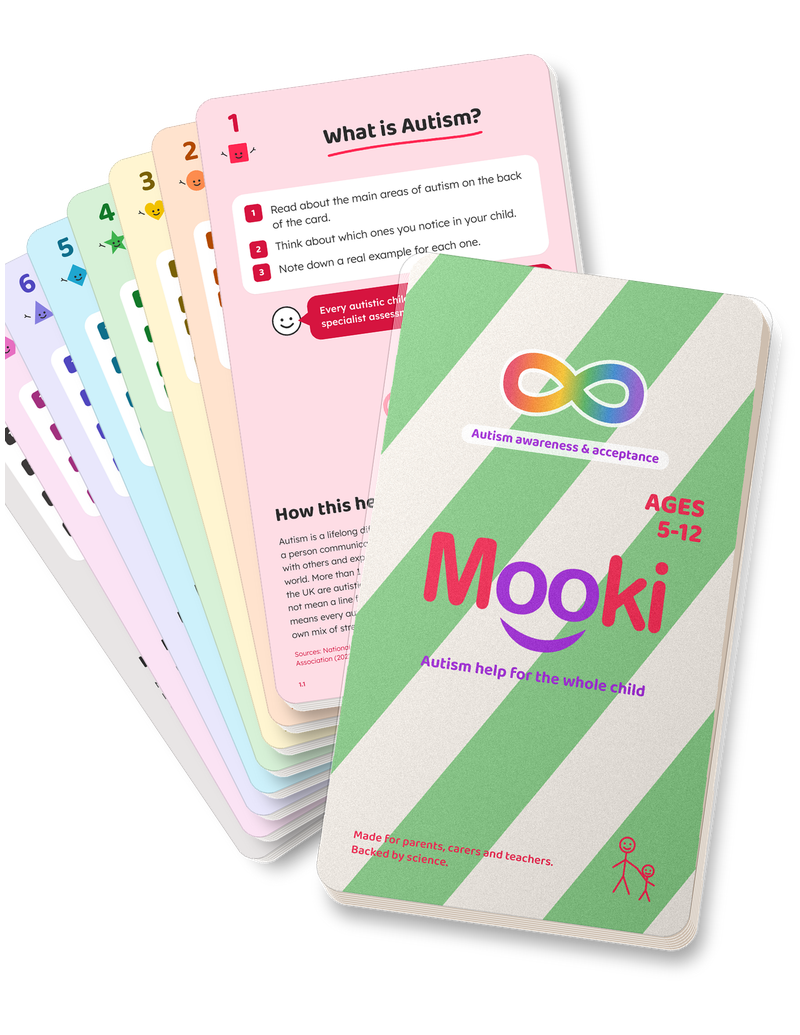
Need quick calm and social activities for class?
Classroom Tweaks, Sensory Breaks and Visual Timetable give you ready-made support you can use tomorrow. Each is one of 56 ten-minute activities in the Mooki Autism deck.
Instant download · use on a phone or tablet, or print and fill in at home or school
Movement breaks and regulation
Movement helps many autistic pupils stay regulated. Build it in before stress builds up, not just as a reward.
- Jobs with purpose: taking the register to the office, carrying books or setting out chairs.
- Planned breaks: two to five minutes of movement between tasks, shown on the timetable.
- Fidget tools: a quiet fidget or putty that doesn’t distract others.
- Calm routines: a short breathing or stretching routine after break time.
Task boxes and structured work
Task boxes (sometimes called “shoe box tasks”) are small, self-contained activities with a clear start and finish. Searches for “30 task boxes for autism” show how popular they are, but even five or six good ones can help.
- Make them visual: everything needed is in the box, and the finished result is obvious.
- Link them to targets: sorting, matching, counting, fine motor skills or reading words.
- Use a simple system: work from left (to do) to right (finished).
- Build in interests: dinosaur counting, train matching, football spellings.
Task boxes build independence and give pupils a calm, predictable activity when the class is busy. Rotate them every week or two so they stay interesting, and store them on a shelf the pupil can reach on their own.
Using an ABC chart to find triggers
When a pupil’s behaviour is a worry, an ABC chart helps you find patterns. NICE recommends looking at what triggers behaviour that challenges before deciding on support.
| Letter | What to record | Example |
|---|---|---|
| A: Antecedent | What happened just before? | Class moved to the hall for PE |
| B: Behaviour | What did the pupil do? | Hid under the table, covered ears |
| C: Consequence | What happened straight after? | Pupil stayed in class with a teaching assistant |
After a week or two, look for patterns. Is it always noise? Transitions? A particular lesson or time of day? Then change the antecedent, for example, by giving a warning and ear defenders before moving to the hall.
Try it today: a 10-minute calm start
Try this with an autistic pupil, or the whole class, at the start of the day.
- Check the timetable (2 minutes): go through the visual timetable together and point out any changes.
- Feelings check (2 minutes): the pupil points to a face or colour to show how they feel.
- Movement (3 minutes): wall push-ups, stretches or a quick walk.
- Calm focus (3 minutes): a simple task box or colouring while the class settles.
Working with families and the wider team
Parents know their child best. A simple home-school diary or weekly email helps you spot patterns and share what works.
In England, adjustments are part of SEN support, coordinated by the SENCo. In the US, adjustments may be written into a 504 plan or IEP. Understood’s guide for teachers on 504 plans explains your role in making accommodations happen and recording how well they work. If a pupil uses pictures, signs or a device to communicate, the AAP explains that AAC supports speech rather than stopping it.
Key points
Good accommodations for autism are about predictability, sensory comfort, movement and clear communication. Start small, watch what helps and keep talking to the family. Ready-made ten-minute calm and social activities, like those in Mooki Cards, can slot easily into your day. When an autistic pupil feels safe, they can show you just how much they can do.