Looking for fun early years speech and language activities for 3 to 5 year olds? This guide gives parents and nursery staff playful games for listening, attention, new words and early sentences, with no special kit needed.
Children aged 3 to 5 learn to talk best through play, songs, stories and chatting with the adults they love. A few minutes of focused fun each day can make a real difference.
Why early years speech and language matters
The years from 3 to 5 are a time of huge growth in talking and understanding. In England, nurseries and Reception classes follow the Early Years Foundation Stage (EYFS), which sets standards for learning and development from birth to 5. In the US, this is the preschool and pre-K (pre-kindergarten) stage.
Speech and Language UK says that by around 4, many children:
- Use sentences of 4 to 6 words, such as “I want to play with cars”.
- Join ideas with “and”.
- Answer simple “why” questions.
- Ask lots of “what”, “where” and “why” questions.
- Enjoy make-believe play with others.
Every child develops at their own pace. But the building blocks are the same: listening, attention, words and then sentences.

Listening and attention games
Good listening comes before good talking. These speech and language games work at home or in an EYFS setting.
- Sound walk: Go outside and stop to listen. What can you hear? A bird, a car, a door? Take turns naming sounds.
- Ready, steady… go!: Line up toy cars. Say “Ready, steady…” and wait. Your child launches the car on “go!” Vary the wait to build attention.
- Copy me: Clap, stamp or tap a simple pattern for your child to copy. Swap roles.
- Musical statues: Dance while music plays and freeze when it stops. Great for listening to sounds starting and stopping.
- What’s in the bag?: Hide noisy objects, such as keys, a shaker or a squeaky toy, in a bag. Make the sound and guess the object.
Try it today: a 10-minute listening and talking routine
- Warm up (2 minutes): Sing a favourite action song together.
- Listening game (3 minutes): Play “Ready, steady… go!” with cars or balls.
- Word time (3 minutes): Pick three objects from a basket and name them together. Talk about what they do.
- Story chat (2 minutes): Look at one page of a picture book. Point and comment: “Oh no, the dog’s muddy!”
Finish while your child is still having fun. Little and often works far better than long sessions. Many of these games also work as speech and language activities for toddlers if you keep the words simple.
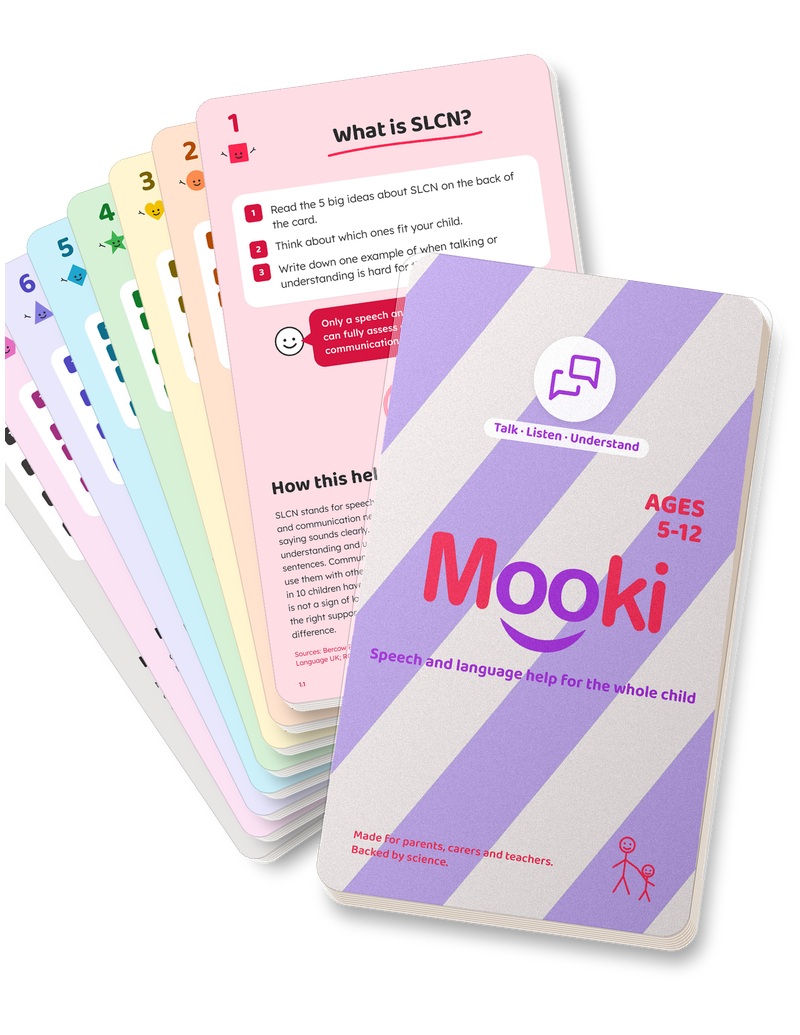
Want more playful listening and talking games?
Our Listening Games, Sound Play and Describe It cards are packed with simple games for little ones. They're three of 56 ten-minute activities in the Mooki Cards Speech and Language deck.
Instant download · use on a phone or tablet, or print and fill in at home or school
More speech and language activities for 3 to 5 year olds
Once your child enjoys listening games, try these activities. Pick one or two a week and repeat them often.
Activities to build vocabulary
Young children learn new words by hearing them many times in real, fun situations.
- Feely bag: Put a few objects in a bag. Your child feels one and describes it before pulling it out. Is it soft, hard, bumpy, smooth?
- Sorting games: Sort toys or pictures into groups, such as animals, food and clothes. Talk about why things belong together.
- Word of the week: Choose one new word, such as “gigantic” or “slippery”. Use it often in play, at mealtimes and in stories.
- Shopping play: Set up a pretend shop. Take turns being the shopkeeper and asking for items.
- Describe it: Pick a toy and take turns saying one thing about it: “It’s red”, “It has wheels”, “It goes fast”.
Activities for sentences and stories
Once children have lots of words, they start joining them into sentences and stories.
- Model and expand: When your child says “Car go”, add a word or two: “Yes, the red car goes fast!” The NHS recommends adding a few words to what your child says.
- Puppet chat: Puppets make talking feel safe. Let the puppet ask simple questions or make silly mistakes for your child to fix.
- First, next, last: Take three photos of a simple activity, such as making a sandwich. Muddle them up and put them in order together.
- Retell a favourite story: Use toys to act out a well-known story. Pause and let your child fill in the next bit.
Sound play and rhyme
Playing with sounds helps speech clarity and gets children ready for reading.
- Nursery rhymes: Sing rhymes and pause before the rhyming word so your child can fill it in.
- Silly rhymes: “Cat, hat, bat… zat!” Laugh together at made-up words.
- Clap the syllables: Clap names and words: “Ba-na-na” has three claps.
- I spy with sounds: “I spy something that starts with ‘b’.” Use the letter sound, not the letter name.
Don’t worry about perfect pronunciation at this age. If your child says a word in a babyish way, just say it back clearly without asking them to repeat it.
Speech and language games in EYFS and pre-school settings
These tips help nursery and pre-school staff get the most from group games.
- Get down to children’s eye level when talking.
- Use visuals, such as objects, pictures and gestures, alongside words.
- Give children extra thinking time before expecting an answer.
- Use small groups for listening games so every child gets a turn.
- Share simple game ideas with parents so they can play at home too.
The National Literacy Trust’s Words for Life site has more ideas for chatting, playing and reading with young children.
When to ask for advice
Speech and Language UK suggests getting advice if, around age 3 to 4, your child isn’t joining words into sentences, is hard for unfamiliar adults to understand, or struggles to follow instructions. By around 5, look out for a child who isn’t using full sentences or struggles to have a conversation that makes sense. Their 4 to 5 years guide has more detail.
If you’re worried, talk to your GP or paediatrician, or your child’s nursery or school. In the UK, you can also talk to your health visitor or the nursery SENCo. In the US, your pediatrician or local school district can arrange an evaluation.
The bottom line
Early years speech and language activities don’t need to be complicated. Listening games, songs, stories and chats during everyday play all build strong foundations. Keep it short, playful and frequent, and celebrate every new word along the way.