Worried that your child’s worries are more than “just a phase”? This guide explains anxiety vs anxiety disorder in plain English, so you can tell everyday worry from something that needs extra help, and know who to talk to next.
All children worry. Worry is part of growing up, and a little of it can even help: it makes us check our homework or look both ways before crossing the road. But for some children, worry gets so big and so constant that it starts to run their life.
Normal anxiety vs anxiety disorder: the key difference
The simplest way to think about it is this: everyday worry comes and goes, while an anxiety disorder sticks around and gets in the way.
The NHS explains that it’s normal for children to feel worried at times, for example when starting school or nursery or moving house. Many of these worries fade with a bit of reassurance. Anxiety becomes a concern when it affects a child’s thoughts and behaviour every day and interferes with school, home and social life. You can read this on the NHS page about anxiety disorders in children. In the US, the CDC’s guide to children’s mental health makes the same point: many children have fears now and then, and a diagnosis is only considered when symptoms are severe, last a long time and get in the way at school, at home or in play.
Three questions help you tell the difference:
- How often? Now and then, or most days?
- How strong? Can your child be comforted, or does the worry take over?
- How much does it get in the way? Is your child still going to school, playing and sleeping, or are they avoiding things?
A side-by-side comparison
| Everyday worry | Possible anxiety disorder |
|---|---|
| Linked to a clear event, like a test or a new class | Worries about many things, or about things that are unlikely |
| Settles with reassurance or once the event is over | Comes back again and again, even after reassurance |
| Your child still joins in, even if nervous | Your child avoids school, friends, clubs or trips |
| Sleep and appetite mostly OK | Ongoing sleep problems, tummy aches or changes in eating |
| Lasts days | Lasts weeks or months and may get worse |
No table can diagnose your child. But if most of your answers fall in the right-hand column, it’s worth talking to someone.
Common types of anxiety disorder in kids
Doctors describe several types of anxiety disorder in kids. Your child might show signs of more than one.
- Generalised anxiety disorder (GAD): worry about lots of different things that is hard to control.
- Separation anxiety: strong distress at being apart from a parent or carer, beyond what’s expected for their age. The NHS notes it is common in younger children.
- Social anxiety: intense fear of being judged or embarrassed. The NHS says social anxiety is more than shyness.
- Specific phobias: extreme fear of one thing, such as dogs or the dark. The NHS says phobias usually develop in childhood, the teenage years or early adulthood.
What does generalized anxiety disorder in kids look like?
GAD (spelled “generalized” in the US) is the type parents most often search for. A child with GAD tends to worry about everything: school, health, family, the news, being late, getting things wrong.
The NHS overview of generalised anxiety disorder is written for adults, but many of the signs it lists also show up in children:
- worry that is hard to control and affects daily life;
- restlessness and finding it hard to settle;
- irritability or a short temper;
- trouble concentrating;
- difficulty sleeping;
- tiredness, feeling tense or stomach problems.
Children with GAD often ask “what if?” questions over and over and need lots of reassurance. They may be perfectionists, afraid of making mistakes, and very hard on themselves.
Try it today: a 10-minute worry check
This helps you see your child’s worries more clearly. It isn’t a test, just a way to notice patterns.
- Draw a thermometer (2 minutes). Mark it 0 (calm) to 10 (the biggest worry ever).
- List the worries (4 minutes). Ask your child to tell you everything they worry about. Write each one down.
- Rate them (3 minutes). Your child puts each worry on the thermometer.
- Notice (1 minute). How many worries are there? How many are above 5? Do they stop your child doing things?
Repeat once a week for a month. If the list keeps growing, or high scores stay high, keep a note of what you see. It will help if you talk to a professional.
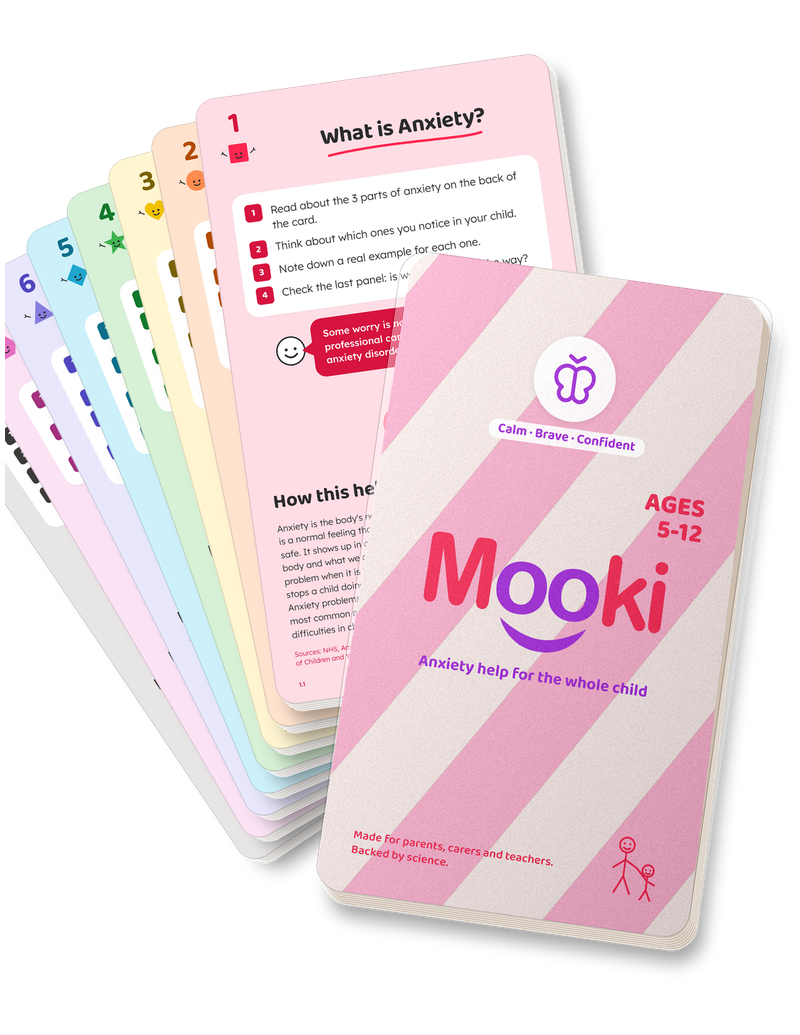
Not sure how big your child's worries are?
Kinds of Worry, Worry Thermometer and Spot the Signs help you and your child map worries together and notice patterns. Each is one of 56 ten-minute activities in the Mooki Anxiety deck.
Instant download · use on a phone or tablet, or print and fill in at home or school
Signs that worry needs more help
The NHS lists signs of anxiety in children that include:
- trouble concentrating;
- sleep problems or bad dreams;
- eating more or less than usual;
- angry outbursts or irritability;
- constant worry or negative thoughts;
- feeling tense or fidgety, or going to the toilet often;
- clinginess, crying often, or tummy aches.
YoungMinds’ guide to anxiety adds behaviours such as not wanting to go to school, avoiding social situations and repeatedly seeking reassurance.
Children with SEN, such as autistic children or children with ADHD, are more likely to experience anxiety, according to the NHS. Their anxiety can also look different, so trust your knowledge of your own child.
What to do next: UK and US
If you think your child’s anxiety is more than everyday worry, you don’t have to wait until things are very bad.
In the UK:
- Book an appointment with your GP. If your child won’t go, you can call the GP yourself for advice. YoungMinds’ guide to getting support from the GP has tips to help you prepare.
- The GP may refer your child to children and young people’s mental health services (CYPMHS, often still called CAMHS).
- Talk to your child’s class teacher or SENCo about support in school.
In the US:
- Talk to your pediatrician, who can assess your child or refer you to a mental health specialist. The NIMH guide to children and mental health explains what a full evaluation involves and what to ask.
- Ask the school counselor or school psychologist for support. If anxiety affects learning, ask about a 504 plan or an evaluation for an IEP.
In both countries, a doctor or specialist will talk through the options with you. The NHS and the CDC both describe talking therapies such as cognitive behavioural therapy (CBT) as a main way of helping children with anxiety. Whatever happens, your support at home still matters a great deal.
The bottom line
Everyday worries are part of childhood and usually pass with comfort and time. An anxiety disorder is different: it’s frequent, hard to shift and gets in the way of daily life. If you’re worried, talk to your GP or paediatrician, or your child’s school. Reaching out early is a loving, sensible step, not an overreaction.