If you think your child might have dyscalculia and you live in the UK, this step-by-step guide explains how to get a dyscalculia assessment. You’ll learn who to talk to first, who can diagnose dyscalculia, what it costs and what to do at home while you wait.
Getting a dyscalculia assessment in the UK can feel confusing. There’s no single, simple route, and it usually doesn’t go through the NHS. The good news is that you don’t need a diagnosis for your child to get help at school, and there are clear steps you can take today.
Who can diagnose dyscalculia in the UK?
Dyscalculia is a learning difference, not a medical condition. So in the UK it’s assessed by education specialists, not doctors. The British Dyslexia Association (BDA) explains that the NHS doesn’t cover these assessments for this reason.
A formal dyscalculia diagnosis can be given by:
- A specialist teacher assessor with the right qualifications. The BDA recommends someone with a level 7 qualification in assessment who also holds a specific dyscalculia qualification (AMBDA dyscalculia). It says a dyslexia-only qualification isn’t enough on its own.
- An educational psychologist (EP). “Educational psychologist” is a protected title, so anyone using it must be registered with the Health and Care Professions Council (HCPC). The HCPC explains how psychologists are regulated and how to check the register.
Always ask an assessor about their qualifications and experience with dyscalculia before you book.
Step 1: Talk to your child’s class teacher
Start with the person who sees your child’s maths every day. Share what you’ve noticed at home, such as counting on fingers, number facts not sticking or worry about maths. Ask:
- What do you see in class?
- How does my child compare with what’s expected for their age?
- What extra help could they have now?
Step 2: Ask to meet the SENCo
Every mainstream school has a SENCo (special educational needs co-ordinator). Gov.uk advises parents to talk to the teacher or SENCo if they think their child needs extra help.
The SENCo can:
- Look at your child’s maths more closely.
- Put SEN support in place.
- Arrange screening or an informal assessment.
- Ask outside specialists for advice, if needed.
Under the SEND Code of Practice, schools should identify and support children with special educational needs. A diagnosis is not needed for SEN support.
What to do at home while you wait
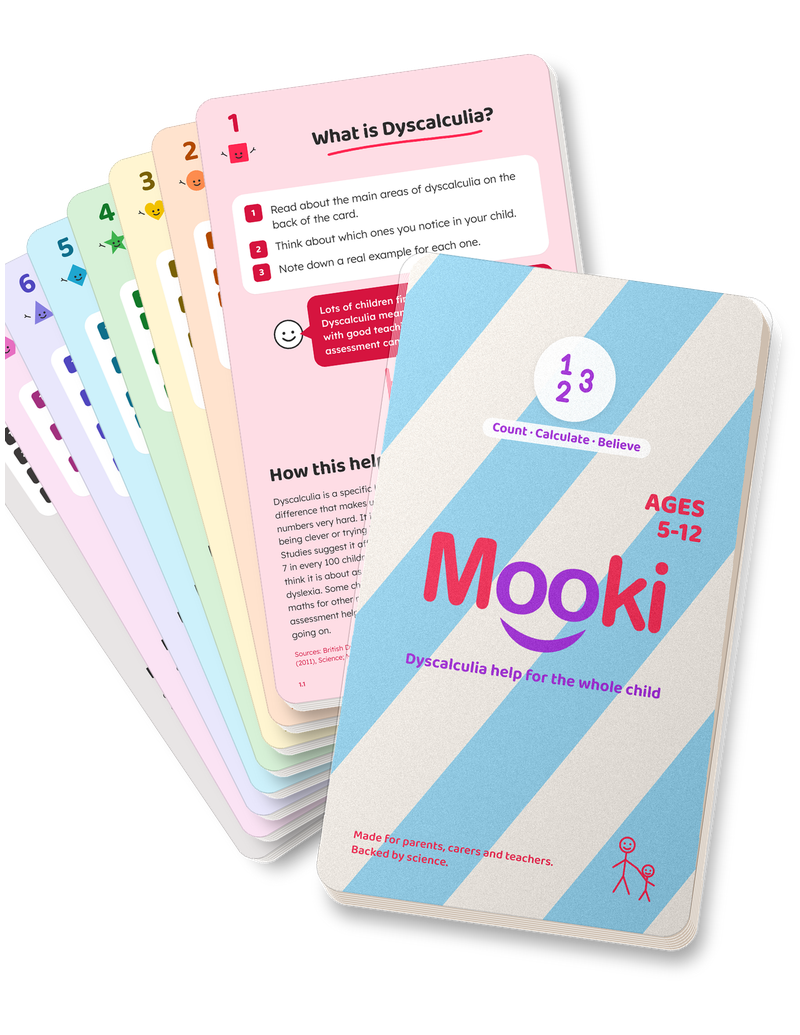
Getting Assessed walks you through the route, Talk to School helps you prepare for meetings, and Support Plan keeps help on track. Each is one of 56 ten-minute activities in the Mooki Cards dyscalculia deck.
Instant download · use on a phone or tablet, or print and fill in at home or school
Step 3: School screening and informal assessment
Many schools start with a screener or informal assessment. These are different from a formal diagnosis:
- A screener looks for signs that a child may need a full assessment.
- An informal assessment shows exactly where your child’s maths breaks down, so support can be planned.
These may be done by a teacher, SENCo, specialist teacher from the local authority or a trained teaching assistant. They’re useful even if you never go on to a full diagnosis.
Step 4: SEN support and the graduated approach
If your child needs extra help, the school should follow the “assess, plan, do, review” cycle. Contact explains how this graduated approach works and says schools should meet parents at least three times a year.
For maths, SEN support might include:
- Small-group or one-to-one maths sessions.
- Hands-on equipment like counters, number lines and ten frames.
- Extra time and fewer questions per page.
- Targets reviewed each term.
Give it time. If your child still isn’t making progress after a couple of review cycles, it may be time to think about a formal assessment.
Step 5: A formal dyscalculia assessment
There are a few ways this can happen:
- Through school. Some schools or local authorities can arrange an assessment with a specialist teacher or EP. Availability varies a lot, and waiting lists can be long.
- Privately. Many families pay for a private assessment from a qualified specialist teacher or EP.
What does it cost?
Costs vary by provider and area. As an example, the BDA lists its own dyscalculia assessment at £690 including VAT at the time of writing, carried out in person by a specialist teacher. An assessment by a psychologist may cost more: the BDA’s own dyslexia assessments, for example, cost more with a psychologist than with a specialist teacher. Always check exactly what’s included, such as the written report.
What happens on the day?
The assessor will usually:
- Talk to you about your child’s history and your concerns.
- Gather information from school.
- Work with your child on a range of number tasks, such as comparing numbers, counting, number facts and problem solving.
- Look at related skills, like memory and processing speed.
- Write a report with findings and clear recommendations.
Prepare your child gently. Tell them they’ll be doing some puzzles and activities with someone whose job is to find out how they learn best.
Step 6: Using the report
A good report should explain your child’s strengths as well as their difficulties, and give practical advice. Share it with the SENCo and ask how school will use the recommendations.
If your child’s needs are complex and SEN support isn’t enough, you or the school can ask the local authority for an EHC (education, health and care) needs assessment. Gov.uk says the council should issue a final EHC plan within 20 weeks of the request. Many children with dyscalculia are supported well through SEN support without one.
If you’d like free, impartial advice, contact your local SENDIASS (SEND Information, Advice and Support Service).
Try it today: what to do at home while you wait
Waiting can take months. Here’s a 10-minute activity to keep things positive:
- Get out 10 coins or counters and a simple ten frame (draw 2 rows of 5 boxes).
- Make a number, like 7. Ask your child how many boxes are full and how many are empty.
- Talk about it: “7 and 3 make 10. Can you see it?”
- Swap roles: let your child make a number for you to work out.
Keep it short, calm and fun. If your child seems very anxious or unhappy, talk to your GP as well as the school.
Ready-made ten-minute activities, like Mooki Cards, can help you keep this going without extra planning.
The bottom line
In the UK, the route to a dyscalculia assessment usually runs through school, the SENCo and a qualified specialist teacher or educational psychologist, not the NHS. Remember that support shouldn’t wait for a label. Ask for help now, keep notes, and keep maths at home short and kind.