Does your child learn their times tables one night and forget them the next? Many dyslexic kids struggle with times tables. Here’s why, plus 5 tips and tools that help, and a 10-minute times-table game to try today.
Dyslexic children often find memory and recall hard. This makes it difficult to remember lists of number facts and number sequences. To help a dyslexic child learn their times tables, try:
- Multi-sensory learning: use colours, objects and movement, not just repetition.
- Memory cues: teach times-table facts through songs and stories.
- Patterns, not lists: show how tables link, like the 4s being double the 2s.
Free 10-minute course
Help a dyslexic child get organised
Build independence and calmer mornings, in 3 short activities. 10 minutes a day, with free printable worksheets.
5 times-table tips and tools for dyslexic kids
Here are 5 tools that help a dyslexic child learn their times tables:

- A colour-coded times-table tray. Dyslexic kids learn best with multi-sensory methods. A colour-coded tray lets them see and touch the patterns.
- Times-table board games. Turn practice into a game the whole family can play.
- A times-table fan. A handy fan of times-table facts to use at home or in class.
- A colourful abacus. Moving beads helps your child see groups and build each fact, instead of just remembering it.
- Times-table flash cards. Cards that pair pictures with facts make them easier to remember.
Also try a pocket-sized times-table counter. It fits in your child’s pocket, so it’s easy to take to class.

A true story: struggling to learn times tables
Read about the Dyslexic Mum’s own struggle with times tables, and what helps her child now.
“When my child began learning her times tables, it brought back bad memories from my own primary school days. I spent hours each evening looking at times-table sums. I tried to remember the answers for the weekly tests, but I always failed. What I didn’t know then was that I am dyslexic.
Dyslexic children can struggle to remember things in the right order, making learning times tables especially hard. A better way to help me remember would have been using pictures, colours, stories and games. Now, we use these methods to help my child learn her times tables.”
Try it today: a 10-minute times-table game
- Pick one table (1 minute). Start with an easy one, like the 2s, 5s or 10s.
- Build it (3 minutes). Use Lego, coins or pasta to make groups: 3 groups of 2, 4 groups of 2. Count them together.
- Spot the pattern (2 minutes). Write the answers in a coloured list. What do you notice? (The 5s always end in 5 or 0.)
- Move and chant (3 minutes). Jump, clap or bounce a ball for each answer as you count up the table.
- One quick quiz (1 minute). Ask 3 facts out of order. Stop while it’s still fun, and praise every try.
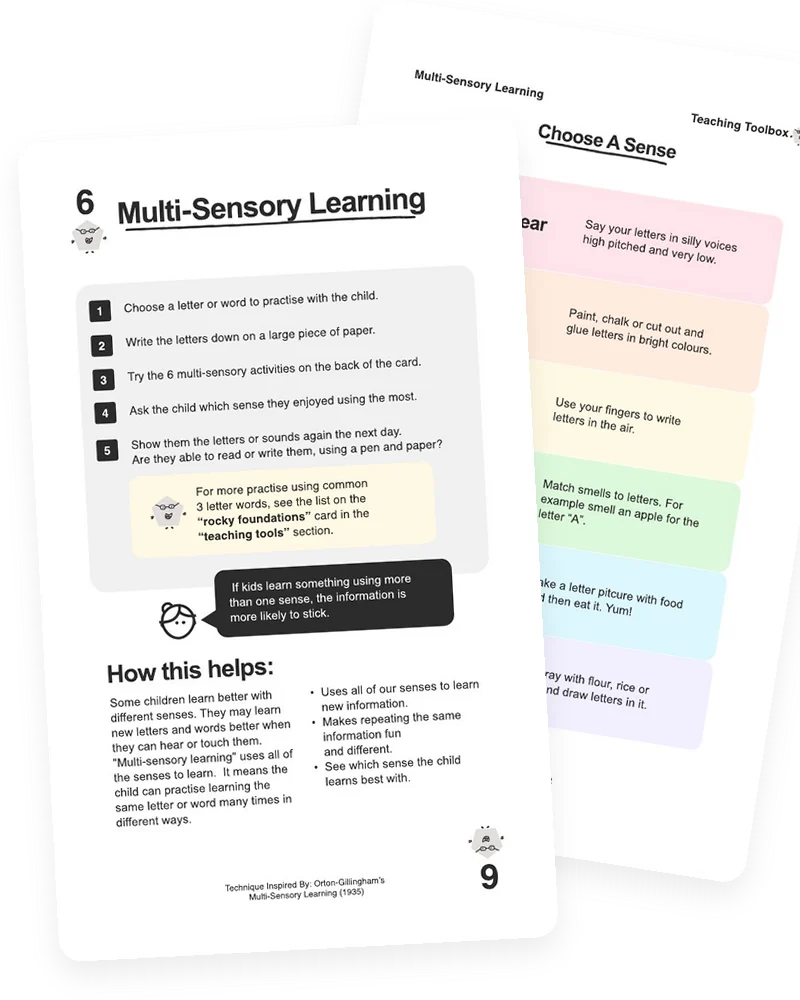
Want more multi-sensory learning ideas?
The Multi-Sensory Learning card shows you how to use sight, sound, touch and movement to make learning stick, with steps for you on the front and an activity for your child on the back. It’s one of 56 ten-minute activities in the Mooki Cards deck.
Instant download · use on a phone or tablet, or print and fill in
Could it be something more?
Lots of children find times tables hard. But if your child also struggles with numbers in general, like counting, simple sums or knowing which number is bigger, it may be worth looking more closely. Dyscalculia is a learning difference that affects number skills, and it can happen alongside dyslexia.
Read about what dyscalculia is, the signs of dyscalculia, and dyscalculia tests for kids. You can also learn the differences between dyslexia, dyscalculia, dyspraxia and dysgraphia.
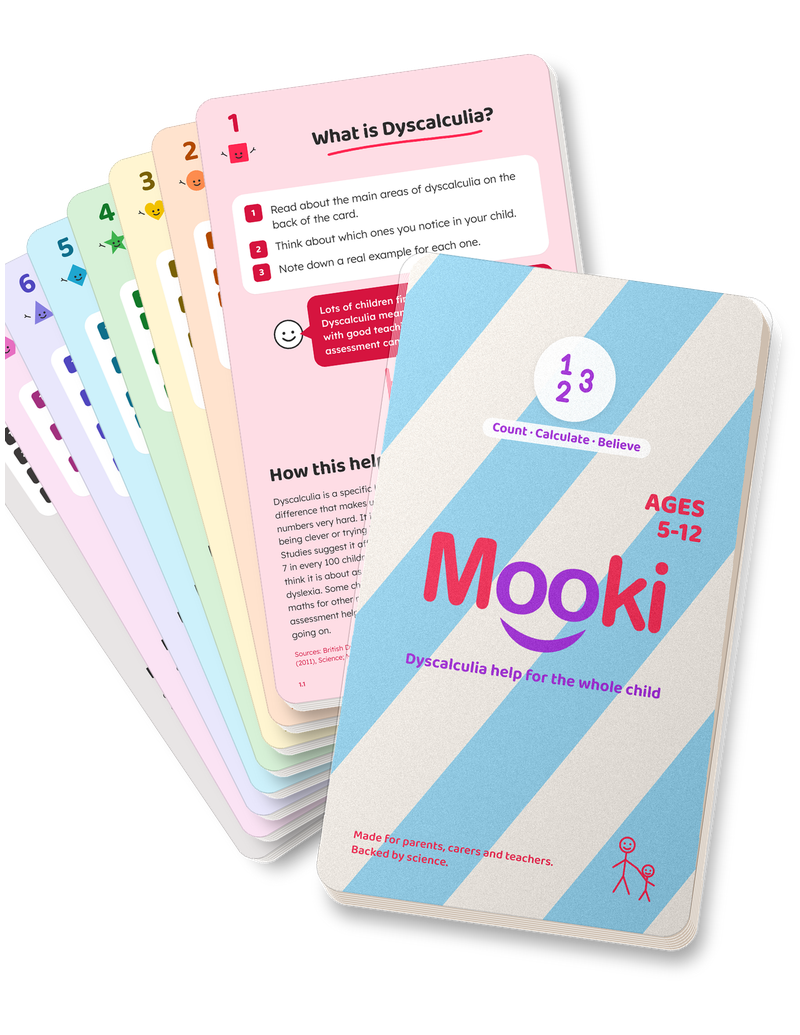
Does your child find all numbers hard?
The Mooki Cards: Dyscalculia deck has ten-minute number activities for you and your child, with ready-made steps on the front and a picture activity on the back.
Instant download · use on a phone or tablet, or print and fill in at home or school
Helpful articles
- How can I help with times tables and math? (Dyslexia Assist)
- How to teach multiplication tables to dyslexic kids
- Dyslexia: make a difference – maths (BBC Teach)
- Dyslexia-friendly times tables (Twinkl)
- Learn to tell the time: 5 tips for dyslexic kids
The bottom line
Dyslexic children often find times tables hard because they rely on memory and sequences. Make them visual, hands-on and fun, and practise little and often. If numbers in general are a struggle, look into dyscalculia. The Mooki Cards deck has 56 ten-minute activities, including Multi-Sensory Learning, to help learning stick.